Connect with us

News

AI and the Great Workforce Shift: Why Junior Programmers Are Struggling While Other Professions Adapt

Avatar photo

Published

on

From Promising Careers to a Harsh Reality

In 2012, fresh computer science graduates were courted like star athletes on draft day. Big tech firms in the U.S. dangled six-figure starting salaries, signing bonuses worth tens of thousands, and stock packages that could make a young coder a millionaire before turning thirty. It was the era when learning to code was marketed as a “future-proof” career.

Fast forward just over a decade, and the story has changed dramatically. In cities from San Francisco to Berlin, junior programmers are sending out hundreds—sometimes thousands—of applications and hearing nothing back. The culprit isn’t just economic slowdown; it’s a shift in how companies build software in the age of AI.

Tools like GitHub Copilot, ChatGPT, and Tabnine now write, debug, and optimize code at a pace no human junior developer can match. Instead of hiring entry-level coders to write boilerplate code, companies are investing in smaller teams of senior engineers who oversee AI systems that do much of the work.


The Numbers Tell the Story

A recent analysis by the Federal Reserve Bank of New York shows that unemployment rates among recent U.S. computer science graduates have climbed to over 6 percent, while computer engineering grads face nearly 7.5 percent—both more than double the rate for biology or art history graduates. In mechanical engineering, the unemployment rate is just 1.5 percent; for aerospace engineering, it’s 1.4 percent.

What’s striking is that fields once considered more “at risk” from automation—like the arts—are weathering the storm better than junior programmers. In visual arts and design, AI tools are certainly making inroads, but human creativity, brand identity, and cultural context still hold irreplaceable value.


A Global Phenomenon

This isn’t just a U.S. story. Across Europe, graduates from software engineering programs report difficulty landing their first jobs. In the UK, the Institute of Student Employers notes a 23% drop in entry-level tech openings compared to 2022. In India, one of the world’s largest IT outsourcing hubs, major employers like Infosys and Wipro have slowed graduate hiring dramatically, citing “process automation and AI efficiencies.”

Meanwhile, other professions—particularly those combining technical skill with deep domain expertise—are more resilient. Biologists, for example, increasingly use AI to analyze genomic data or model ecosystems, but the AI tools serve as assistants, not replacements. The same is true for many design roles, where AI can generate drafts, but human oversight shapes the final product.
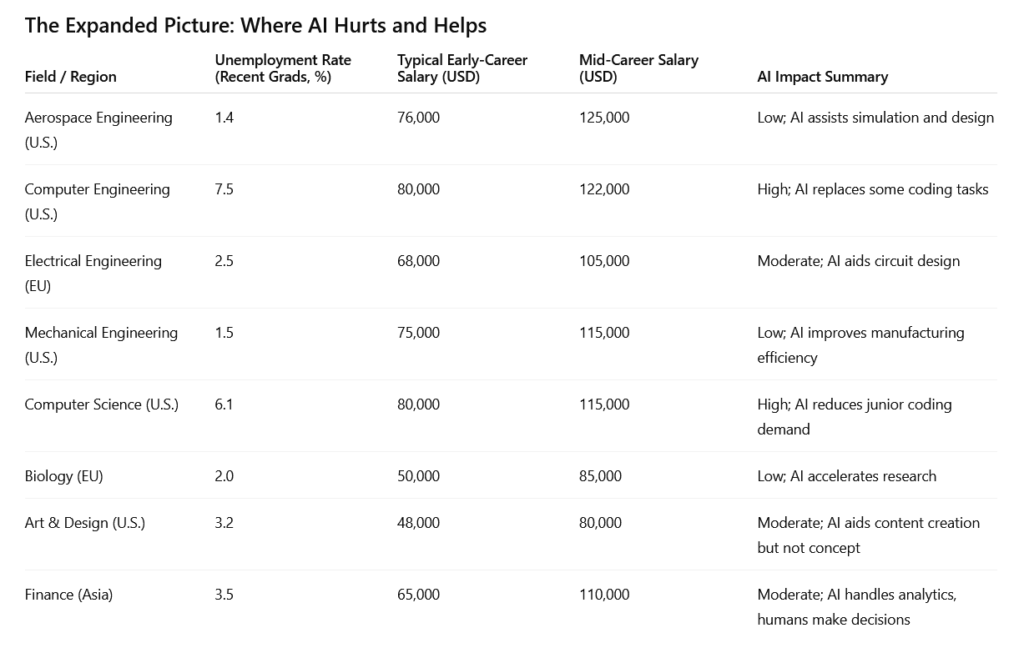
Sources: Federal Reserve Bank of New York, Eurostat, OECD, Institute of Student Employers.


Lessons from History: This Has Happened Before

The AI-driven shake-up mirrors earlier technological transitions. In the 19th century, mechanized looms displaced textile workers; in the mid-20th century, automation reduced the number of typists and factory assemblers. In each case, some jobs vanished, but new roles emerged—often in industries unimaginable to the displaced workers.

The difference now is speed. Whereas past industrial transitions took decades, AI is compressing job transformation into just a few years. This leaves workers—and educational institutions—scrambling to adapt.


Industry Voices

Economist Carl Benedikt Frey of Oxford University’s Future of Work program has noted that “AI is less about replacing entire occupations than it is about automating tasks within them.” That’s cold comfort to junior programmers whose main tasks are the easiest to automate.

On the tech side, Fei-Fei Li, co-director of Stanford’s Human-Centered AI Institute, argues that the opportunity lies in human–AI collaboration: “We need to prepare our workforce not just to compete with AI, but to create with it.”


Policy and Corporate Response

Governments are beginning to respond to the AI employment wave. In the United States, federal initiatives are funding AI literacy programs for both students and mid-career workers. In the EU, the Digital Skills and Jobs Coalition aims to reskill millions in AI and data analysis over the next decade.

Corporations are also investing in workforce transformation. Microsoft, for instance, has pledged billions toward AI training, both to develop its own talent pipeline and to position itself as a leader in the AI economy. In Singapore, the government is subsidizing AI courses for professionals in finance, healthcare, and manufacturing, acknowledging that these sectors will need human oversight despite automation.


The Future Workforce: Adaptation Over Replacement

While junior programmers face immediate challenges, AI’s broader impact on the workforce is more nuanced. In many fields, AI is an accelerator rather than a threat, enabling humans to focus on higher-value work. The key difference lies in whether a profession’s entry-level tasks are creative, context-specific, and relational, or repetitive and easily codified.

Educational systems will need to change accordingly. For computer science programs, that might mean integrating AI-assisted development into coursework from the first year. For other disciplines, it might mean teaching data literacy alongside traditional subject matter.


The Human Edge

One consistent theme emerges across industries: soft skills and domain expertise still matter. Problem-solving, ethical reasoning, and the ability to interpret AI output in context are qualities that machines cannot fully replicate. Workers who can combine these skills with AI fluency will be best positioned in the coming decade.


Closing Thoughts

The global workforce transformation sparked by AI is neither purely dystopian nor utopian—it’s disruptive. Junior programmers are the early casualties, not because programming is obsolete, but because the first rungs of the ladder have been kicked out. The challenge for universities, companies, and governments is to build new rungs before an entire generation is left behind.

AI will not replace humans outright. But humans who fail to adapt to an AI-infused workplace may find themselves replaced by others who do. The winners in this transition will be those who learn to see AI not as a competitor, but as a collaborator.

AI Model

Grok 4.5’s First Users Have Spoken: Fast, Affordable and Impressive—Until It Gets Too Confident

Avatar photo

Published

on

By

Grok 4.5 did not arrive as another conversational assistant designed to write birthday messages, summarize recipes or entertain users with a provocative personality. Its real target was considerably more valuable: the growing population of developers and professionals willing to delegate hours of computer-based work to an artificial intelligence agent.

The first reactions suggest that this strategy is working. Developers are using Grok 4.5 to refactor codebases, prepare product requirements, review pull requests, research technical documentation and complete long sequences of tool-based actions. Many are enthusiastic about its speed and unusually low operating cost. Others have discovered a less flattering side: a model that can rush through difficult work, ignore instructions and produce confident mistakes that another AI must later repair.

Less than two weeks after its initial release, the verdict is therefore neither that Grok 4.5 has transformed the AI market nor that it has failed to meet expectations. The more interesting conclusion is that xAI may have created a highly competitive workhorse—one that users enjoy precisely because it does not always try to be the smartest model in the room.

A Release Built Around Work, Not Conversation

Grok 4.5 began reaching developers through the xAI API and Cursor on July 8, 2026. xAI formally presented the model on July 16, followed by a broader rollout to Grok’s website, X, iOS and Android on July 22. That staged release matters when interpreting the initial response. Developers had approximately two weeks to test it in professional environments, while most ordinary Grok users had access for only about a week by July 29.

The model’s intended purpose was unusually explicit. xAI described Grok 4.5 as a system for coding, agentic tasks and knowledge work. It was trained jointly with Cursor and became the default model inside Grok Build, xAI’s environment for autonomous development and computer-based projects. The company also demonstrated it working with spreadsheets, documents and presentations rather than limiting the launch campaign to chatbot conversations.

Its pricing reinforced that positioning. Grok 4.5 costs $2 per million input tokens and $6 per million output tokens through the API, with a context window of up to 500,000 tokens. Those figures place it below several flagship models from OpenAI and Anthropic, particularly when large agentic tasks consume millions of tokens while reading files, running commands and revising their own work.

This was not a product designed merely to win a benchmark comparison. It was designed to make repeated AI delegation economically practical.

Are People Using Grok 4.5 as Intended?

Among the first technical users, the answer is largely yes.

Early discussions in Cursor’s community show developers assigning Grok 4.5 substantial software-engineering tasks. Reported uses include reorganizing thousands of lines of code, extracting methods into separate files, running scripts, producing product requirement documents, investigating documentation and implementing features across complex projects. Some users have adopted it as an execution model while reserving more expensive systems for planning or final review.

This division of labor may prove more important than any claim that Grok 4.5 is the market’s most intelligent model. Professional AI users are increasingly building workflows in which one model creates a plan, another executes it and a third checks the result. In that environment, a fast and inexpensive model does not need to defeat every competitor in every category. It needs to complete enough reliable work that the cost of supervision remains lower than the cost of using a premium model for the entire process.

Grok 4.5 appears well suited to that role. Users repeatedly praise its ability to call tools, read project documentation and make direct edits without producing pages of explanation. Several describe it as less verbose than competing models, which is an advantage when the desired output is a working patch rather than a tutorial.

However, Grok’s broader consumer behavior still looks different from xAI’s professional vision. A recent academic analysis examined more than 169,000 posts in which people invoked Grok on X. It found that users primarily called the assistant reactively to explain posts, verify claims or provide context during social-media conversations. Adoption was broad but shallow: 76.8% of the observed users invoked Grok only once. The study predates Grok 4.5, but it reveals the behavioral habits that the new model inherits.

There are consequently two distinct versions of Grok in the market. One is a social-media companion summoned to settle arguments and interpret breaking news. The other is an increasingly serious professional agent expected to work inside code editors, terminals and office software.

The first Grok generates visibility. The second could generate durable revenue.

The Positive Reaction: Speed Changes the Experience

The strongest early praise concerns speed and cost rather than personality.

Developers who responded positively describe Grok 4.5 as noticeably faster than top-tier alternatives. Some report using it for hours while consuming only a small percentage of their available usage allowance. Others say it produces cleaner, less padded responses and reaches useful results in fewer steps. One early Cursor user said the model’s output resembled Anthropic’s premium Opus models but arrived considerably faster. Another described it as particularly effective at reading documentation, calling tools and implementing changes across a complex application.

Independent testing broadly supports the perception that efficiency is Grok 4.5’s defining strength. Artificial Analysis placed the model near the frontier of general intelligence and scored its Grok Build implementation on par with OpenAI’s GPT-5.5 in Codex on a composite coding-agent index. In those tests, Grok 4.5 completed coding tasks at substantially lower average cost and with fewer tokens than the leading OpenAI and Anthropic systems included in the comparison.

For individual developers, this changes how an AI model can be used. A premium assistant may be consulted selectively because every long task consumes a meaningful portion of a subscription or API budget. A cheaper model can remain active throughout the entire workflow: exploring a repository, running tests, rewriting files, checking errors and trying again.

That produces a different kind of satisfaction. Users are not necessarily claiming that every Grok answer is superior. They are saying that the model provides enough intelligence, quickly enough and cheaply enough, to become their default worker.

The Negative Reaction: Fast Work Still Needs Inspection

Enthusiasm is far from universal.

Other developers report that Grok 4.5 failed multiple complex tasks before they handed the same work to an Anthropic model for repair. Complaints include inconsistent instruction-following, declining quality during long assignments and a tendency to become “lazy” when a project requires many sequential steps. Some users find it competent for code but poor for writing and other tasks that require careful structure or stylistic control.

There have also been frustrations unrelated to model intelligence. Early Cursor users encountered regional availability problems, confusing usage accounting and unclear limits. Some could not find Grok 4.5 in the model selector, while others were uncertain whether it consumed their general Cursor allowance or a separate API quota. These problems can shape the launch reaction almost as strongly as the model itself. A powerful AI that unexpectedly exhausts a usage pool will be remembered as expensive, even when its published token price is low.

The most important technical warning is confidence. Artificial Analysis found that Grok 4.5 improved its factual accuracy over its predecessor on one knowledge evaluation, but also recorded a higher hallucination rate. In practical terms, the model knew more while becoming more willing to produce unsupported answers when it did not know enough.

That finding matches the divided user response. Grok 4.5 can complete a large volume of work rapidly, but speed magnifies the consequences of an undetected error. A flawed answer in a chat window wastes several minutes. A flawed autonomous edit applied across thousands of lines can create hours of debugging.

Users appear happiest when Grok operates inside a structured process with clear instructions, tests and a review stage. They are less satisfied when they expect it to complete an entire complex project from a single prompt without supervision.

How Large Is Grok Compared With Its Rivals?

Grok is no longer a niche chatbot, but it remains considerably smaller than the two largest consumer AI platforms.

A regulatory filing from SpaceX reported that approximately 117 million monthly active users had used Grok’s AI features as of March 31, 2026. The figure included people accessing Grok through its deep integration with X, not only users of the standalone Grok application. At the time, this represented roughly 21% of X’s approximately 550 million monthly users.

Google reported 950 million monthly active users for the Gemini app in July 2026. On a monthly-user basis, Grok’s last disclosed audience was therefore approximately one-eighth the size of Gemini’s.

OpenAI’s most recent widely reported figure was approximately 900 million weekly active ChatGPT users. That is an even stronger engagement measure because users must return within a seven-day period rather than once during a month. Grok’s 117 million monthly users amount to about 13% of ChatGPT’s weekly audience, although the different reporting periods make the comparison inherently imperfect.

Claude is harder to compare. Anthropic has not provided a directly equivalent, current global consumer-user figure, and much of Claude’s value comes through business accounts, coding tools and API integrations rather than its standalone chatbot. Third-party estimates generally place Claude’s direct consumer audience below Grok’s disclosed reach, but those estimates do not capture enterprise and automated usage consistently.

The numbers reveal both Grok’s advantage and its weakness. Through X, xAI can expose its assistant to hundreds of millions of people without persuading them to install a new application. Yet exposure is not the same as habitual use. ChatGPT and Gemini have far larger recurring audiences, while Claude has established a powerful reputation among developers and enterprises.

Grok 4.5 is therefore not launching from zero, but neither is it entering the market as an equal in distribution.

A Successful First Reaction, With Important Conditions

The early response to Grok 4.5 is more favorable than the polarized reputation of the Grok brand might suggest. Developers who judge the model on practical economics rather than corporate identity are finding a tool that is fast, capable and unusually affordable. Many are using it exactly as xAI intended: not as a novelty chatbot, but as an agent that performs real work across code, research and documents.

They are not uniformly happy. The positive reaction weakens when tasks become long, ambiguous or difficult to verify. Reliability remains uneven, usage limits have caused confusion and the model’s confidence can exceed its factual accuracy.

The emerging consensus is not that Grok 4.5 should replace every competing model. It is that the model deserves a place in a multi-model workflow. Grok can execute routine and moderately complex work at high speed, while more expensive systems or human reviewers handle planning, sensitive decisions and final verification.

That may sound less dramatic than declaring a new AI champion. Strategically, it could be more significant. The model that becomes the default workhorse can process far more tasks than the model reserved for occasional moments of maximum difficulty.

Grok 4.5’s first users are not simply chatting with it. They are putting it to work. For xAI, that is the reaction that matters most.

Continue Reading

AI Model

Claude Opus 5 vs GPT-5.6 Sol: The Frontier AI Battle Has Shifted From Answers to Execution

Avatar photo

Published

on

By

The old chatbot contest was easy to understand. Ask two models the same question, compare their answers and declare a winner. That method now feels as dated as benchmarking smartphones by call quality. Claude Opus 5 and GPT-5.6 Sol are not merely conversational systems. They are increasingly designed to inspect repositories, operate software, search across large collections of documents, coordinate tools, revise their own work and produce finished assets that can move directly into a professional workflow.

That changes the nature of the comparison. The central question is no longer which model sounds more intelligent in a chat window. It is which one can accept a difficult objective, survive the messy middle of the task and return something that is genuinely usable.

As of late July 2026, the answer is not a clean victory for either side. Claude Opus 5 has emerged as an exceptionally strong model for long-horizon knowledge work, analytical judgment and agentic coding. GPT-5.6 Sol counters with formidable scientific reasoning, cybersecurity capabilities, computer use and presentation quality, while often completing complex work with impressive token efficiency.

The result is a rivalry defined less by raw intelligence than by execution style.

This Is Not Quite a Flagship-to-Flagship Comparison

The naming makes Claude Opus 5 and GPT-5.6 Sol look like direct equivalents, but the product positioning is slightly asymmetrical.

GPT-5.6 Sol is the flagship model in OpenAI’s GPT-5.6 family, sitting above the less expensive Terra and faster Luna variants. OpenAI presents Sol as its primary frontier model for complex professional work, with a higher-capability Sol Pro option available for especially demanding or long-running tasks.

Claude Opus 5 occupies a different strategic position inside Anthropic’s lineup. It is the company’s strongest Opus model and the default model for Claude Max, but Anthropic’s Fable 5 remains the company’s highest-capability generally available system. Opus 5 is therefore intended to deliver near-frontier performance more economically, rather than represent the absolute limit of Anthropic’s model stack. Anthropic launched Opus 5 on July 24, 2026, two weeks after OpenAI introduced GPT-5.6 Sol on July 9.

That distinction matters. Sol is OpenAI’s attempt to set the frontier. Opus 5 is Anthropic’s attempt to make frontier-level work practical enough for daily use.

Remarkably, Opus frequently competes with or beats Sol despite that positioning. Independent evaluations from Artificial Analysis place Opus 5 at maximum effort slightly ahead of GPT-5.6 Sol on its overall Intelligence Index. The margins remain narrow enough that workflow design, tool access and reasoning settings may matter more than the headline score.

Two Models, Two Different Working Styles

Claude Opus 5 feels designed around sustained deliberation. Anthropic has emphasized improvements in deep reasoning, long-horizon tasks and test-time compute scaling—the ability to turn a larger inference budget into better results. Its adaptive thinking system chooses how much internal work a request requires, while developers can adjust effort from low through medium, high, extra-high and maximum.

The practical effect is a model that tends to behave like a cautious senior contributor. It often spends more time establishing context, narrates its progress during agentic sessions and verifies completed work without requiring explicit instructions. Anthropic even advises developers to remove some verification prompts written for earlier Claude models because Opus 5 may otherwise check its work excessively. It is also more willing to delegate portions of a complicated assignment to subagents.

GPT-5.6 Sol is more execution-oriented. It also supports adjustable reasoning, including a new maximum setting, but OpenAI’s broader design language focuses on extracting more useful work from every token. Sol tends to break tasks into active steps, make frequent tool calls and move through the environment with less visible hesitation. OpenAI’s new ultra mode extends this approach by coordinating multiple agents across parallel workstreams.

The contrast is subtle rather than absolute. Both models can reason deeply, use tools and manage extended workflows. But Opus often resembles an analyst who wants to understand the whole assignment before committing. Sol resembles an operator who develops its understanding while advancing the task.

Neither personality is universally better. A slower, more reflective model can catch hidden assumptions in financial, legal or strategic work. A more active model can outperform when the assignment demands browsing, computer interaction, iterative testing or coordination across many independent subtasks.

Coding Has Become a Contest of Persistence

Traditional programming benchmarks measure whether a model can generate the correct function or repair a contained bug. Modern coding agents face a more realistic challenge. They must inspect unfamiliar repositories, understand architectural conventions, modify multiple files, run tests, interpret failures, use browsers or terminals and avoid leaving unfinished placeholders behind.

Claude Opus 5 is exceptionally well suited to this style of work. Anthropic says its largest gains appear in agentic coding and extended software-engineering assignments, including large refactors and end-to-end feature development. Early users have reported better consistency across repeated runs, stronger frontend judgment and greater willingness to inspect completed interfaces at multiple screen sizes before declaring the job finished.

Independent results support that positioning. Artificial Analysis placed Claude Opus 5 with Claude Code in joint first place on its Coding Agent Index. At maximum effort, Opus also reached 89% on Terminal-Bench 2.1, roughly matching the leading GPT-5.6 Sol configuration. Anthropic reported that Opus 5 led Frontier-Bench at launch and performed close to the more expensive Fable 5 on CursorBench.

Sol remains a formidable coding model. OpenAI reports that GPT-5.6 Sol established a new high on the Artificial Analysis Coding Agent Index when tested at maximum reasoning, while using fewer output tokens and less execution time than several competing frontier configurations. It also excels in terminal workflows, where a model must repeatedly plan, execute commands and recover from errors rather than produce code in a single response.

The practical difference may depend on the shape of the repository. Opus is particularly compelling when the work requires architectural understanding, careful edits and quality control across a long session. Sol is attractive when the workflow benefits from rapid tool interaction, broad environment exploration and efficient iteration.

For development teams, the model alone is only half the equation. Claude Code and OpenAI’s Codex environment provide different harnesses, permissions, context-management systems and tool behaviors. A slightly weaker model inside a better-configured agent can outperform a benchmark leader running with poor instructions or restricted access.

Claude Takes the Lead in Knowledge Work

The clearest advantage for Claude Opus 5 appears in agentic knowledge work: assignments that begin with a large, disorganized body of information and end with a professional deliverable.

These are not simple summarization tasks. A model may need to examine hundreds or thousands of files, locate contradictory evidence, calculate metrics, form a defensible conclusion and produce a spreadsheet, presentation or research report. Success depends on judgment, information discipline and the ability to maintain a coherent objective across many tool calls.

Artificial Analysis tested Opus 5 on AA-Briefcase, a benchmark built around private, realistic professional assignments involving research reports, spreadsheets and presentations. At maximum effort, Opus 5 scored 1,720 Elo, substantially ahead of the previous leader. Its high and extra-high settings also occupied the top positions. On GDPval-AA v2, another professional-work benchmark, Opus 5 reached 1,861 Elo and finished more than 100 points ahead of both Fable 5 and GPT-5.6 Sol at their maximum settings.

The source of the lead is revealing. Opus performed particularly well on objective criteria and analytical quality. It appeared better at finding the right evidence, applying it correctly and producing conclusions that satisfied detailed evaluation rubrics.

GPT-5.6 Sol remained stronger in presentation quality within the same AA-Briefcase evaluation. Its presentation Elo exceeded Opus 5’s score, suggesting that Sol may be better at converting analysis into visually polished deliverables even when Opus produces the stronger underlying reasoning.

This creates an interesting division of labor. Opus may be the better choice for investigating a company, reviewing a market, evaluating a legal record or reconciling a complex data room. Sol may have the edge when the final output needs to look ready for an executive meeting.

GPT-5.6 Sol Has a Stronger Eye for Finished Artifacts

OpenAI has made design judgment a central part of GPT-5.6 Sol’s identity. The model is intended not only to generate text but also to produce editable presentations, documents and spreadsheets with clearer hierarchy, more accurate visualizations and less need for manual cleanup.

That focus matters because professional usefulness is often determined by the final 10% of a task. A correct analysis delivered in a disorganized document still creates work for the user. A presentation with mismatched layouts, clipped text or misleading charts can erase the time saved during research.

OpenAI says Sol can transform source material into fully editable presentation decks and work with information drawn from environments such as Slack, Notion, Microsoft 365 and Google Drive. The model also achieved 92.2% on BrowseComp and 62.6% on OSWorld 2.0, evaluations related to browsing and computer use. Those capabilities support workflows in which the model must gather information, operate interfaces and package the result rather than merely write an answer.

Claude Opus 5 is far from weak in this area. Anthropic’s launch partners reported improvements in slide creation, visual understanding and revision. Opus also appears more willing than previous Claude models to inspect its own frontend work and correct interface problems before handoff.

The distinction is one of emphasis. Opus generally shines in the intellectual structure of a deliverable. Sol often shines in the transformation of that structure into a polished asset.

For consulting, investment research or corporate strategy teams, a hybrid workflow could be especially effective: use Opus to conduct the analysis and challenge the thesis, then use Sol to turn the findings into an executive-ready deck. That approach is not elegant from a vendor-management perspective, but it reflects the reality of a market in which no single model dominates every stage.

Context Windows Are Similar, but the Economics Are Not

Both models support extremely large context windows. GPT-5.6 Sol offers 1.05 million tokens, while Claude Opus 5 supports one million. Both can generate outputs of up to 128,000 tokens. In practical terms, either model can ingest a large codebase, an extensive legal record or a substantial corporate document collection in one request—although fitting information into the window does not guarantee that the model will use every detail equally well.

Their knowledge cutoffs differ. OpenAI lists February 16, 2026, for GPT-5.6 Sol, while Anthropic lists May 2026 as the reliable knowledge and training cutoff for Opus 5. The difference gives Claude a modest advantage for recent information when external search is unavailable. In connected applications with browsing or enterprise retrieval, the cutoff becomes less decisive.

Base API pricing begins identically at $5 per million input tokens. Claude Opus 5 charges $25 per million output tokens, while GPT-5.6 Sol charges $30. Both offer cached input at $0.50 per million tokens.

Claude’s advantage becomes larger for very long prompts. Anthropic applies its standard token rates across the entire one-million-token context window. OpenAI applies a premium when a GPT-5.6 Sol request exceeds 272,000 input tokens: input pricing doubles and output pricing rises by 50% for the full request.

That difference can materially change the economics of document-heavy systems. A developer repeatedly sending 500,000-token case files, repositories or diligence archives may find Opus considerably cheaper, even before accounting for its lower output rate.

Sol can still be the less expensive model for a completed task when it reaches the answer with substantially fewer tokens or tool calls. Token price is not the same as task price. A model that costs more per output token but produces a correct result in half the output can remain the better economic choice.

Speed Depends on How Much Intelligence You Request

Reasoning settings complicate any simple speed comparison. Maximum-effort configurations can spend minutes—or much longer—working on a single assignment. Lower settings may respond quickly but surrender some of the capabilities that make these models valuable.

Claude Opus 5 demonstrates an unusually wide performance range across its effort levels. Artificial Analysis found that its output-token use varied by roughly eight times between low and maximum effort on professional evaluations. On AA-Briefcase, its top configurations averaged more than 25 minutes per task, with maximum effort taking around 36 minutes and more than 100 turns.

Those numbers should not automatically be interpreted as inefficiency. The tasks involved extensive document collections and production of completed deliverables. Opus was spending additional time to reach results that lower-effort models could not match. But the figures illustrate a real operational issue: top-tier intelligence can carry significant latency.

GPT-5.6 Sol also becomes slower as reasoning increases, but OpenAI has emphasized efficiency and parallelism. On several evaluations, Sol reached frontier results with fewer output tokens than competing systems. OpenAI’s ultra setting attempts to reduce wall-clock time by distributing complex work across multiple agents rather than forcing a single reasoning trajectory to proceed sequentially.

For interactive coding or customer-facing applications, Sol’s tendency toward faster active execution may be advantageous. For asynchronous research, due diligence or overnight development tasks, Opus’s longer deliberation may be an acceptable price for higher analytical quality.

The right metric is therefore not tokens per second. It is successful tasks per hour, adjusted for the cost of human review.

Science and Cybersecurity Favor Sol

GPT-5.6 Sol’s strongest differentiated capabilities appear in science and cybersecurity. OpenAI describes it as the company’s most capable cybersecurity model so far, with major improvements in vulnerability research, exploitation analysis, secure code review, patching and threat modeling.

On ExploitBench, OpenAI reported a score of 73.5%, compared with 47.9% for GPT-5.5 at a similar output-token budget. On ExploitGym, Sol nearly doubled the previous model’s peak pass rate under a two-hour limit and improved further when allowed six hours. OpenAI has paired these capabilities with additional safeguards and a trusted-access program for qualified defensive-security users.

Claude Opus 5 is capable in technical research, but Anthropic does not position it as the company’s leading cybersecurity system. The company explicitly notes that Opus remains behind the restricted Mythos 5 model on cyber tasks. Independent testing also found that Opus 5 trailed GPT-5.6 Sol and some other OpenAI configurations on CritPt, a frontier physics evaluation.

For laboratories, security teams and highly technical research organizations, Sol therefore has a compelling case. Its combination of scientific reasoning, computer use and defensive-security competence makes it more than a general-purpose assistant with coding skills.

That advantage does not eliminate the need for expert oversight. Frontier models can generate confident but incorrect scientific interpretations, misread experimental assumptions or propose insecure implementation details. Their value lies in accelerating qualified researchers, not replacing verification.

Multimodality Is More About the Platform Than the Model

At the API level, both models accept text and images and return text. GPT-5.6 Sol’s model documentation does not list native audio or video input support, although the broader OpenAI platform includes separate speech, transcription, image and video systems. Current Claude models similarly support text and image input with text output.

This is where comparisons based only on model cards become misleading. Users rarely experience a frontier model in isolation. They experience ChatGPT, Claude, Codex, Claude Code, connected cloud drives, browser tools, office integrations and enterprise permission systems.

OpenAI’s advantage is breadth. Its ecosystem combines reasoning models with image generation, deep research, computer use, real-time interfaces and a large consumer distribution channel. GPT-5.6 Sol can be routed into a broad range of workflows without leaving that environment.

Anthropic’s advantage is coherence around professional agents. Claude Code has become an important interface for software development, while Claude’s desktop and workplace integrations emphasize extended collaboration with documents and local tools. Opus 5’s behavior seems particularly tuned for this environment: it explains progress, works for long periods and escalates judgment calls rather than demanding constant supervision.

Organizations should therefore evaluate the complete system. A benchmark victory cannot compensate for missing identity controls, incompatible data residency, weak observability or an agent interface that employees resist using.

Reliability Is Still the Uncomfortable Question

Frontier benchmarks show what models can accomplish under particular conditions. They do not guarantee consistent performance in production.

Claude Opus 5 received praise from early testers for reduced run-to-run variance and stronger self-verification. That consistency may be more valuable than a small increase in peak benchmark performance. A coding agent that solves a task 80% of the time but behaves unpredictably can be harder to deploy than one scoring slightly lower with a stable failure pattern.

Yet Opus is not immune to overconfidence. Artificial Analysis found that it improved factual accuracy over Opus 4.8 on the AA-Omniscience evaluation but answered more questions when uncertain, resulting in a higher measured hallucination rate. That finding comes from one benchmark and should not be generalized to every workflow, but it is a reminder that deeper reasoning does not automatically produce better calibration.

Sol faces the same fundamental challenge. Strong computer-use and cybersecurity capabilities expand the consequences of mistakes. An incorrect paragraph is inconvenient. An incorrect command executed inside a production environment can be destructive.

The most reliable deployment pattern is still layered. Models should work inside scoped permissions, preserve logs, request approval for consequential actions and be evaluated on organization-specific tasks. The winning model is not the one that never fails. No current model meets that standard. It is the one whose failures are easiest to detect, contain and correct.

Which Model Should You Choose?

Claude Opus 5 is the stronger default for organizations centered on deep document analysis, financial research, due diligence, policy work, legal review and long-running coding projects. Its analytical quality, one-million-token context at standard pricing and lower output-token cost make it particularly attractive when the model must read extensively before producing an answer.

GPT-5.6 Sol is the stronger choice for workflows involving computer interaction, scientific problem-solving, cybersecurity, rapid tool coordination and polished presentation assets. It is also attractive when token efficiency matters more than the listed price per token, or when the wider OpenAI ecosystem reduces integration complexity.

For software engineering, the decision is unusually close. Opus has a strong case for repository-scale work requiring sustained architectural understanding. Sol may be preferable for terminal-heavy tasks, fast iteration and workflows that combine coding with browsing or interface operation. Teams should test both against their own repositories rather than treating public leaderboards as procurement decisions.

For individual professionals, Claude may feel more like a thoughtful collaborator, while Sol may feel more like an ambitious executor. The first tends to spend longer shaping the reasoning. The second often pushes harder toward a finished object.

The Verdict: Opus Thinks Like an Analyst, Sol Moves Like an Operator

Claude Opus 5 wins the comparison where intellectual depth, long-context economics and analytical judgment dominate. It has established a meaningful lead on independent professional-work benchmarks and delivers that performance at a lower output-token price than GPT-5.6 Sol. It is one of the strongest available models for assignments that involve reading a great deal, reasoning carefully and maintaining coherence over a long session.

GPT-5.6 Sol wins where the job expands beyond analysis into active execution. Its strengths in computer use, science, cybersecurity, tool coordination and visual presentation make it a more versatile production engine. It may not lead every aggregate intelligence ranking, but it frequently converts its intelligence into action with impressive efficiency.

The larger conclusion is that “best model” has become an increasingly unhelpful category. Claude Opus 5 and GPT-5.6 Sol are optimized around overlapping but distinct theories of useful intelligence. Anthropic is betting that users need an AI capable of sustained judgment. OpenAI is betting that they need one capable of turning ambiguous goals into completed work.

Both bets are proving correct.

The real frontier is no longer the model that can produce the most impressive answer. It is the model that can be trusted with the longest distance between an instruction and a result.

Continue Reading

AI Model

Opus Is No Longer Just an AI Clipper—It Wants to Run the Entire Video Workflow

Avatar photo

Published

on

By

The newest version of Opus looks increasingly different from the tool that first attracted creators by automatically slicing podcasts into vertical clips. Over the past several weeks, the company behind OpusClip has introduced automated fine-cut editing, context-aware video B-roll, voice cloning for multilingual dubbing, intelligent sound effects, mobile editing features and integrations that allow external AI agents to control the platform.

Taken together, the releases reveal a larger strategy. Opus is attempting to move beyond the crowded market for AI clipping and become an operating layer for video production—one that can find ideas, generate scripts, search archives, edit footage, localize content and distribute the results.

That transformation places Opus in a potentially stronger position, but it also pushes the company into direct competition with a much wider group of products. It must now defend its original territory against Vizard, Klap, Submagic, Reap and other clipping specialists while challenging broader platforms such as CapCut, Descript, VEED, InVideo, Kapwing and HeyGen.

From OpusClip to a Broader AI Video Platform

The name “Opus” now describes more than one product.

OpusClip remains the core application. It analyzes existing long-form footage, identifies potentially valuable moments, reformats them for social platforms, adds captions and produces multiple short clips. Its ClipAnything model expanded this process beyond podcasts and talking-head interviews to material such as sports, gaming, documentaries, music and vlogs.

OpusSearch adds a content-intelligence layer. It indexes video libraries and allows users to search for scenes through natural-language requests involving topics, speakers, phrases, moods or visual elements. Instead of manually reviewing years of footage, a media company can ask the system to locate every discussion of a particular subject or find moments matching a current news trend.

Agent Opus represents the most ambitious part of the expansion. It functions more like an LLM-powered video producer than a conventional editor. Users can provide an idea, script, outline or article, after which the system develops the narrative, creates a storyboard, generates or sources visuals, adds motion graphics, produces narration and assembles a finished video. The company currently supports Agent Opus projects of up to approximately 10 minutes, depending on the input and available credits.

This three-part structure gives Opus a coherent strategic story. OpusClip repurposes footage that already exists, OpusSearch discovers valuable material buried inside an archive, and Agent Opus creates videos from ideas or written information.

July’s Releases Show a Push Toward Automated Production

Opus has maintained an unusually aggressive release schedule in July 2026.

On July 23, the company introduced Viral Fine-Cut Presets. The feature takes a basic talking-head or avatar recording and applies tighter pacing, designed backgrounds, motion graphics and a predefined visual treatment. Rather than simply extracting a section from a longer recording, Opus can now perform part of the editorial work normally completed after the initial clip has been selected.

A day earlier, automatic headlines were added to brand templates. Teams can configure the font, color, alignment and position of a headline once, then apply those settings automatically to future clips. This is not a technically spectacular feature, but it addresses an important operational problem for agencies and media teams: keeping hundreds of AI-produced videos visually consistent.

Opus also launched automated sound-effect generation on July 14. The system detects moments where an effect could improve the edit, generates or selects an appropriate sound, and synchronizes it with the timeline. Editors remain able to review, replace or regenerate the result.

On July 10, the company brought dynamic AI video B-roll into the editor. The software analyzes the transcript, identifies sections that could benefit from supporting visuals and generates moving footage rather than relying only on stock video or static images. Opus says the feature includes roughly 20 visual styles, covering formats such as animation, product showcases and editorial explainer graphics.

The significance of these upgrades is cumulative. Captions, headlines, B-roll, backgrounds, sound effects and pacing were previously separate editing decisions. Opus is converting them into a coordinated generation process.

Voice Cloning and Mobile Apps Expand the Addressable Market

Localization is another major area of investment.

On July 7, Opus released video dubbing that clones a creator’s voice and reproduces it across 25 supported languages. Multiple clips can be dubbed in bulk, allowing a creator or company to produce localized versions without recording every script again.

Voice cloning is rapidly becoming a standard feature in AI video platforms, so dubbing alone will not create a durable competitive advantage. Its value comes from being integrated into an existing repurposing workflow. A company can identify a successful section of a webinar, turn it into several clips, apply branded formatting and then publish localized versions from the same environment.

The mobile strategy has also accelerated. Opus launched its Android application on July 2, joining the company’s existing iOS offering. The initial Android release supports video uploads, YouTube links, clip-length settings, aspect-ratio selection, captions, AI clipping, virality scores and direct mobile sharing. Opus subsequently added image overlays to the iOS editor, giving users control over an overlay’s size, position and duration.

These mobile products remain less capable than the full browser application, but they extend Opus beyond desktop-based production teams. Mobile access is especially relevant for solo creators, social-media managers and event teams that need to publish while away from a traditional editing workstation.

AI Agents Can Now Control Opus Directly

One of the most strategically important releases arrived on July 1, when Opus introduced beta support for the Model Context Protocol, or MCP, along with an installable skill for agent environments.

MCP allows an AI assistant to communicate with external software through standardized tools. Opus says its beta endpoint exposes 25 video-related operations and can be connected to compatible hosts such as Claude Desktop or Cursor. Its skill can also be installed in coding and agent environments, allowing users to issue requests such as clipping a YouTube video, retrieving the five strongest segments or correcting a specific caption.

This moves Opus beyond a standalone application. A marketing agent could theoretically monitor a content calendar, send a video to OpusClip, retrieve the best outputs, make basic corrections and pass the finished assets into a publishing workflow.

The company’s release follows a broader movement toward agent-controlled creative software. The competitive question is no longer simply which editor has the most AI buttons. It is which platform can become a dependable component inside an automated production system.

Opus has also upgraded speech cleanup, with the current version detecting filler words, repeated stutters and long pauses. The company claims detection accuracy above 90 percent, while still allowing editors to approve or reject each proposed removal.

How Many People Are Using Opus?

Opus currently says its platform is used by more than 16 million creators and businesses. That is the newest publicly displayed adoption figure and represents substantial growth from the 12 million creators and brands reported in June 2025.

At its two-year anniversary, the company said users had created more than 229 million clips. Earlier, in March 2025, Opus reported more than 10 million users, 172 million generated clips and approximately 57 billion combined views for content produced through the platform.

These numbers suggest that Opus added at least four million cumulative users between June 2025 and July 2026. They also reinforce the company’s position as one of the most widely adopted specialist products in AI-powered video repurposing.

There is, however, an important limitation. Opus does not publicly disclose monthly active users, daily active users, paying subscribers or retention rates. The 16 million figure should therefore be understood as a cumulative company-reported adoption number, not evidence that 16 million people actively use the platform every month.

The distinction matters because AI products frequently attract large numbers of free registrations and experimental users. Opus offers a free plan with 60 monthly processing credits, watermarked exports and limited editing, making it relatively easy for new users to test the service.

Funding Gives Opus Room to Expand

Opus raised $20 million in a SoftBank Vision Fund 2-led investment announced in March 2025. The transaction valued the company at approximately $215 million and followed an earlier funding announcement covering $30 million in Series A and seed capital.

The capital has allowed Opus to invest beyond its original clipping model. OpusSearch, Agent Opus, mobile development, video generation, dubbing and agent integrations all require different combinations of model infrastructure, product engineering and distribution expertise.

The company’s funding also provides a buffer in a market where inference costs can be substantial. Generating moving B-roll, cloned voices and complete videos is more computationally expensive than analyzing a transcript or applying captions. As Opus adds generative features, controlling those costs will become increasingly important to its margins.

Where Opus Stands Against the Competition

Within dedicated AI clipping, Opus remains one of the category’s strongest brands. Its scale, ClipAnything model, automated reframing and virality ranking give it a clear identity. Current comparisons frequently position Opus as particularly effective at identifying compelling moments, while Vizard is often favored for higher-volume processing and transcript-focused workflows.

Opus is not the undisputed leader in every technical category. A 2026 benchmark published by competitor Reap placed OpusClip among the leading tools but ranked Reap first overall, citing faster initial results, wider language coverage and more accessible developer interfaces. That test was conducted before Opus released its July MCP integration, illustrating how quickly competitive comparisons can become outdated.

Against full editing platforms, the trade-off is different. CapCut offers an enormous library of effects and strong manual short-form editing. Descript remains attractive for transcript-based control and detailed spoken-word editing. VEED and Kapwing combine broader browser editing with increasingly capable generative features. InVideo is pushing its own agent-based production model and advertises access to a large collection of third-party generation models.

Opus is generally easier to understand because it begins with a specific outcome: turn content into publishable social video. Its weakness is that professional editors may still require another application when they need frame-level precision, complex compositing or extensive manual control.

Pricing is competitive for moderate usage but becomes a consideration for high-volume teams. The free plan includes 60 credits per month. Starter costs $15 per month, while Pro costs $29 monthly or an effective $14.50 per month when billed annually. Processing generally consumes one credit for every minute of imported source footage. A company handling several long podcasts, webinars or broadcasts each week can therefore exhaust a standard allowance quickly and may need a custom Business agreement.

Opus’ Advantage Is the Workflow, Not a Single Model

Opus’ strongest competitive asset may no longer be its clipping algorithm. Individual AI features are becoming easier for rivals to reproduce. Automatic captions, reframing, B-roll, dubbing and text-based editing are spreading across the industry.

The harder product to replicate is an integrated workflow supported by a large existing user base. Opus can use the same content library for search, clipping, editing, localization, generation and publishing. Its years of user interactions may also provide valuable signals about which clips are exported, rejected or posted, although those signals do not make virality predictable.

The company still faces a fundamental creative limitation. An algorithm can estimate whether a clip has a strong hook, logical flow or recognizable format, but it cannot guarantee that audiences will care. Timing, distribution, creator credibility and cultural context remain difficult to reduce to a score.

For that reason, Opus is most compelling as a production accelerator rather than an autonomous replacement for editorial judgment.

The Next Battle Is Over the Video Operating System

Opus enters the second half of 2026 in a strong but contested position. Its reported 16 million users give it greater reach than most dedicated clipping startups, while its recent releases demonstrate that it is moving faster than a company protecting a single feature.

The strategy is clear: own the process that begins with an idea or archive and ends with a published video. OpusClip finds and edits the moment. OpusSearch retrieves the material. Agent Opus builds new videos. Mobile applications extend the workflow, while MCP allows other AI agents to control it.

Whether Opus becomes the default operating system for short-form production will depend less on how many features it launches and more on whether those features work reliably together. The market is converging rapidly, and rivals are competing on price, editing depth, model access, language coverage and automation.

For now, Opus remains one of the best-positioned companies in AI video repurposing—and one of the clearest examples of how a focused generative-AI tool can expand into a broader creative platform. Its next challenge is proving that an automated video pipeline can deliver not only more content, but consistently better content.

Continue Reading

Trending