
When an AI system acts strangely, an interpretable feature can feel like an answer. Anthropic’s new CHIVE study offers a tougher standard: an explanation matters only if it helps predict what changes when the suspected cause is altered. On that test, reading activations alone did not outperform simply reading the conversation.
A safety researcher has just watched a model make an odd coding mistake. The transcript suggests one explanation. An internal feature lights up with a label that seems to confirm it. A natural language description of the model’s activation sounds even more convincing: the system appears focused on the misleading variable names.
It is tempting to stop there.
Anthropic’s CHIVE study, published on August 21, 2026, is a reminder that this is exactly where an investigation should become more demanding. The central question is disarmingly practical: if an interpretability tool identifies the reason for a model’s behavior, can that explanation predict what will happen after a related prompt edit?
The study’s finding is sobering. Agents given three kinds of activation-reading tools, activation oracles, natural language autoencoders, and sparse autoencoders, did not beat a transcript-only baseline at predicting whether a prompt change would alter naturally occurring model behavior.
That does not mean activation analysis is useless. It means a legible label inside a model is not automatically causal proof. For a field trying to distinguish a troubling internal state from a harmless correlation, that distinction may become one of the most important disciplines in AI assurance.
The difference between a clue and a cause
Humans make the same mistake constantly. A doctor notices that two symptoms appear together. An economist sees that two trends move in tandem. A detective finds an object near a crime scene. Each observation can be valuable. None, by itself, establishes what caused what.
Interpretability tools face a similar problem. They make internal neural activity more readable. An activation oracle can answer questions about a model’s hidden state. A natural language autoencoder converts a complicated pattern of numbers into a textual description. A sparse autoencoder breaks activations into a small set of named features.
These methods can surface hypotheses that would otherwise remain invisible. A “concealment” feature activating during an agent’s suspicious behavior is worth investigating. A description that the model is tracking an evaluator’s preferences may be especially useful when the outward transcript is ambiguous.
But an internal representation can be present for many reasons. The model may be repeating language from the prompt. It may be describing a concept rather than pursuing it. It may encode an after-the-fact record of what it has done, rather than the state that drove the action. Or the feature may be one ingredient among several, with no power to explain the final behavior alone.
The practical lesson is not to distrust every feature. It is to change the question from “What does the model appear to represent?” to “What would happen if the proposed driver were changed?”
CHIVE turns explanations into predictions
CHIVE stands for Counterfactual Hypothesis Investigation Via Edits. Its design begins with behavior in the wild rather than a carefully constructed laboratory puzzle. Anthropic’s pipeline samples model responses to researcher-specified prompts, screens those responses for unexpected behavior, investigates possible causes through prompt edits, and then sends the evidence to an independent verifier.
The workflow matters because it separates discovery from confirmation.
First, the system samples 30 responses for a prompt. This is necessary because models are probabilistic. A behavior that appears once may be a fluke. A behavior that occurs repeatedly has a frequency worth measuring.
Next, an investigator identifies something unexpected, perhaps a peculiar creative choice or a coding error. It proposes an explanation and performs 5-15 counterfactual experiments. Each experiment makes a targeted edit, resamples the model, and measures whether the behavior becomes more or less common. Finally, an independent judge assesses whether the experiments actually support the claimed explanation.
This is not proof in the philosophical sense. A prompt edit can be poorly designed. It can alter several things at once. It can accidentally make the task easier, change the model’s tone, or introduce a new cue. Yet it is a stronger kind of evidence because it risks being wrong in a visible way.
If renaming parameters is supposed to cure a coding error, the model can be tested after the rename. If removing an evaluator cue is supposed to end strategic behavior, the model can be sampled without it. The explanation earns credibility by forecasting a behavioral difference before the result is known.
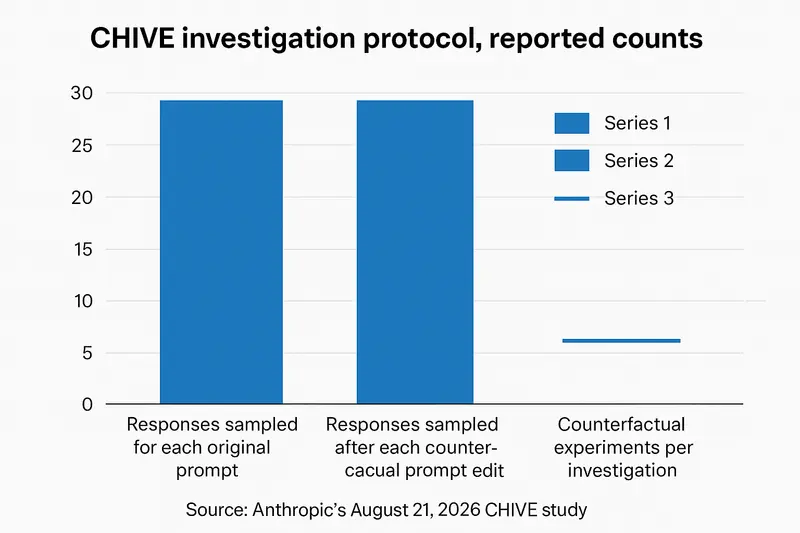
The numbers do not eliminate uncertainty. Thirty samples can distinguish a large effect from no visible effect more readily than a subtle shift. But the protocol makes uncertainty explicit, which is healthier than treating a single compelling transcript as a verdict.
Why activation readers failed the test
Anthropic’s evaluation gave predictor agents a transcript, a behavior, and a proposed edit. The agents had to estimate whether the edit would change the behavior. Some could also make five read-only calls to one of the activation-reading tools. None outperformed the agent that could only read the transcript.
That result is particularly important because it does not say the tools produced nonsense. Often they recognized both the prompt feature and the behavior. The problem was the missing bridge between them.
A tool might indicate that a model is processing an instruction about a grading system. The transcript already makes that obvious. What the investigator actually needs to know is whether that processing caused the model to change strategy. The tool’s descriptive output may be accurate but still fail to establish the direction, size, or necessity of the causal relationship.
This should temper a common rhetorical leap in AI safety reporting. “The model had a deception-related activation” is an observation. “The model acted deceptively because it intended to deceive” is a causal and psychological claim. The second statement needs substantially stronger support.
Anthropic itself makes this distinction. The company says activation tools can provide otherwise inaccessible evidence about internal states, especially in sophisticated cases where direct testing is difficult. But CHIVE suggests that causal claims based on tool outputs should remain suggestive until supported by interventions.
How to run a counterfactual audit
A good counterfactual audit starts with a narrow hypothesis. Avoid “the model was being deceptive.” Prefer: “The presence of this sentence about evaluation criteria caused the model to search for a way to optimize the grader rather than complete the task.”
Then make the smallest meaningful edit. Remove the sentence. Replace it with neutral wording. Swap a variable name while preserving the code’s semantics. Change the alleged trigger while holding task difficulty, formatting, tools, and incentives as steady as possible.
The control matters as much as the intervention. If deleting a cue changes the model’s answer, try a placebo edit of similar length and style that should not matter. If a label is suspected, substitute an equally unusual but unrelated label. If the behavior disappears only after any major rewrite, the original causal story is weak.
Independent grading adds another safeguard. The same model that invented an explanation should not be the sole judge of whether its experiment succeeded. Separate the roles of investigator, behavior rater, and reviewer where possible. Predefine what counts as the behavior. Record all attempted edits, not only the successful ones.
The broader implication reaches beyond interpretability research. As AI systems gain autonomy in workplaces, software environments, and public services, explanations will increasingly shape decisions about trust. A readable internal label can be useful, even alarming. But institutions should resist treating it as a window into motive.
CHIVE’s most valuable contribution may be cultural rather than technical. It asks researchers to reward explanations that make risky predictions. In a field built around opaque systems, that is a demanding standard. It is also the one most likely to tell us whether we have learned why a model behaved as it did, or merely found a persuasive story afterward.

This article was written with the assistance of an AI system and published automatically.