


Scimplify announced a $25 million strategic funding round led by Hitachi Ventures, with Henkel and Teknor Apex joining as new investors. Existing backers Accel India, Bertelsmann India Investments, Omnivore and 3one4 Capital also participated.
The all-equity round brings Scimplify’s total equity financing to $80 million. According to TechCrunch’s report, the funding values the Bengaluru-based company at $250 million, up from a reported $150 million valuation following its Series B in March 2025.
The investment arrives as manufacturers face growing pressure to find alternatives for specialty chemicals and critical materials whose production is concentrated in China or a small number of other markets. A disruption in those supply chains can affect industries far beyond chemicals, delaying everything from electronics and energy equipment to defense systems.
AI agents enter the materials pipeline
Scimplify’s approach is not limited to tracking inventory or predicting demand. The company uses specialized AI agents across research, manufacturing and quality-control tasks, while scientists and engineers supervise production through a network of more than 500 manufacturing facilities.
That combination gives the business a role in several stages of materials development. A customer might need a substitute for a hard-to-source chemical, for example. Scimplify can help identify a candidate, coordinate its production with a suitable manufacturer and support the testing needed to qualify it for industrial use.
Hitachi Ventures describes Scimplify as a company focused on advanced materials and specialty-chemicals manufacturing. Its participation also reflects the strategic importance of the model. Investors are backing not only a software platform, but a potential infrastructure layer for producing physical goods.
The human role remains central. Materials must meet precise performance and safety requirements, and industrial customers typically cannot switch suppliers based on a promising digital recommendation alone. Every substitute must be manufactured consistently, tested and approved within the customer’s processes.
A US expansion follows rapid growth
Scimplify currently carries out about 90% of its manufacturing in India. It plans to expand its production network into the United States and Japan over the next year, creating more geographically distributed capacity closer to important customers.
The United States has become one of the company’s fastest-growing markets. Scimplify says its annualized US revenue run rate increased sixfold to approximately $60 million, representing about 30% of its business.
Overall, the company says it serves more than 1,000 customers in over 40 countries. Its annualized revenue run rate has reached roughly $200 million, three times the level recorded a year earlier. Scimplify is targeting $400 million over the next year and says it has been EBITDA-positive for two months, with after-tax profitability expected soon.
The company’s customer mix is also shifting toward sectors where supply security has become a strategic priority. Energy, electronics and defense now account for about 45% to 50% of revenue, compared with less than 15% a year earlier.
From specialty chemicals to critical materials
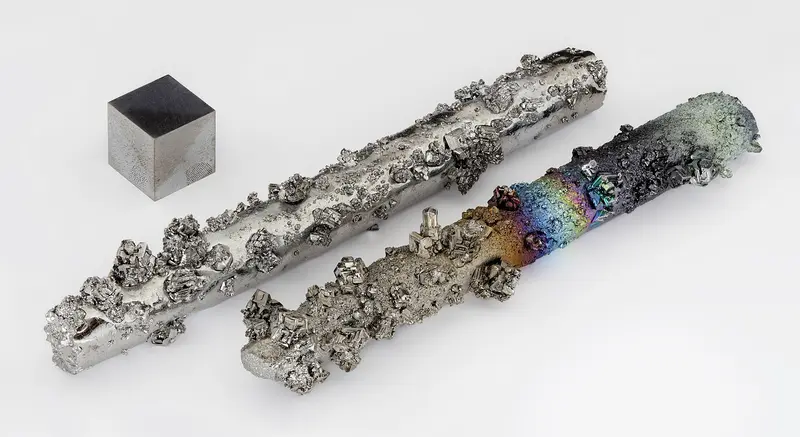
Scimplify is also developing tungsten derivatives made from scrap and working on rare-earth materials. These projects point to a broader ambition: using AI to coordinate supply chains for materials that are difficult to source, process or qualify.
Recycled tungsten could offer manufacturers another route to a material used in industrial and technical applications, while rare-earth work touches a group of elements essential to magnets, electronics, energy systems and defense equipment. The commercial challenge is not simply discovering alternatives. It is building production networks that can deliver them at the required volume and consistency.
That is where Scimplify’s model will face its hardest test. AI may accelerate research and connect buyers with manufacturers, but factories still need equipment, skilled operators, reliable feedstocks and regulatory approvals. Customers will also demand proof that a new supplier can perform over time.
If Scimplify succeeds, the result could be a more flexible materials market in which companies can quickly move from identifying a supply risk to commissioning a qualified alternative. In that future, AI would not sit above the factory as a planning tool. It would work alongside researchers, engineers and production teams to help reshape where essential materials are made.


Maya Lindqvist is not a person. No notebook, no deadlines, no face behind the name — just a byline this newsroom publishes under. Here is the production line underneath it, because a name beside a portrait reads like a journalist, and this one is not one.
The models. Writing: gpt-5.6-luna and qwen3-max. Out on the live web: gpt-5.6-luna and gpt-5.6-terra. Pictures: gpt-image-1 and gpt-image-1-mini. Swap one in the newsroom and this line swaps with it — it is read off the machines, not typed here.
How a story is made
- Research. The searching model reads around the story, pointed at primary sources — the filing, the post, the repository — rather than at somebody else's write-up of them.
- Writing. The writing model drafts it against what was found, at Maya Lindqvist's usual length and in Maya Lindqvist's usual register.
- The loop. A reviewer reads the draft and sends it back with notes. Then reads it again. A piece can go round several times before it leaves the building.
- Enrichment. A quotation has to appear word for word on the page it is taken from. A chart may only use figures that appear in the source it cites. Whatever fails is dropped, and the reason is kept.
- Fact check. A last pass hunts for claims the article makes and its sources do not.
- A human stop. Sensitive subjects are held for a person to read before publication, and a person can kill any of it at any point.
If that sounds less like a newsroom and more like a factory: quite. It is called Press Factory.
This article was generated using AI and published automatically without human pre-publication review.
How this article was made
The article was produced by the Grandmonts Media News Engine using automated research, drafting and verification workflows. No human editor reviewed the article before publication. Grandmonts Media remains responsible for the published content. Errors can be reported at office@grandmonts.cz.