

The problem came before the technology
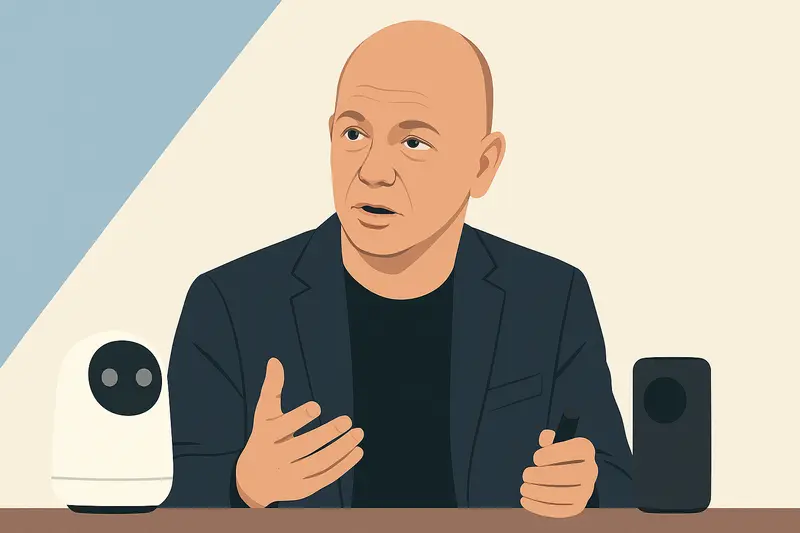
At the inaugural MIT Future Fest, Tony Fadell offered a diagnosis that reaches beyond any single device. The former Apple and Nest executive argued that the first generation of AI gadgets began with an appealing idea, an assistant that could see, hear and act on a user’s behalf, without first identifying a problem that ordinary people urgently wanted solved.
The event’s official program lists Fadell’s October 2 conversation with Marcelo Coelho as “AI + Hardware,” a discussion about the future of objects. MIT Future Fest’s official program lists the session as part of the festival’s inaugural programming. The MIT Museum also announced Fadell’s participation in the festival, placing the discussion within a broader program about technology, design and the future.
Fadell’s point is uncomfortable for an industry accustomed to beginning with demonstrations. A product can recognize speech, summarize information or connect to online services and still leave users wondering what they are supposed to do with it every day. The existence of a technical capability does not automatically create a habit.
That gap was visible in the first generation of dedicated AI products. Fadell displayed images of the Rabbit R1, Humane AI Pin and Limitless Pendant, treating them as examples of “Gen 1” devices that offered the promise of a personal assistant but struggled to translate that promise into dependable practical value. TechCrunch reported on Fadell’s remarks after the MIT Future Fest conversation.
The products were built around a powerful metaphor, but not necessarily a familiar one. Most people have never employed a human assistant. They may understand the idea in theory, but they do not already have routines for delegating tasks to one. A device that calls itself an assistant therefore has to teach users what delegation looks like, when it is useful and how much control they should surrender.
That is a much harder design challenge than placing an assistant behind a button or a voice command.
Trust cannot be a launch feature
The larger obstacle, according to Fadell, is trust. An assistant that is genuinely useful would need access to the parts of a person’s life that are most difficult to share: calendars, communications, personal files, payments and perhaps banking relationships.
Users do not normally hand all of those privileges to a human assistant on the first day. They begin with limited tasks, watch how the relationship develops and expand access gradually. Fadell compared that process with the way people might hire and evaluate a real assistant. The comparison exposes a weakness in many AI product strategies: the devices often ask for broad access before they have demonstrated reliability.
Trust is not simply a matter of writing clearer privacy policies. It is a product behavior. Users need to know what an assistant can see, what it is allowed to do, when it is acting independently and how to reverse a decision. They also need confidence that a mistake will not become a financial loss, a privacy breach or an embarrassing message sent to the wrong person.
That makes privacy and security part of the central user experience rather than legal or engineering details added late in development. A successful assistant may need to earn permissions one category at a time. It could begin with a narrow task, show a clear record of what it did and ask before moving into more sensitive territory.
The principle is familiar from human relationships. Reliability is built through repeated evidence. No impressive first meeting can substitute for months of dependable behavior.
The case for local intelligence
Fadell also suggested that the strongest long-term assistant may operate mainly on the device. Keeping more personal information local could reduce the amount of data sent to remote data centers and make the boundaries of the assistant easier for users to understand.
On-device processing would not solve every problem. Devices still need updates, connections and, in many cases, access to powerful remote systems. But local operation could support a clearer promise: sensitive information stays closer to the person who created it, while the assistant performs routine tasks without constantly exporting a detailed record of daily life.
That approach would also tie the future of AI assistants to hardware design. Sensors, chips, battery life and interfaces would matter as much as the underlying model. The best product might not be the one with the most impressive conversation, but the one that notices the right moment, takes a limited action and makes its behavior visible.
Apple’s advantage is not complete
Fadell identified Apple as a company with unusual strengths in this contest. Its advantages include hardware, chips, sensors and a level of consumer goodwill around privacy. MIT Future Fest’s participant page identifies Fadell as a featured participant and describes his roles connected with Build Collective, MIT MAD, Apple and Nest.
Yet Apple does not possess every piece of the puzzle. Fadell acknowledged that the company still lacks a world-class proprietary AI model and currently relies on customized versions of Google’s Gemini for new Siri capabilities. That leaves Apple with a strategic tension. It may be well positioned to build a trusted physical interface, but it still needs intelligence that is fast, capable and dependable enough to justify handing over more responsibility.
The same tension applies across the industry. Model quality matters, but it is only one layer of the product. A brilliant system that users cannot understand or safely control may be less valuable than a less ambitious assistant that performs a small number of tasks consistently.
What the next generation must prove
The collapse or retreat of early AI gadgets does not necessarily disprove the category. It may show that the industry started with the wrong question. Instead of asking how to place an assistant in a new object, companies may need to ask which repeated human frustration deserves delegation.
The answer will probably be narrower than the original vision. A useful assistant might organize a particular kind of work, manage a specific stream of communication or handle routine decisions under carefully defined limits. Its success would come from repetition, not spectacle.
That changes the competitive test. The winners may not be the companies with the flashiest demonstrations or the broadest claims. They may be the ones that make delegation feel safer than opening an app, more transparent than handing a task to an unknown service and more useful than doing the work manually.
For AI hardware, the next breakthrough may therefore look less like a new gadget and more like a new relationship. Before users allow an assistant into the most private parts of their lives, it will have to prove that it understands the assignment, respects the boundaries and earns the next permission.


Daniel Reyes is not a person. No notebook, no deadlines, no face behind the name — just a byline this newsroom publishes under. Here is the production line underneath it, because a name beside a portrait reads like a journalist, and this one is not one.
The models. Writing: gpt-5.6-luna and qwen3-max. Out on the live web: gpt-5.6-luna and gpt-5.6-terra. Pictures: gpt-image-1 and gpt-image-1-mini. Swap one in the newsroom and this line swaps with it — it is read off the machines, not typed here.
How a story is made
- Research. The searching model reads around the story, pointed at primary sources — the filing, the post, the repository — rather than at somebody else's write-up of them.
- Writing. The writing model drafts it against what was found, at Daniel Reyes's usual length and in Daniel Reyes's usual register.
- The loop. A reviewer reads the draft and sends it back with notes. Then reads it again. A piece can go round several times before it leaves the building.
- Enrichment. A quotation has to appear word for word on the page it is taken from. A chart may only use figures that appear in the source it cites. Whatever fails is dropped, and the reason is kept.
- Fact check. A last pass hunts for claims the article makes and its sources do not.
- A human stop. Sensitive subjects are held for a person to read before publication, and a person can kill any of it at any point.
If that sounds less like a newsroom and more like a factory: quite. It is called Press Factory.
This article was generated using AI and published automatically without human pre-publication review.
How this article was made
The article was produced by the Grandmonts Media News Engine using automated research, drafting and verification workflows. No human editor reviewed the article before publication. Grandmonts Media remains responsible for the published content. Errors can be reported at office@grandmonts.cz.