
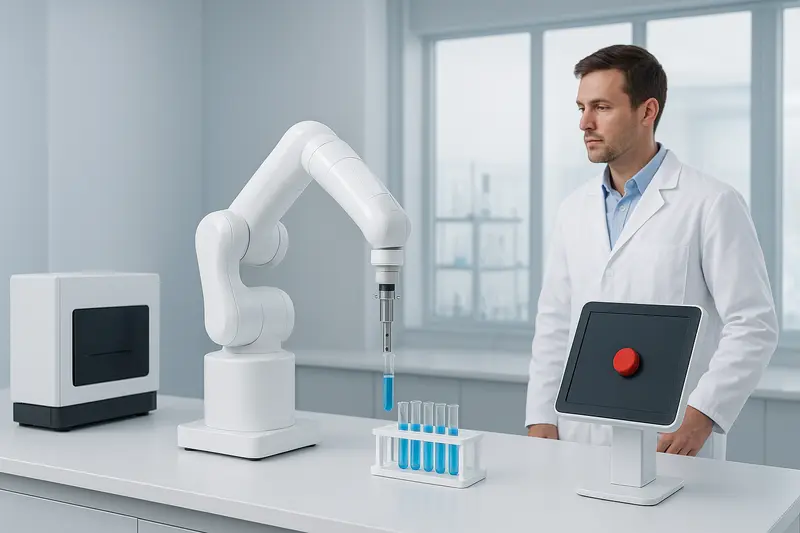
A scientist may ask an AI agent to prepare samples, tune an instrument, and record a result. But the consequential question begins after the instruction leaves the model: what software decides whether a proposed action is physically possible, permitted, timely, and safe? Anthropic’s new Model Hardware Standard puts that question at the center of agentic automation.
The moment language meets machinery
Picture a researcher leaving a laboratory at 7 p.m. An automated run will continue overnight: plates need moving, liquids need dispensing, measurements need recording, and a small error needs noticing before it ruins a batch of samples. An AI agent can make the setup feel almost conversational. It can interpret the protocol, inspect instrument status, and choose the next task.
That convenience can obscure a profound change. A language model can be uncertain, creative, and wrong without much consequence when it drafts an email. A model that can command a liquid handler, robotic arm, laser, or centrifuge has entered a world where an extra retry can contaminate a sample, a mistimed movement can cause a collision, and an outdated reading can turn a safe action into a hazardous one.
Anthropic opened a research preview of the Model Hardware Standard, or MHS, on August 27, 2026. The company describes it as a model agnostic specification for enabling AI agents to work with programmable physical devices through a shared interface. Its early partners include scientific labs and advanced manufacturers.
The essential idea is less glamorous than an autonomous laboratory, but more important: the model should not directly improvise in the language of every machine. It should operate through a driver layer that describes what a device is, what state it is in, what actions it supports, and what limits cannot be crossed.
That arrangement makes the driver the new safety boundary. It is the layer that translates a probabilistic recommendation into a bounded, inspectable command.
A manifest is a contract, not a brochure
A natural language description is useful, but it is not enough. “This robot arm transfers plates” helps an agent form a plan. It does not establish whether the arm is currently parked, whether its path is clear, whether the gripper is holding a plate, or whether another machine has reserved the same workspace.
For that, the system needs typed state. A temperature sensor should expose a temperature with units, a timestamp, a quality flag, and an acceptable range. A plate position should identify a specific plate, a specific location, and whether that location is occupied. A liquid handler should distinguish between a requested volume, an allowable volume, an actual measured volume, and an error state.
Anthropic says MHS drivers use common primitives such as read and write, while device information can include natural language tags that supply practical context normally buried in manuals or held as operator knowledge. That is useful for orientation. Yet natural language must remain advisory. The enforceable parts of a manifest need the rigidity of an engineering contract.
A strong manifest therefore has at least five parts:
- Identity: device model, firmware version, driver version, calibration status, and location.
- State: typed variables, units, freshness requirements, uncertainty, and fault codes.
- Procedures: named operations with inputs, outputs, preconditions, postconditions, and timeouts.
- Limits: hard bounds for speed, pressure, temperature, travel, payload, and chemical compatibility.
- Authority: who or what may call each procedure, under which operating mode, and with which approval.
The distinction matters because a model can understand the intent of “dispense gently” while still choose an unsafe flow rate. The driver should never ask the model to remember an upper bound. It should enforce the upper bound itself.
Capability is not permission
An agent may be technically capable of moving a plate, changing an incubator temperature, or starting a high energy laser procedure. That does not mean it should be authorized to do so.
This is where many demonstrations of physical agents remain incomplete. They show tool use, but not governance. A robust deployment separates three questions:
- Can the device perform this action?
- Is the action safe in the current state?
- Is this particular agent allowed to request it now?
The first is a driver question. The second belongs to the driver, local controller, and interlocks. The third belongs to an authorization system that can consider operator roles, shift rules, experiment approvals, maintenance windows, and the classification of materials being handled.
An emergency stop should not be another tool available to the model. It should be a local, independent mechanism that removes energy or blocks motion even if the network is down, the agent is confused, or the software stack has crashed. Likewise, a hardware interlock should not merely report that a door is open. It should prevent motion that would be unsafe with the door open.
This is the difference between putting a capable assistant in a lab and giving it the keys to the building.
Let the model plan, let deterministic code control
The model is well suited to tasks with ambiguity and broad context. It can translate a scientific objective into a sequence of steps, notice that one instrument is unavailable, compare results with a protocol, or explain why a run was paused. It can also turn recurring lessons into reusable procedures.
It is poorly suited to subsecond control loops. A laser stabilization loop, robotic collision avoidance routine, temperature controller, or pressure regulator cannot wait for a fresh round of model reasoning. These jobs require known timing, predictable behavior, and testing against physical failure modes.
The best architecture treats the model as a planner and supervisor, not as a real time controller. The agent can select a verified routine, supply bounded parameters, monitor results, and escalate anomalies. A deterministic script, programmable logic controller, or embedded controller executes the fast sequence.
Anthropic’s account of work at QuEra Computing makes the point unusually clearly. An agent iteratively improved a laser recovery process, but the production result was a deterministic, inspectable decision tree that ran without an AI agent in control. In a later blind test, that script recovered the correct lock in 695 of 700 trials.
The lesson is not that agents are unnecessary. It is that their highest value may be to discover, organize, test, and improve the routines that eventually make their own direct involvement unnecessary.
Failure is where the boundary proves itself
The important test of an MHS deployment is not whether it succeeds on a clean demonstration. It is what happens when reality becomes inconvenient.
Consider stale sensor data. A temperature reading from two minutes ago might be adequate for a dashboard and dangerous for a decision to transfer a sensitive sample. Every state value should carry a timestamp and a maximum acceptable age. If the reading is stale, the safe response is not guesswork. It is a failed precondition.
Then there are retries. Anthropic recounts a liquid handling case in which Claude encountered bubble related errors and initially tried repeating the operation in the same well, which worsened the problem by creating more bubbles. The eventual remedy required physical context: use a clean well, mix more gently, and reduce cycles.
That episode contains a wider principle. A retry is an action, not a neutral recovery mechanism. Every procedure should specify whether it is safe to retry, how many times, after what diagnostics, and whether a retry must use a fresh material, a new location, or human review.
Race conditions are equally physical. If a robotic arm and a plate reader both believe they control a handoff zone, software disagreement becomes a collision risk. Instruments need reservations, leases with expiry, and an authoritative shared state, rather than a loose sequence of messages that each machine interprets differently.
A practical test for buyers and builders
Anyone evaluating an agent controlled lab should ask simple, uncomfortable questions. Can every material action be traced from the agent’s request through a manifest, policy decision, driver call, controller response, and sensor confirmation? Can an operator identify the hard limits without reading model prompts? Does loss of network access cause a safe stop or an uncontrolled continuation? Are time critical loops outside the model? Can the team simulate stale data, partial completion, duplicated commands, and conflicting reservations?
If the answer is no, the system may have automation, but it does not yet have a credible safety boundary.
MHS matters because it shifts attention from the intelligence of the agent to the discipline of the interface. In the physical world, the decisive safeguard is rarely the elegance of a model’s explanation. It is the unglamorous software layer that can say, clearly and reliably, no.

This article was written with the assistance of an AI system and published automatically.