
The important shift in AI imagery is not simply that generation is getting faster or more realistic. It is that provenance is becoming a systems problem. As images move through chats, screenshots, cloud drives, publishing tools and social platforms, no single marker can reliably carry context from creation to verification. The winning approach will combine independent signals, disclose their limits and treat uncertainty as a product feature rather than a failure.
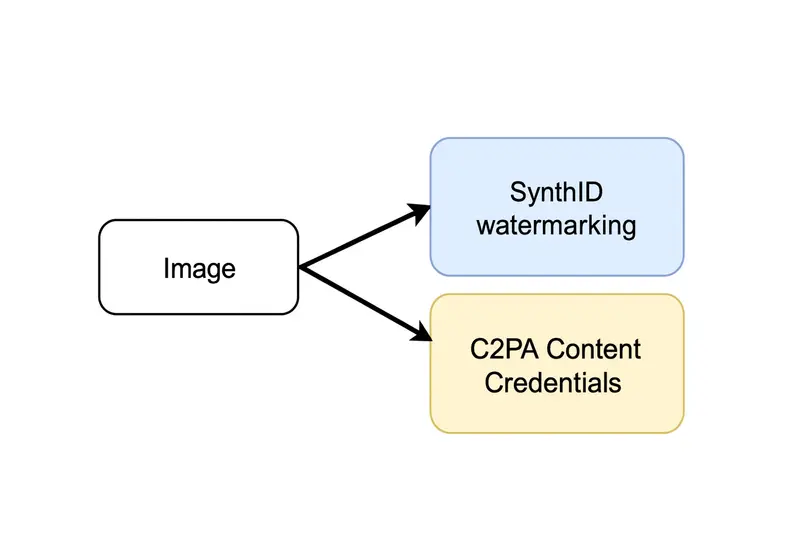
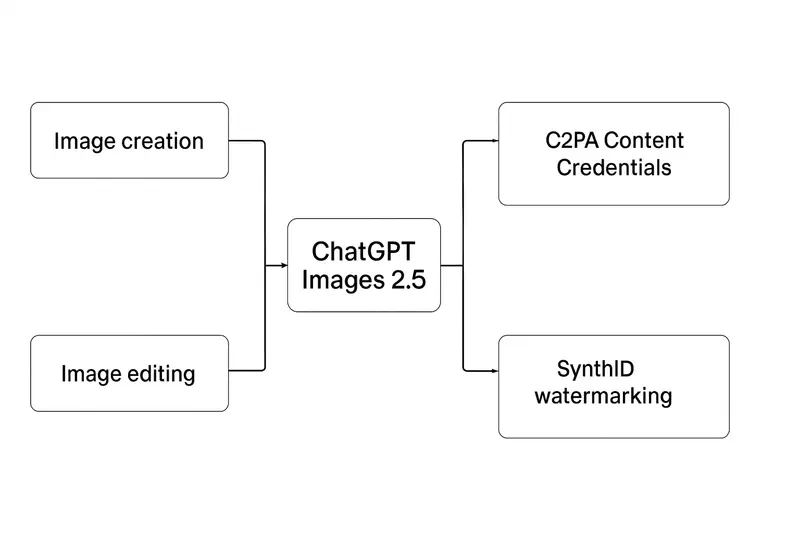
OpenAI’s September 8 release of ChatGPT Images 2.5 makes that architecture more consequential. The model improves image creation and editing, but OpenAI is also continuing to attach C2PA Content Credentials and invisible SynthID watermarking to supported images. That pairing matters because it rejects a tempting but flawed idea: that the industry can build one universal AI detector and settle the authenticity question with a green checkmark.
It cannot.
A signed provenance record and a pixel-level watermark solve different problems. Each has failure modes that the other can partially cover. Neither can establish truth, ownership, consent or real-world context. Used together, however, they can give an editor, platform, investigator or ordinary reader a much better answer to a narrower and more useful question: what evidence survives about this file’s origin and handling?
OpenAI says people now create more than 3 billion images each week across ChatGPT Images and the GPT-Image API family. It also says Images 2.5 can reduce generation latency by as much as 50 percent compared with Images 2.0. Faster creation increases the importance of reliable evidence trails, because verification will increasingly face content at industrial scale.
Provenance is not a detector
The first mistake is linguistic. “AI detection” implies a binary judgment about an image itself. Provenance is different. It is evidence about a file, a toolchain and, sometimes, a declared sequence of actions.
Three claims are frequently bundled together even though they are not interchangeable:
This file has a signed origin record. A Content Credential can carry signed information about the software or service that created or edited a media file, plus relevant provenance assertions. When the credential is present and its signature validates, a verifier can establish that the record has not been silently altered since the relevant party signed it.
This media contains a provider watermark. A SynthID detector can identify an invisible watermark embedded in pixels. That is evidence that the image, or material within it, carries a signal associated with a participating provider’s generative system.
This media is not AI-generated. Neither of the first two claims can prove this. An image lacking both markers may be a camera original, an illustration, an AI image from another provider, an AI image whose signals were removed or damaged, or a conventional image that has been manipulated in other ways.
That distinction is more than technical hygiene. It determines whether provenance tools make decisions safer or create a dangerous false confidence. An absent signal is usually an observation about the verifier’s evidence, not a conclusion about the image’s authenticity.
OpenAI’s own guidance is unusually clear on this point. It describes C2PA metadata as a way to carry richer origin information, while noting that it may be lost in uploads, conversions and editing. It describes SynthID as an additional signal embedded in media that may persist through some transformations, while cautioning that provenance signals do not guarantee accuracy, ownership, lack of editing or correct context.
The first channel: a signed account that travels with the file
Think of Content Credentials as a tamper-evident envelope attached to a digital asset. The envelope is useful because it can contain structured context: which product created the file, what tool performed an edit, and which party signed those statements.
The key property is integrity. A valid signature does not prove that every statement inside the record is morally or factually correct. It shows that a named signer made the assertions and that the assertions have not been modified undetectably after signing. That is a much stronger proposition than ordinary metadata fields, which can be changed with routine software.
For an image generated and then edited inside a provenance-aware workflow, this record can preserve a chain of declared actions. OpenAI has previously described C2PA credentials that update to show an image was edited and how, including the application, tool, and actions such as edits or format conversion.
But the envelope has an obvious weakness: it must remain attached to the file.
A screenshot is a newly created raster image. It captures what was visible on a screen, not necessarily the original file’s credential. Exporting to a different format, passing through software that ignores provenance metadata, or uploading to a platform that recompresses and rebuilds images can also sever the record. The pixels may look almost identical while the provenance history disappears.
That is not a cryptographic failure. It is a transport failure.
This is why storage and delivery architecture now matter to provenance. A publisher that preserves originals in a digital asset management system, retains sidecar data where appropriate, and distributes files through credential-preserving paths can maintain useful evidence. A publisher that treats images as disposable blobs cannot.
The operational implication is straightforward: provenance preservation needs to be designed into asset handling before an incident occurs. It cannot be reconstructed reliably after a viral image has been copied, cropped and reposted hundreds of times.
The second channel: evidence embedded in the pixels
SynthID addresses the transport problem from a different direction. Google DeepMind developed the system to embed an imperceptible watermark in generated media. Rather than depending on a metadata container, it changes the content in ways intended to remain detectable without visibly degrading the image.
This gives the watermark a different resilience profile. Google DeepMind says SynthID is designed to remain detectable through common modifications such as cropping, filters, colour and brightness adjustments, and lossy compression. OpenAI says watermarking can survive transformations, including screenshots, that can break metadata-based provenance.
That advantage is meaningful in the real internet. Screenshots, messaging apps and social feeds are hostile environments for attached records. A pixel-level signal may be the only remaining provenance clue once a file has escaped its original distribution path.
Yet it is also a deliberately narrow clue. A watermark detector can indicate that a supported provider’s signal is present. It generally cannot provide the rich authorship, tool, timing and edit assertions available in a signed manifest. Nor can it distinguish a fully generated image from every possible workflow involving partial generation, compositing or later modification unless the provider’s detector and policy specifically support that interpretation.
Google DeepMind has stressed that SynthID is not foolproof against extreme manipulation. That limitation should not be treated as an embarrassment. It is a reminder that watermarking is a probabilistic signal operating in an adversarial medium.
Two channels fail differently, which is the point
The strategic value of the C2PA and SynthID pairing is not redundancy in the simplistic sense of placing two identical locks on a door. It is diversity.
The signed record is highly informative when it survives. It can identify a signer and present a structured provenance account. But it is brittle in common internet circulation paths because the surrounding file container can be discarded.
The watermark is less informative but more closely bound to visual content. It may survive routine transformations that remove metadata. But it is provider-specific, can be weakened by sufficiently aggressive changes, and does not by itself narrate how the image traveled from generation to publication.
Independent failure modes are what make a system robust. If a social platform strips metadata but leaves enough pixel signal intact, the watermark can still flag relevant origin evidence. If a detector does not find a watermark but the original file carries a valid credential, the signed record can still establish a documented origin path. If both survive, confidence rises because two different mechanisms agree.
Disagreement, however, should trigger investigation rather than automatic rejection.
A valid C2PA record with no detectable watermark could mean the watermark was not applicable, the export path did not embed it, or the visual file suffered a transformation that weakened detection. A detected watermark with no C2PA record may simply reflect a screenshot or an upload path that stripped metadata. A credential that fails validation is more serious: the verifier should report that the record cannot be trusted, not quietly convert that failure into a claim that the image is fake.
Build the verifier around evidence, not verdicts
The product challenge is to turn that technical nuance into an interface people can use under pressure. The wrong interface says “real” or “fake.” The better one reports evidence in layers.
First, preserve the submitted original. Hash the received file, record when and where it entered the system, and avoid overwriting it during analysis. This is basic chain-of-custody discipline. A derivative made for display, thumbnailing or annotation should not become the sole retained asset.
Second, inspect attached credentials before modifying the file. Extract the manifest, validate its signature and trust relationship, record the assertions it makes, and capture validation failures precisely. “Manifest missing” and “signature invalid” are different states with different implications.
Third, run watermark detection on the original pixels when supported. Return the detector’s actual confidence category rather than compressing it into a binary result. Google DeepMind’s original SynthID deployment used categories corresponding to detected, possibly detected and not detected. A verifier should preserve that uncertainty rather than pretending a borderline result is decisive.
Fourth, compare the channels. The system should explain agreement and disagreement in plain language. It should say, for example, that metadata was absent but an embedded watermark was detected, which is consistent with a file that has passed through a metadata-stripping workflow. It should not say that the image has been “proven authentic.”
Finally, retain verification receipts. Store the file hash, manifest result, detector version, confidence level, verifier timestamp and any transformations made during review. Provenance is only useful if a later reviewer can understand how the earlier conclusion was reached.
OpenAI’s public verification work points toward this model. Its tool checks supported images for OpenAI-associated Content Credentials and SynthID signals, and OpenAI has introduced verification API access so organizations can integrate such checks into their workflows. The long-term market opportunity is not a universal detector. It is a reliable evidence layer built into editorial systems, marketplaces, archives and social distribution.
The future of image trust will therefore look less like a single classifier and more like modern security engineering. Multiple signals. Clear provenance boundaries. Logged decisions. Explicit uncertainty. And a constant refusal to claim more than the evidence can support.
That is the real lesson of the two-channel approach. It does not solve authenticity. It makes authenticity claims harder to fake, easier to inspect and more honest about what remains unknown.

This article was written with the assistance of an AI system and published automatically.