
News
Apple’s OpenAI Lawsuit Reveals the Real AI War: Who Owns the Device After the iPhone?

- Share
- Tweet /data/web/virtuals/375883/virtual/www/domains/spaisee.com/wp-content/plugins/mvp-social-buttons/mvp-social-buttons.php on line 63
https://spaisee.com/wp-content/uploads/2026/07/law-1000x600.png&description=Apple’s OpenAI Lawsuit Reveals the Real AI War: Who Owns the Device After the iPhone?', 'pinterestShare', 'width=750,height=350'); return false;" title="Pin This Post">
Apple’s lawsuit against OpenAI may be framed as a dispute over confidential files, former employees and allegedly misappropriated hardware knowledge. Strategically, however, the case is about something much larger: control of the next computing platform.
For nearly two decades, Apple has occupied one of the most valuable positions in technology. The iPhone is not simply a successful product. It is the device through which hundreds of millions of people communicate, shop, consume media, access financial services and interact with the wider digital economy. Every major software company ultimately has to negotiate with that reality.
Artificial intelligence threatens to rearrange this hierarchy. If consumers begin interacting with digital services through an always-available AI assistant embedded in glasses, earbuds, a pendant or another ambient device, the smartphone could lose its role as the default gateway to computing. Apple’s aggressive legal response suggests it is taking that possibility seriously.
A Trade-Secret Case With Platform-Sized Stakes
In its complaint, Apple accuses OpenAI, its affiliated hardware operation and two former Apple employees of improperly obtaining confidential information connected to product development, manufacturing and supply-chain operations. OpenAI has denied seeking or using competitors’ trade secrets.
Those allegations will now be tested through the legal process. The strategic meaning of the confrontation is already visible.
OpenAI is attempting to move beyond being an application that runs on devices controlled by Apple, Google and Microsoft. Its hardware ambitions represent an effort to own the full relationship with the user: the interface, the sensors, the operating logic, the distribution of services and potentially the commercial transactions that follow.
That is exactly the kind of vertical integration Apple has used to build its own power.
A company that controls both a leading AI model and the device through which that model observes the world could create a new category of consumer computing. Such a product would not necessarily need to replace the iPhone immediately. It would only need to capture enough attention and high-value interactions to weaken Apple’s position at the center of the ecosystem.
The lawsuit therefore looks less like a routine attempt to protect isolated engineering secrets and more like a defensive action at the edge of a potentially historic platform transition.
The Interface Is Becoming More Valuable Than the Model
Much of the AI industry’s first competitive phase focused on model performance. Companies raced to build systems that could generate better text, write more reliable code, interpret images and complete increasingly complex tasks.
As model capabilities converge, the strategic battleground is moving closer to the user.
The winning AI company may not be the one with the highest benchmark score. It may be the one whose assistant is easiest to reach, possesses the richest real-world context and can act across the widest range of services.
Hardware is critical to that equation. A camera can provide visual context. Microphones can capture spoken intent. Location sensors can establish where the user is. Health and motion sensors can reveal what the user is doing. A persistent device can maintain continuity throughout the day rather than waiting for someone to unlock a phone and open an application.
This changes the nature of the interface. Instead of navigating menus and selecting apps, users can express a goal and allow an AI agent to coordinate the necessary steps.
A request such as “find the product I looked at yesterday, compare prices and order it for delivery before Friday” could bypass several traditional interfaces. The assistant might search, compare, authenticate payment and arrange delivery without the user consciously interacting with a browser, marketplace or app store.
Whoever controls that assistant could influence which businesses are discovered, which payment systems are used and which services receive customer traffic. The commercial implications extend far beyond device sales.
OpenAI Wants Independence From the Smartphone Gatekeepers
OpenAI’s current reach is enormous, but much of that reach still depends on platforms operated by other companies. ChatGPT runs inside web browsers, mobile operating systems and cloud infrastructures that OpenAI does not fully control.
That dependency creates strategic limitations. Apple can determine how deeply an outside assistant integrates with the iPhone. Google controls important parts of Android distribution. Microsoft remains both a partner and a powerful platform owner with its own commercial priorities.
A dedicated AI device would give OpenAI a direct consumer channel.
The company could determine how the assistant is activated, what information it receives and how it interacts with third-party services. It could develop a subscription model tied to hardware, create an AI-focused marketplace or position ChatGPT as the operating layer for everyday decisions.
The involvement of former Apple design chief Jony Ive makes the project particularly significant. OpenAI already possesses advanced software capabilities and a globally recognized AI brand. Ive’s design organization contributes experience in turning complex technology into consumer products that feel simple, personal and culturally desirable.
That combination does not guarantee success. Consumer hardware is littered with ambitious failures. Yet it is credible enough to command Apple’s attention.
Apple’s Dependence on the iPhone Changes the Calculation
Apple has successfully expanded into services, wearables, computers and tablets, but the iPhone remains the economic and strategic center of the company.
In Apple’s fiscal second quarter of 2026, iPhone revenue reached approximately $57 billion out of total quarterly sales of about $111 billion. Services generated nearly $31 billion, but much of the value of that business is strengthened by the enormous installed base of Apple devices.
The iPhone drives more than direct hardware revenue. It supports App Store activity, cloud subscriptions, advertising relationships, payments, accessories and customer loyalty across the broader Apple ecosystem.
A successful ambient AI device could pressure this structure without causing an immediate collapse in smartphone sales. The danger is gradual displacement.
Consumers may continue carrying phones while spending less time actively using them. Search queries could move to AI assistants. Messages could be summarized and answered through wearables. Navigation could become conversational. Purchases could be initiated by an agent. Cameras on glasses could provide information before a user reaches for a screen.
In that scenario, the iPhone remains present but becomes less central. It risks turning into a powerful processor, connectivity hub and authentication device operating behind a more influential AI interface owned by another company.
For Apple, that would be a meaningful loss of control.
Smart Glasses Are Giving the Post-Phone Thesis Credibility
Previous attempts to create a new consumer AI device have struggled with limited functionality, poor battery life, awkward industrial design and unclear use cases. The failure of early products demonstrated that enthusiasm for AI does not automatically translate into demand for new hardware.
Smart glasses are beginning to present a more credible path.
Unlike experimental pins or unfamiliar wearable formats, glasses already have a socially accepted purpose. Adding cameras, microphones, speakers and AI capabilities to an established product category reduces the behavioral change required from consumers.
Meta and EssilorLuxottica have increasingly emphasized AI glasses as a major consumer platform. Their expansion into more frame styles and brands indicates that the category is moving beyond a narrow technology demonstration. The strategic value comes from the camera’s position: glasses can see roughly what the wearer sees.
That creates a natural interface for multimodal AI. A user can ask about a building, translate a sign, identify an object, record a reminder or receive contextual guidance without holding a phone.
Apple has several assets that could support a competing approach. It has advanced custom silicon, expertise in miniaturized devices, an established wearables business and significant experience with spatial computing through Vision Pro. Its challenge is turning those capabilities into a lightweight product that consumers will wear throughout the day.
The company cannot assume that its ownership of the smartphone market will automatically translate into leadership in AI eyewear.
Apple’s Best Defense Is Not the Courtroom
Protecting trade secrets is a legitimate part of competing in technology, particularly when product development depends on specialized manufacturing processes and deeply coordinated supplier relationships.
Litigation alone cannot secure Apple’s future.
The stronger defense is to make the iPhone ecosystem the most useful, trusted and convenient environment for personal AI. Apple needs an assistant that can understand context, operate across applications and complete meaningful tasks without forcing users through multiple screens.
Its advantage is not necessarily having the largest model. Apple can combine on-device processing, custom chips, operating-system integration and its privacy architecture into a differentiated experience.
The company’s approach to Apple Intelligence uses local processing when possible and private cloud infrastructure for more demanding requests. That model could become increasingly valuable as AI assistants gain access to personal communications, health information, financial activity and visual data from a user’s surroundings.
Trust may become one of the defining competitive variables in AI hardware. Consumers will need confidence that an always-listening or camera-equipped assistant is not quietly converting their private lives into advertising profiles or unrestricted training data.
Apple has spent years positioning privacy as a product feature. In the ambient-computing era, that message could evolve from a brand advantage into a fundamental requirement.
The iPhone Does Not Have to Disappear
Predictions about the death of the smartphone are likely premature. Phones combine large displays, capable cameras, substantial batteries and powerful processors in a format that remains difficult to replace.
The more plausible future is a distributed AI ecosystem.
A person may use glasses for visual assistance, earbuds for private conversations, a watch for health monitoring and a phone for tasks that benefit from a screen. Intelligence will move between these devices depending on context.
Apple is well positioned for such a world because it already controls a family of connected products. Its opportunity is to make those products behave like extensions of one continuous assistant rather than separate pieces of hardware.
Under that model, the iPhone could retain its importance as the secure computational and communications core of a wider personal network. It may appear less frequently in the user’s hand while remaining essential behind the scenes.
The risk arises when the intelligence coordinating that network belongs to someone else.
An OpenAI device connected to third-party services could weaken Apple’s ecosystem from the outside. Instead of users asking Siri to manage their digital lives, they might ask ChatGPT to operate across Apple hardware, cloud applications and physical surroundings. Apple would provide the infrastructure while OpenAI controlled the relationship.
The Next Platform War Has Already Started
Apple’s conflict with OpenAI captures a fundamental shift in the technology industry. AI companies no longer want to remain software suppliers inside somebody else’s operating system. They want their models to become the operating system for human intent.
At the same time, incumbent platform owners understand that artificial intelligence could reduce the importance of traditional apps, screens and navigation systems. Their control over distribution is valuable only as long as consumers continue using the interfaces they control.
The next major computing platform may be a pair of glasses, an audio device or a collection of coordinated sensors rather than a single revolutionary gadget. Its defining feature will not be its shape. It will be the presence of an assistant capable of perceiving context, reasoning across information and taking action.
Apple’s lawsuit cannot determine which form factor wins. It can, however, slow a competitor, protect valuable internal knowledge and signal that the company considers AI hardware strategically important.
That signal may be the most revealing part of the case.
Apple is behaving like a company that understands the iPhone’s greatest future rival may not look like another smartphone. It may be an intelligent interface that makes reaching for a phone feel unnecessary.
The battle is no longer simply over who builds the best AI model. It is over who owns the device that is present when the user asks the model to act.











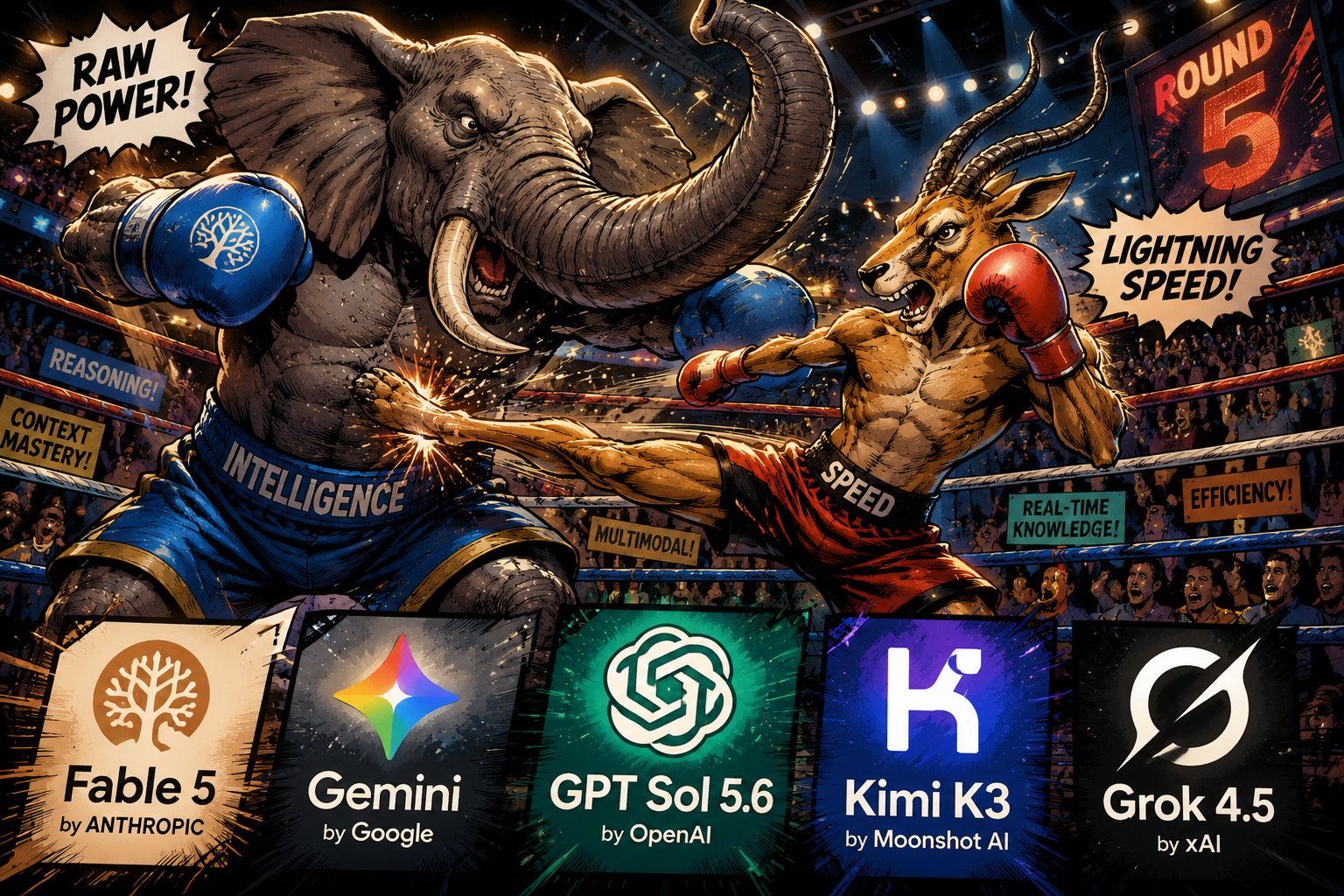
Artificial intelligence no longer has an undisputed champion. The industry’s most capable models now trade victories across mathematics, software engineering, research, writing, multimodal analysis and autonomous computer use. A model that dominates a laboratory benchmark can feel frustrating in an ordinary conversation, while a system that millions of people enjoy using may fall behind on difficult technical evaluations.
That tension defines the AI market in 2026.
Anthropic’s Claude Fable 5 currently occupies the top position on several broad intelligence rankings. OpenAI’s GPT-5.6 Sol is close enough that the difference often disappears in practical use, while benefiting from the reach and tooling of ChatGPT. Moonshot AI’s Kimi K3 has placed an open-weight model within striking distance of the most powerful proprietary systems. SpaceXAI’s Grok 4.5 offers an unusually aggressive combination of speed, price and directness. Google’s Gemini 3.5 Flash, meanwhile, demonstrates that a fast model deeply embedded in a global product ecosystem can be more strategically valuable than a slower model with a slightly higher benchmark score.
The result is not a conventional ranking in which first place is excellent and fifth place is mediocre. Every model in this comparison is capable of work that would have seemed extraordinary only a few years ago. The important differences are subtler: how reliably a model follows complicated instructions, how long it can sustain a task, how frequently it invents information, how it behaves when requirements conflict, how much it costs to operate, and whether users actually enjoy collaborating with it.
This comparison examines five leading publicly available models: Claude Fable 5, GPT-5.6 Sol, Kimi K3, Grok 4.5 and Gemini 3.5 Flash. It combines independent benchmarks, developer evaluations, human-preference rankings, pricing, context windows, adoption estimates and recurring subjective opinions from active users.
The central conclusion is simple. There is no universally best AI model. There are, however, increasingly clear winners for particular kinds of work.
How to Compare Models Without Being Misled
AI benchmarks are valuable, but they are not neutral measurements of some universal quantity called intelligence.
A mathematics test rewards formal reasoning. A coding benchmark may measure whether a model can repair real software repositories. An agent benchmark evaluates whether it can use tools and complete a sequence of actions. A human-preference leaderboard asks people which of two answers they like better. These evaluations overlap, but they do not measure the same thing.
This is why the benchmark picture looks contradictory. On the Artificial Analysis Intelligence Index, which aggregates several difficult evaluations, Claude Fable 5 scores 60. GPT-5.6 Sol at maximum reasoning scores 59, Kimi K3 scores 57, Grok 4.5 scores 54 and Gemini 3.5 Flash scores 50.
That appears to produce a straightforward order. Human preferences complicate it.
In the Arena.ai text leaderboard published on July 16, Claude Fable 5 held first place with a score of 1507. Kimi K3 and GPT-5.6 Sol were effectively tied around 1486, although both results were based on fewer votes than longer-established models. Gemini 3.5 Flash sat within the top group but below those three. Grok 4.5 ranked considerably lower in the general text arena despite performing strongly on several independent reasoning and efficiency tests.
This does not mean one leaderboard is correct and another is defective. It means users evaluate qualities that conventional tests do not capture fully. People notice tone, pacing, formatting, unnecessary disclaimers, conversational warmth, willingness to make a decision and the amount of editing needed before an answer becomes useful.
Speed and cost introduce another dimension. Artificial Analysis measured Gemini 3.5 Flash at roughly 157 output tokens per second, Grok 4.5 at about 97, Claude Fable 5 at 66, Kimi K3 at 62 and GPT-5.6 Sol at 54. These values can change with infrastructure, reasoning settings and provider load, but they illustrate the trade-off. The models with the highest intelligence scores are not necessarily the fastest.
The same is true of price. At representative blended usage rates tracked by Artificial Analysis, Claude Fable 5 was the most expensive of this group. GPT-5.6 Sol cost less, while Kimi K3, Grok 4.5 and Gemini 3.5 Flash offered progressively more aggressive economics. For a consumer sending a few prompts, these differences may be invisible. For a company processing hundreds of millions of tokens, they can determine whether an application has a viable business model.
A responsible comparison must therefore treat intelligence, preference, speed, cost, ecosystem and adoption as separate variables.
| Model | Broad intelligence score | Context window | Approximate output speed | Best available reach indicator |
|---|---|---|---|---|
| Claude Fable 5 | 60 | Around 1 million tokens | 66 tokens per second | Claude app estimated at 56 million monthly active users |
| GPT-5.6 Sol | 59 | About 1.05 million tokens | 54 tokens per second | ChatGPT exceeds 900 million weekly active users |
| Kimi K3 | 57 | About 1.05 million tokens | 62 tokens per second | No reliable current global total publicly disclosed |
| Grok 4.5 | 54 | 500,000 tokens | 97 tokens per second | Grok reached 17.8% of the US chatbot app market in early 2026 |
| Gemini 3.5 Flash | 50 | Around 1 million tokens | 157 tokens per second | Gemini exceeds 900 million monthly active users |
These adoption figures are not directly comparable. OpenAI reports weekly users, Google reports monthly users, Claude’s figure comes from a third-party app estimate, and Grok’s public data frequently measures market share rather than a consolidated global audience. Model usage is also not the same as product usage. ChatGPT and Gemini can route requests between several models, meaning not every user is interacting with the flagship system examined here.
Even with those limitations, adoption matters. A model’s practical influence depends on distribution as much as raw intelligence.
Claude Fable 5: The Deliberate Expert
Claude Fable 5 is the strongest candidate for the title of most intellectually capable general-purpose model currently available to ordinary developers and professional users.
It leads the Artificial Analysis Intelligence Index and the Arena.ai text leaderboard. It also performs particularly well on advanced mathematics, analytical work and tasks that require sustained reasoning over long periods. On the most difficult tier of the FrontierMath evaluation, Fable 5 recorded a reported score of 87.8%, ahead of the other broadly available systems measured in that test.
Those results reflect Claude’s defining quality: it tends to take the structure of a difficult problem seriously.
When asked to analyze a complex contract, debug an unfamiliar codebase, compare competing strategic plans or explain a technical dispute, Claude often produces an answer that feels considered rather than merely fluent. It is particularly good at identifying hidden assumptions, separating evidence from speculation and maintaining a consistent argument across a long response.
This makes Fable 5 attractive for research, financial analysis, legal drafting, software architecture, policy work and other domains where the quality of the reasoning process matters more than immediate response speed.
Its writing is another major advantage. Claude has long been popular among editors, researchers and developers who dislike the formulaic tone associated with some AI-generated text. Fable 5 generally handles voice, rhythm and transitions well. It can produce polished prose without automatically dividing every thought into a collection of headings and numbered lists. It is also unusually capable of preserving stylistic constraints across lengthy documents.
Subjective user research supports this reputation. A 2026 cross-platform survey of active chatbot users found that Claude attracted people primarily because of perceived answer quality. In the same research, ChatGPT was more strongly associated with interface quality, while Grok attracted users partly through its less restrictive content policies.
Claude’s coding performance is equally important. Anthropic’s broader model family has become deeply associated with agentic programming, largely through Claude Code. Developers frequently praise Claude for reading large repositories, understanding relationships between files and proposing coherent changes instead of isolated snippets. Its strongest coding advantage is not necessarily writing a single function. It is maintaining a workable mental model of an evolving project.
Fable 5 is also designed for long-running agents. A one-million-token context window allows it to inspect substantial document collections or code repositories, although a large context window should never be confused with perfect memory. Like every model, Claude can overlook information buried in an enormous prompt, particularly when instructions are duplicated or contradictory.
Its weaknesses emerge from the same characteristics that make it strong.
Claude can be slow and expensive. At its highest reasoning settings, it may spend substantial time and tokens exploring a problem before delivering an answer. For a high-value analysis, that deliberation may be desirable. For customer support classification, simple extraction or an interactive application, it can be wasteful.
Its API pricing reinforces that concern. Fable 5 is positioned as a premium model, and its representative cost is substantially higher than Grok 4.5, Gemini 3.5 Flash or many open-weight alternatives. Anthropic has improved the range of lower-cost models around it, but Fable itself is not designed to be the default engine behind every routine prompt.
Claude can also be overly cautious. Users regularly report that it interprets ambiguous requests conservatively, adds safety qualifications that interrupt the flow or declines requests that another model would complete. The exact experience varies by model version and system configuration, but the perception has remained persistent across Claude generations.
There is a subtler limitation. Claude’s thoughtful tone can make uncertainty sound like judgment. Its answers are often elegantly reasoned, which may encourage users to trust conclusions that still depend on incomplete or incorrect information. Good prose is not proof of factual accuracy.
Claude therefore works best with users who value depth, can tolerate some latency and know how to verify high-stakes claims. It is the strongest choice in this group for difficult writing, nuanced analysis and large software tasks. It is a weaker choice for extremely price-sensitive applications or workflows that need instant, lightweight responses.
GPT-5.6 Sol: The Most Complete Generalist
GPT-5.6 Sol does not lead every benchmark, but it may be the most complete AI product when model quality, tools, distribution and workflow integration are considered together.
Its Artificial Analysis score of 59 places it only one point behind Claude Fable 5. In practical terms, that difference is too small to justify declaring Claude universally more capable. The models have different performance profiles, and prompt design can matter more than a one-point gap in an aggregate index.
OpenAI reports that GPT-5.6 Sol achieved 92.2% on BrowseComp, an evaluation of difficult web-research tasks, and 62.6% on OSWorld 2.0, which tests a model’s ability to operate computer interfaces. It also demonstrated major improvements in multistage scientific reasoning, agentic research and professional knowledge work.
Its defining strength is breadth.
GPT-5.6 Sol can write, code, browse, analyze images, operate tools, work with files and participate in extended agentic workflows. Individual competitors may outperform it in specific areas, but few combine so many abilities within one mature consumer and enterprise environment.
This matters because users rarely buy intelligence as an isolated API score. They buy an outcome. A researcher may need the model to search, inspect documents, run calculations and produce a report. A developer may need it to understand an issue, modify a repository and test the result. A business user may need it to connect with internal applications and complete a task rather than merely explain how the task should be completed.
OpenAI’s advantage is that GPT-5.6 Sol sits inside the most widely adopted AI platform. OpenAI reported more than 900 million weekly active ChatGPT users in early 2026 and more than 50 million consumer subscribers. Sensor Tower subsequently estimated that the ChatGPT app reached one billion monthly active users in May.
Those numbers are not a direct measure of GPT-5.6 Sol usage. ChatGPT serves multiple models and automatically routes some requests. They nevertheless reveal the scale of OpenAI’s distribution. More people understand how to use ChatGPT, more businesses already support it, and more third-party products are designed around OpenAI-compatible interfaces.
Subjectively, GPT-5.6 Sol feels highly adaptable. It is usually good at inferring the desired format, balancing detail with readability and recovering when a user changes direction. Compared with earlier GPT generations, it is less likely to become trapped in shallow patterns when a task requires several stages of reasoning.
It is especially strong for mixed work. Claude may be preferable for a dense policy memorandum, while Gemini may be preferable for a heavily multimodal Google-based workflow. GPT-5.6 Sol is often the safer choice when the task crosses several categories and the user does not yet know which capabilities will become important.
OpenAI’s research and computer-use results strengthen that position. GPT-5.6 Sol is not merely a chatbot with a better answer generator. It is increasingly an action model capable of navigating software environments and coordinating tools.
Its weaknesses are mostly related to cost, predictability and product complexity.
GPT-5.6 Sol is cheaper than Claude Fable 5 in representative independent measurements, but it remains considerably more expensive than Grok 4.5 or Gemini 3.5 Flash. Maximum reasoning can also generate long internal computations, making cost and latency difficult to predict in applications where prompts vary significantly.
The system’s flexibility can introduce behavioral inconsistency. ChatGPT may route prompts differently depending on plan, mode, load or product settings. Consumers do not always know which model configuration produced a particular answer. Developers have more control through fixed API versions, but they must still manage model updates and changing tool behavior.
OpenAI models also have a recognizable stylistic tendency toward polished structure. This is useful for business communication but can feel overly packaged. GPT answers sometimes convert straightforward requests into frameworks, categories and summaries that the user did not ask for. Careful prompting reduces this behavior, but it remains a common subjective complaint.
Another concern is ecosystem dependence. A company that builds deeply around OpenAI’s agents, file systems, tool protocols and hosted workflows can gain enormous productivity, but it also becomes more sensitive to pricing changes, policy decisions and product redesigns.
GPT-5.6 Sol is therefore the best overall choice for users who want one model to cover the widest range of serious work. It may not be the absolute leader in prose, coding, price or speed, but it has the fewest severe weaknesses. That balance, combined with ChatGPT’s distribution, makes it the model most likely to remain the default reference point for the industry.
Kimi K3: The Open-Weight Disruptor
Kimi K3 is the most strategically significant model in this comparison.
Moonshot AI’s new system demonstrates that the highest tier of AI performance is no longer reserved for a small group of closed American laboratories. Kimi K3 scores 57 on the Artificial Analysis Intelligence Index, placing it behind Claude Fable 5 and GPT-5.6 Sol but ahead of many proprietary systems. In the Arena.ai text leaderboard, its preliminary score put it approximately level with GPT-5.6 Sol in human preference.
That is an extraordinary position for an open-weight model.
Moonshot describes Kimi K3 as a 2.8-trillion-parameter mixture-of-experts system built for long-horizon coding, advanced reasoning and end-to-end knowledge work. The full parameter count is less important than the architecture’s active computation, but the scale shows the ambition behind the release. Its context window exceeds one million tokens, enabling it to process large repositories, extensive research material or long organizational records.
Kimi’s strongest practical advantage is control.
OpenAI, Anthropic, Google and SpaceXAI operate proprietary frontier models. Customers access them through hosted products or APIs and must accept the provider’s pricing, policies, availability and update schedule. An open-weight model can be inspected, adapted and deployed through a broader range of infrastructure, subject to its license and the organization’s technical resources.
That flexibility is particularly attractive to companies concerned about data sovereignty, vendor concentration or long-term inference costs. It is also valuable to researchers who want to fine-tune a frontier-class model or study its behavior more directly.
Kimi K3’s economics are aggressive. Its published API pricing sits below the premium models from OpenAI and Anthropic, while its independent intelligence score remains close to both. Artificial Analysis also measured a much shorter time to first token than the most deliberative versions of Claude and GPT, although complete task time depends on reasoning settings and output length.
Developers have praised earlier Kimi generations for coding, long-context work and value. K3 extends that reputation into a more general knowledge-work model. It appears particularly promising for autonomous software tasks, document-heavy research and agent systems that would become prohibitively expensive on premium proprietary APIs.
It may also prove important for multilingual AI. Moonshot originates in China, and Kimi has historically performed well with Chinese-language material while remaining competitive in English. Global organizations that operate across both linguistic environments may find that more valuable than a marginal advantage on English-centric benchmarks.
The weaknesses are significant, however.
Kimi K3 is extremely new. Its early Arena score was based on only a few thousand votes, far fewer than established models such as Gemini 3.1 Pro. Initial benchmark performance can change as researchers discover prompt sensitivities, evaluation contamination, reliability problems or weaknesses in less-publicized tasks.
Open weights also do not mean easy deployment. A model of K3’s scale requires substantial infrastructure. Most companies will still access it through a cloud provider rather than operate the full system themselves. The freedom to self-host is strategically meaningful, but it is not automatically economical for smaller teams.
Moonshot’s global support ecosystem is less mature than those of OpenAI, Google or Anthropic. Documentation, enterprise integrations, compliance programs and regional customer support can matter more than benchmark scores when a model enters production. Kimi has progressed quickly, but it must prove that it can support demanding international customers over time.
Geopolitical risk is another factor. Chinese AI models are becoming popular because they offer strong capability at lower prices, yet organizations in regulated sectors may face restrictions concerning data processing, procurement or cross-border technology. Conversely, Chinese organizations may view Kimi’s domestic origins as an advantage over American providers. The calculation depends on jurisdiction.
Kimi’s consumer reach is also difficult to quantify. Public reports have provided various historical estimates, but Moonshot has not disclosed a current consolidated global active-user figure comparable with OpenAI or Google. Earlier Kimi products achieved significant adoption in China, then lost consumer ranking during the rise of DeepSeek and other competitors. K3 could reverse that trajectory, but benchmark attention is not the same as durable user loyalty.
Kimi K3 is consequently the strongest option for organizations that prioritize open weights, model control and high capability per dollar. It is not yet the safest choice for a conservative enterprise seeking a mature global vendor relationship. Its importance lies in what it changes: proprietary frontier labs can no longer assume that openness requires accepting dramatically weaker intelligence.
Grok 4.5: The Fast, Unfiltered Challenger
Grok 4.5 occupies an unusual position. Independent measurements suggest that it is technically formidable, particularly relative to its price, but human-preference rankings and enterprise adoption do not place it in the same tier as its strongest benchmark results.
On the Artificial Analysis Intelligence Index, Grok 4.5 at high reasoning scores 54. That puts it below Claude Fable 5, GPT-5.6 Sol and Kimi K3 but above most mass-market models. Its representative output speed of roughly 97 tokens per second is considerably faster than the three systems above it. Its blended cost is also substantially lower.
For developers, that combination is compelling. A model does not need to be number one to be commercially superior. If it produces 95% of the desired quality at a fraction of the latency and cost, it may be the better production model.
SpaceXAI positions Grok 4.5 for coding, agentic work, science, engineering and knowledge tasks. Its 500,000-token context window is smaller than those of Claude, GPT, Kimi and Gemini in this comparison, but still large enough for extensive documents and software repositories.
Grok’s subjective appeal is distinct from its technical performance. It tends to sound more direct, informal and willing to take a position. Users who dislike heavily filtered assistants often perceive Grok as less paternalistic. The 2026 cross-platform user survey found that Grok attracted users partly because of its content policy, whereas Claude was more closely associated with answer quality and ChatGPT with interface design.
Its connection to X also gives it cultural immediacy. Grok can engage with fast-moving online discussions, public posts and breaking narratives in a way that feels native to social media. For trend monitoring, rapid public-sentiment analysis and internet culture, that integration can be useful.
Distribution through X helped Grok grow quickly. Apptopia data reported by Reuters showed its US chatbot market share rising from 1.9% in January 2025 to 17.8% in January 2026. This made it one of the most-used chatbot applications in the United States, although market-share estimates vary depending on whether the measurement includes web, mobile, embedded usage or time spent.
The major weakness is trust.
Grok’s lower Arena.ai position suggests that users do not consistently prefer its responses when shown anonymous side-by-side comparisons. Grok 4.5 ranked around 34th in the general text leaderboard shortly after release, well behind its placement on the Artificial Analysis index. The limited number of initial votes means that position may change, but the gap is too large to ignore.
One explanation is style. Directness can become carelessness. Grok may provide an answer quickly without matching the nuance, organization or restraint of Claude and GPT. For brainstorming or informal analysis, that can feel refreshing. For legal, financial, medical or executive work, it may create extra verification and editing.
Safety controversies surrounding Grok’s image tools and its deployment on X have also affected confidence in the broader product. Even organizations that never use those functions must consider reputational risk, governance practices and the maturity of the provider’s controls.
Enterprise adoption appears weaker than consumer awareness. Reuters reported limited use of Grok across US government applications compared with OpenAI, Anthropic and Google. Some agencies and businesses have preferred competitors because of security, functionality or procurement requirements.
Grok 4.5 is therefore best understood as a high-performance value model with a distinctive personality. It is attractive for fast coding, high-volume agent workloads, research experiments and applications where cost matters. It is less attractive for conservative institutions that prioritize predictable behavior, mature compliance and neutral presentation.
Gemini 3.5 Flash: The Ecosystem Powerhouse
Gemini 3.5 Flash has the lowest broad intelligence score of the five models in this comparison, yet dismissing it as the weakest would be a serious strategic mistake.
Google designed 3.5 Flash to deliver frontier-level capabilities at high speed. Its Artificial Analysis score of 50 trails the premium reasoning models, but its measured output speed of approximately 157 tokens per second is the fastest in this group. Its pricing is also among the most competitive.
More importantly, Gemini is not merely an API or chatbot. It is part of a global software ecosystem that includes Search, Android, Workspace, Cloud, YouTube and a growing collection of agentic products.
Google reported more than 900 million monthly active users for the Gemini application in May 2026, up from 400 million one year earlier. Daily requests increased more than sevenfold over the same period. That puts Gemini’s consumer reach in the same general class as ChatGPT, even though OpenAI reports weekly users and Google reports monthly users.
Distribution on that scale changes the meaning of model competition. A slightly stronger model may be less useful than one already connected to a person’s email, files, calendar, documents, phone and search history. Gemini can become valuable through context and integration even when another model produces a better isolated answer.
Gemini 3.5 Flash is especially strong in multimodal work. Google reported leading results on visual reasoning tests and major improvements in coding, terminal use and agent protocols. The model can process text, images, audio and other media within a single workflow, building on Google’s long-standing strengths in vision and large-scale information retrieval.
Its one-million-token context window makes it suitable for lengthy documents and codebases. Its speed makes it effective for interactive applications, voice systems, real-time assistance and large-volume enterprise processing.
For businesses already using Google Cloud or Workspace, Gemini can offer the lowest integration friction. Security controls, identity management, document access and organizational permissions may already exist. This operational advantage rarely appears on benchmark charts, but it can outweigh a moderate quality difference.
Gemini’s weakness is inconsistency.
Users often describe its best answers as excellent and its ordinary answers as uneven. It may solve a sophisticated visual or scientific problem, then mishandle a comparatively simple instruction. The model’s performance can depend heavily on the specific Gemini mode, reasoning level, product surface and integration being used.
Google’s naming and release strategy adds confusion. Gemini 3, 3.1 Pro, 3.5 Flash, specialized live models and product-specific variants can coexist, while planned flagship releases may be delayed or previewed separately. Technical users can navigate this complexity, but consumers may not know which model they are evaluating.
Its writing is generally competent but less consistently distinctive than Claude’s. Gemini can also over-rely on broad summaries when a prompt requires a decisive interpretation. In extended conversations, it may lose stylistic or procedural constraints even when the raw context remains available.
The gap between Gemini’s enormous adoption and its lower independent intelligence score reveals an important reality: mass-market users do not choose models by benchmark alone. Availability, speed, price and integration can be more influential.
Gemini 3.5 Flash is the best choice for high-volume multimodal applications, Google-centered workflows and products where latency matters. It is less convincing for the most demanding long-form reasoning, where Claude Fable 5 or GPT-5.6 Sol usually provides a stronger baseline.
What User Numbers Really Tell Us
The adoption contest appears to have two giants and three challengers.
ChatGPT has more than 900 million weekly active users, while the Gemini app has more than 900 million monthly active users. Because weekly and monthly activity are different measurements, ChatGPT’s figure represents a higher level of repeated engagement. Sensor Tower’s estimate of one billion monthly ChatGPT app users further reinforces OpenAI’s lead in consumer habit.
Claude remains much smaller, although it has been growing rapidly. Sensor Tower estimated 56 million monthly active users for the Claude mobile app during the second quarter of 2026. That number excludes some web and enterprise usage, and Anthropic has not published a consolidated total.
Grok has achieved substantial US reach through X and its standalone applications, reaching an estimated 17.8% of the American chatbot app market in January. Its penetration appears stronger among consumers than in enterprises and government.
Kimi’s present global audience is the hardest to measure. Historical estimates show meaningful adoption, especially in China, but no current figure is sufficiently reliable for direct comparison with ChatGPT or Gemini.
These figures reveal distribution, not model quality. They are influenced by preinstallation, brand recognition, free access, mobile availability and integration with existing services. Google can place Gemini inside products used by billions. Grok benefits from X. ChatGPT benefits from becoming the generic term many consumers use for conversational AI.
Claude and Kimi must earn adoption more directly through performance.
User scale nevertheless creates a feedback advantage. A widely used product can observe more failure patterns, test more interfaces and support a larger third-party ecosystem. It can also become familiar enough that switching feels inconvenient, even when another model performs better on a particular task.
Yet engaged AI users increasingly refuse to choose only one platform. The cross-platform survey of 388 active users found that more than 80% used at least two AI services. This suggests that the market may evolve less like traditional search, where one engine dominated, and more like cloud computing, where organizations combine several providers.
The Subjective Verdict
Benchmarks can identify capability, but preference determines whether people continue using a system.
Claude Fable 5 feels like the strongest analytical collaborator. Its answers are usually coherent, nuanced and well written. It is the model most likely to notice that the user has asked the wrong question. Its downside is that it can be expensive, slow and too cautious.
GPT-5.6 Sol feels like the strongest universal professional tool. It may not be as elegant as Claude in every writing task or as cheap as Grok and Gemini, but it is consistently capable across more categories. Its ecosystem is the most mature, although that ecosystem can also become complicated and difficult to leave.
Kimi K3 feels like the industry’s most important economic challenge. It offers near-frontier intelligence, open weights and competitive pricing. Its weaknesses are uncertainty, deployment scale, support maturity and the absence of long-term evidence about reliability.
Grok 4.5 feels like the most aggressive value proposition. It is fast, inexpensive and refreshingly direct. It is also the model in this comparison most likely to require additional governance, fact-checking and tone control.
Gemini 3.5 Flash feels like the model designed for ubiquity. It is fast, multimodal and integrated into a software empire. Its strongest argument is not that it wins every test, but that it can be present everywhere. Its weakness is that raw availability does not always translate into consistent depth.
Which Model Should You Choose?
For high-stakes analysis, complex writing and large coding projects, Claude Fable 5 is the strongest first choice. It offers the best combination of reasoning discipline, prose quality and long-horizon coherence.
For organizations seeking one primary AI provider across research, coding, automation and everyday knowledge work, GPT-5.6 Sol is the most balanced option. Its small benchmark deficit relative to Claude is offset by superior distribution and a broader product ecosystem.
For teams that need open weights, lower costs and deployment control, Kimi K3 is the clear strategic candidate. It should still be evaluated carefully under real production conditions because its public track record is short.
For cost-sensitive, latency-sensitive applications that can tolerate more behavioral variation, Grok 4.5 deserves serious consideration. It may be particularly effective as one component in a routed multi-model system.
For multimodal applications, Google Workspace integration and large-scale interactive services, Gemini 3.5 Flash is likely to offer the strongest operational package.
The most sophisticated answer is not to choose one.
A company might use Gemini for fast document classification, Grok for inexpensive first-pass research, Kimi for controlled internal deployment, Claude for final analysis and GPT for tool-rich orchestration. Model routing adds engineering complexity, but it reduces dependence on any one provider and allows each task to reach the system best suited to it.
That multi-model future is becoming more likely because the performance gaps are narrowing. A difference of three or five benchmark points matters at the frontier, but it rarely justifies sending every prompt to the same model.
The Real Winner Is the Portfolio
Claude Fable 5 currently deserves the technical crown. It leads the broadest independent intelligence ranking and the largest human-preference text arena. For difficult reasoning, writing and coding, it is the model to beat.
GPT-5.6 Sol remains the overall market leader. Its intelligence is nearly equal to Claude’s, its tool capabilities are formidable and ChatGPT’s scale gives OpenAI an unmatched distribution advantage.
Kimi K3 is the disruptive winner. It proves that an open-weight model can compete near the top rather than occupying a separate, lower-quality category.
Grok 4.5 is the efficiency winner. Its speed and pricing make it more commercially interesting than its general preference ranking might suggest.
Gemini 3.5 Flash is the platform winner. Google can place capable, fast multimodal intelligence inside products that already mediate work, communication and information for much of the world.
The most important weakness is shared by all five models. None is reliably truthful. All can produce false claims, misunderstand incomplete prompts, accept flawed assumptions or express uncertainty poorly. Research into chatbot performance on current news has found that retrieval failures remain a major source of error, while tests of academic references continue to show that even advanced systems can fabricate citations.
The models are improving rapidly, but fluency continues to advance faster than reliability.
That is why the correct question is no longer, “Which AI is smartest?” The more useful question is, “Which model creates the least dangerous failure mode for this particular task?”
Claude’s failure may be overcaution. GPT’s may be polished overconfidence. Kimi’s may be insufficiently tested behavior. Grok’s may be excessive directness. Gemini’s may be inconsistency concealed by seamless integration.
Understanding those differences is more valuable than memorizing a leaderboard.
The AI market of 2026 has no permanent champion because the contest is no longer being fought on one field. Intelligence, price, speed, openness, user experience and distribution are separate competitions. Claude currently leads some of the most important ones. ChatGPT leads the largest. Gemini possesses the broadest route into existing digital life. Grok is challenging the economics of proprietary APIs, and Kimi is challenging the assumption that frontier intelligence must remain closed.
The five-way fight will continue, and the rankings will change. The durable advantage will belong not to the company that briefly wins the most benchmarks, but to the model that becomes trustworthy enough, affordable enough and useful enough to remain inside real human workflows.

Artificial intelligence writing 90% of a company’s software sounds like the beginning of a mass layoff announcement. Anthropic CEO Dario Amodei sees it differently—at least initially. In his view, automating most of a job does not immediately eliminate the worker. It creates a productivity surge in which humans concentrate their time on the small portion the machine still cannot complete.
That distinction sits at the center of Amodei’s increasingly provocative argument about the future of work.
When Claude generates most of the code, engineers do not necessarily disappear. They become reviewers, architects, product designers, security investigators and managers of increasingly capable digital workers. The human contribution shrinks as a percentage of the production process, but the output of each person can rise dramatically.
The more unsettling question is what happens when AI masters the final 10%.
Amodei’s answer reaches far beyond software development. He imagines artificial intelligence becoming the cognitive core of companies, helping organizations reason, coordinate and execute at a level that makes the modern enterprise resemble a form of collective superintelligence.
It is an ambitious vision combining extraordinary productivity, accelerated medical discovery and potentially severe disruption to white-collar employment.
Writing Code Is Not the Same as Doing the Job
The percentage of code written by AI has become one of the most widely repeated statistics in the technology industry.
Amodei has said that Claude now produces most of the code written by some engineers inside Anthropic. In parts of the company, developers may no longer type significant amounts of code manually. They describe the intended feature, direct the model, inspect its output, test the implementation and intervene when something goes wrong.
This is a fundamental change in the interface between an engineer and a computer.
Traditional software development requires humans to translate ideas into precise instructions written in programming languages. AI coding agents can absorb much of that translation work. A developer can increasingly communicate at the level of goals, constraints and architecture while the model handles implementation.
But lines of code are a poor measurement of complete job automation.
Compilers already generate enormous quantities of machine code, yet their arrival did not make programmers unnecessary. Higher-level programming languages automated much of the work once performed manually, allowing developers to build larger and more complex systems.
Claude writing 90% of a codebase may therefore say less about the disappearance of engineers than it does about the abstraction level at which they work.
The remaining 10% can still contain the most difficult and consequential decisions. Someone must determine what should be built, understand the needs of users, choose between competing technical designs, identify security risks and decide whether the output is safe to deploy.
AI can generate a plausible implementation in minutes. Knowing whether it solves the correct problem remains a different challenge.
The Productivity Hump
Amodei describes a transitional period in which automation produces an enormous increase in productivity before it produces full replacement.
Imagine that AI can reliably perform 90% of the work involved in a software project. The engineer is still necessary because the final 10% requires human judgment, organizational knowledge or technical expertise. Yet the engineer can now spend nearly all available time on those remaining tasks.
In simplified terms, one engineer may become capable of supervising the volume of work previously handled by ten.
Companies could respond by reducing staff, but they could also build far more software. Projects previously rejected as too expensive could become viable. Internal tools that never reached the top of the development queue could be created quickly. Small teams could launch products that once required large engineering departments.
This is the productivity hump: the period in which humans remain essential but become dramatically more leveraged.
The economic consequences will depend on how much additional demand appears. When productivity rises, companies do not always reduce employment proportionally. Lower costs can create new markets, new products and new categories of work.
However, that protection has limits.
If AI advances from writing most of the code to completing nearly the entire software-engineering process, the remaining human bottleneck begins to disappear. The model would not merely implement a feature. It would identify the requirement, inspect the existing system, design the solution, configure the environment, run tests, diagnose failures, document the change and prepare it for deployment.
At that point, engineering becomes less about humans using better tools and more about humans assigning objectives to autonomous systems.
From Roughly 5% to More Than 77%
The speed of improvement in coding benchmarks helps explain Amodei’s confidence.
The original SWE-bench evaluation was designed around genuine software issues collected from public GitHub repositories. Instead of asking a model to write a small function or solve an interview-style coding puzzle, it required the system to understand an existing codebase and generate a patch that resolved a documented problem.
Early results were poor. Claude 2 resolved only a small percentage of the tasks under the initial evaluation setup. The result demonstrated how far language models still had to go before they could perform practical repository-level software engineering.
Later Claude models made rapid gains. Anthropic reported that Claude Sonnet 4.5 achieved 77.2% on SWE-bench Verified, a human-reviewed subset containing 500 software problems.
The figures should not be treated as a perfectly controlled comparison. The benchmark variant, model scaffolding, prompting strategy, tool access and evaluation methodology changed over time. A score on the original benchmark is not directly interchangeable with a score on the Verified subset.
Even with those caveats, the direction of travel is difficult to ignore.
AI coding systems have moved from solving only the simplest isolated issues to handling substantial portions of carefully selected real-world software tasks. They can navigate repositories, edit multiple files, execute commands, run tests and revise their own attempts.
Benchmarks still do not capture the complete reality of production engineering. Real companies have undocumented systems, conflicting stakeholder demands, legacy infrastructure and security requirements that cannot be represented by a clean test suite.
Yet the improvement suggests that the islands of work reserved for humans are becoming smaller.
A Medical Story With Larger Implications
Amodei has also used a personal family experience to illustrate how AI can identify patterns across complicated information.
According to his account, his sister and Anthropic co-founder Daniela Amodei developed an infection while pregnant. Several doctors believed the illness was viral. After her medical information was provided to Claude, the model suggested that the infection could instead be bacterial.
The anecdote is powerful because it captures a potential advantage of medical AI: the ability to process a large volume of records, symptoms and reference material without fatigue.
A doctor may have limited time with each patient and may receive information spread across laboratory reports, previous appointments, medication histories and specialist notes. A model can examine those records together and surface possibilities that deserve another look.
That does not make Claude a replacement for a physician.
A personal account is not a clinical trial, and an AI-generated suggestion should not be treated as a verified diagnosis. Language models can misunderstand records, overlook critical context or produce confident but inaccurate conclusions. Medical decisions also require physical examinations, professional accountability and an understanding of the patient that cannot always be captured in uploaded data.
The more realistic near-term role is that of a second reader.
An AI system can summarize a patient’s history, identify unusual combinations of symptoms, compare test results over time and suggest questions for a clinician. The doctor remains responsible for evaluating those suggestions and deciding whether further tests or treatments are appropriate.
The same productivity dynamic seen in coding could emerge in medicine. AI handles the information-intensive portion of the work, allowing medical professionals to spend more time on difficult judgments, procedures and patient relationships.
The stakes, however, are much higher. A coding error may break an application. A medical error can harm a person.
The Enterprise as a Collective Intelligence
Amodei’s broadest idea concerns the nature of the company itself.
An enterprise already behaves like a distributed intelligence. It collects information from customers and markets, stores institutional knowledge, assigns tasks, makes decisions and coordinates the actions of thousands of people.
Executives act as strategic planners. Managers distribute information and resources. Employees operate as specialized units. Databases and software systems function as organizational memory.
The result is more capable than any individual person.
Placing AI at the center of that structure could make the organization faster, more coordinated and more responsive. Instead of acting as a chatbot used by isolated employees, the model could become a shared reasoning layer connected to the company’s data, applications and operational processes.
An AI-centered enterprise might monitor sales activity, examine customer feedback, analyze product performance and recommend changes continuously. It could draft software updates, prepare financial forecasts, identify supply-chain risks and coordinate specialized agents responsible for different departments.
Human employees would establish objectives, approve sensitive decisions and intervene when judgment or accountability is required.
In this model, AI is not simply another application purchased by the information-technology department. It becomes part of the company’s operating system.
That prospect explains why enterprise AI is strategically important to Anthropic. Consumer chatbots attract public attention, but organizations control enormous collections of proprietary data and repeatable workflows. Connecting models to those systems could generate far greater economic value than answering standalone questions.
The New Bottleneck Is Judgment
As AI takes over execution, the value of human work may shift toward deciding what deserves to be executed.
A model can write a technically correct feature that customers do not need. It can optimize a metric that damages the wider business. It can confidently follow instructions that were badly designed from the beginning.
Greater execution capacity can therefore magnify poor judgment.
When software becomes cheaper to produce, companies may generate more unnecessary complexity. When reports become effortless to create, employees may drown in synthetic analysis. When autonomous agents can perform thousands of actions, a poorly specified objective can produce failures at extraordinary speed.
The most valuable workers may be those who understand systems deeply enough to direct AI effectively and recognize when its output is misleading.
That requires more than clever prompting. It requires domain knowledge, skepticism, taste and accountability.
Junior roles present a particular challenge. Companies traditionally develop senior experts by giving beginners routine tasks and gradually exposing them to harder problems. If AI absorbs the entry-level work, organizations may struggle to train the people eventually expected to supervise advanced systems.
A company cannot indefinitely remove the bottom rung of the career ladder while expecting experienced professionals to appear at the top.
Productivity and Displacement Can Both Be True
The optimistic and pessimistic interpretations of Amodei’s argument are not mutually exclusive.
AI can make engineers ten times more productive and still reduce the total number of engineers companies need. It can create new products while eliminating familiar roles. It can help doctors detect overlooked conditions while introducing new forms of diagnostic risk.
The outcome will not be determined by a single automation percentage.
It will depend on how quickly new demand develops, whether organizations reinvest productivity gains, how governments respond and whether humans can continue moving into new areas of comparative advantage.
The transition may also unfold unevenly. The strongest engineers could become dramatically more valuable because they can manage fleets of coding agents. Less experienced developers may face fewer opportunities. Large companies could become leaner, while small teams gain the power to compete with established organizations.
The result could be both democratizing and concentrating at the same time.
What Happens When AI Learns the Rest?
The most important part of Amodei’s argument is not that Claude writes 90% of the code. It is that the remaining percentage may not remain protected for long.
Today’s models still need supervision. They make mistakes, lose track of objectives and struggle with ambiguous organizational realities. Humans remain necessary because the final portion of the task contains uncertainty, responsibility and context.
But frontier AI companies are specifically working to improve reasoning, memory, tool use and long-horizon autonomy—the capabilities required to attack that final portion.
The productivity hump may therefore be temporary.
For now, AI allows one person to accomplish far more. The engineer becomes an architect. The doctor gains a tireless second reader. The enterprise acquires a new layer of collective intelligence.
Beyond that stage lies a harder question: not how humans work with machines, but what economic role remains when machines can carry an objective from conception to completion.
Amodei’s vision is compelling because it contains both possibilities. AI could become the greatest amplifier of human capability ever created. It could also advance so quickly that the new roles it creates are automated almost as soon as people learn to perform them.
The decisive battle will not be over the first 90%.
It will be over the last 10%.
AI Model
GPT-5.6 Sol Raises the Stakes: OpenAI’s New Model Is Built to Do the Work, Not Just Discuss It

The most important improvement in GPT-5.6 Sol is not that it can produce a sharper answer to a difficult question. It is that the model is increasingly capable of turning an ambiguous objective into a sequence of actions, carrying those actions across tools, checking the results and returning something that resembles finished professional work. That distinction matters because the artificial intelligence market is moving beyond the chatbot era. The next competitive frontier is not conversation. It is execution.
Released for general availability on July 9, 2026, GPT-5.6 Sol sits at the top of OpenAI’s new three-tier model family. Sol is the flagship, Terra balances capability with cost, and Luna is optimized for speed and affordability. The naming change is more than branding. It reflects an industry-wide shift away from presenting each model as a single, static intelligence and toward selling families of systems that can allocate different amounts of reasoning, computation and agent activity depending on the task.
Sol is therefore best understood as a professional execution engine. It is designed for software engineering, research, cybersecurity, scientific analysis, document creation, computer use and other workflows in which the model must maintain context, operate tools and revise its own work. It also introduces OpenAI’s most ambitious multi-agent mode so far, allowing several coordinated model instances to investigate different parts of the same problem in parallel.
The result is one of OpenAI’s most consequential releases since the company began turning general-purpose language models into operational agents. GPT-5.6 Sol does not win every benchmark, nor does it eliminate the strengths of Claude, Gemini, Grok or DeepSeek. Its more significant achievement is combining frontier-level reasoning with a serious attempt to control the cost, latency and token consumption of autonomous AI work.
What GPT-5.6 Sol Actually Is
GPT-5.6 is a family rather than a single model. Sol occupies the premium capability tier, roughly replacing the role played by the unsuffixed flagship models in previous GPT generations. Terra is positioned as the practical middle option, while Luna targets high-volume applications where response speed and operating cost matter more than extracting the final percentage points of intelligence.
For developers, GPT-5.6 Sol supports text and image input and produces text output. Its API specification provides a context window of approximately 1.05 million tokens and a maximum output length of 128,000 tokens. That gives the model enough theoretical capacity to inspect enormous codebases, extensive legal or financial records, long research collections and complex multi-document projects within a single working context.
A large context window, however, is only useful when the model can identify and preserve the right information. Frontier models have repeatedly demonstrated that accepting a million tokens is not the same as reasoning reliably across a million tokens. Sol shows substantial improvements on several long-context tests, but its results are not uniformly dominant. On some evaluations involving very large contexts, competing Claude models remain highly competitive, and GPT-5.5 occasionally matches or narrowly exceeds Sol.
The more important improvement is therefore not raw context size. It is how Sol combines context with reasoning, tool use and iterative execution. The model can write lightweight programs to process intermediate data, coordinate tools and decide what to do next. Instead of repeatedly sending every tool result back through a conventional conversational loop, it can filter and transform information programmatically, retaining only what is useful for the next step.
This is a major architectural shift at the product level, even though OpenAI has not disclosed every detail of the model’s underlying neural architecture. The system is being optimized around completed workflows rather than isolated responses.
From GPT-5.5 to GPT-5.6: A Change in Operating Philosophy
GPT-5.5, released in April 2026, already represented a substantial move toward agentic work. It was designed to understand messy requests, navigate software, use external tools, research information and continue working without requiring the user to supervise every decision. GPT-5.6 Sol extends that direction but places much greater emphasis on efficiency, parallelism and polished output.
The difference can be seen in how the two generations approach complexity. GPT-5.5 was a stronger autonomous worker than GPT-5.4, particularly in coding, computer use and document-heavy tasks. Sol is designed to make that worker more economical and more adaptable. It can invest additional reasoning only where it is likely to improve the result, while using fewer tokens on routine stages of the workflow.
That distinction becomes significant at enterprise scale. A model that solves a task 5 percent more accurately but consumes twice as many tokens may be unsuitable for production. It may also become slower as the workflow expands, particularly when an agent repeatedly reads large tool outputs, revisits previous reasoning or generates unnecessary explanations. OpenAI’s emphasis on token efficiency suggests that the company increasingly views wasteful inference as a product defect rather than an unavoidable cost of higher intelligence.
The performance differences are especially visible in computer use and cybersecurity. OpenAI’s published evaluations show Sol making large gains over GPT-5.5 on operating-system tasks, browsing, computer-aided design and security research. The improvement in general academic reasoning is more incremental. Sol scores above GPT-5.5 on demanding science and mathematics evaluations, but the gap is smaller than it is on tasks requiring sustained interaction with tools.
This pattern reveals the real purpose of the release. GPT-5.6 is not primarily a better examination candidate. It is a better operator.
Reasoning That Can Scale Up When Necessary
Sol introduces several levels of reasoning effort, allowing users and applications to choose between faster execution and deeper analysis. The new “max” setting gives the model more time to explore alternatives, test assumptions and revise its approach than the previous highest reasoning configurations.
The more dramatic feature is “ultra,” which moves beyond a single reasoning process. In its default configuration, ultra coordinates four agents operating in parallel. Different agents can research separate questions, test competing approaches or perform independent checks before a root agent synthesizes their results.
Multi-agent systems are not automatically superior. Four agents can consume more tokens, duplicate effort or amplify the same incorrect assumption. Coordination itself can become a source of failure if the agents divide the problem poorly or if the final synthesizer cannot distinguish strong evidence from confident noise.
OpenAI’s implementation is therefore important because it treats multi-agent reasoning as an optional escalation mechanism rather than the default response to every prompt. Routine tasks can remain on a lower reasoning setting, while research, engineering and strategic analysis can receive additional computational investment.
This resembles how professional teams allocate human effort. A straightforward memo does not need four analysts. A complex acquisition, software migration or security investigation might. The advantage is not simply having more intelligence. It is being able to match the amount and organization of intelligence to the economic value of the task.
Ultra also changes the relationship between latency and capability. Parallel agents may use more total tokens, but they can complete independent workstreams simultaneously. For time-sensitive projects, the result may arrive faster than a single agent working through every branch sequentially. The trade-off is a higher total inference bill in exchange for greater breadth, stronger cross-checking and a shorter time to completion.
Coding Becomes a Full Engineering Workflow
Coding remains one of Sol’s strongest areas, but describing it as a code-generation model would understate the change. The model is designed to operate across the engineering lifecycle: inspecting repositories, understanding architecture, reproducing failures, editing files, running tests, reviewing results and continuing until the implementation works.
On OpenAI’s reported Terminal-Bench 2.1 evaluation, Sol reaches 88.8 percent, while ultra rises to 91.9 percent. GPT-5.5 records 85.6 percent in the same comparison. Sol also improves on long-horizon engineering tests involving real codebases and command-line environments.
Those gains are meaningful because terminal benchmarks are harder to game with elegant-looking but nonfunctional code. The model must use tools, cope with errors and maintain a plan across multiple actions. This is closer to the way engineering work actually happens.
The results are not a universal victory. On SWE-Bench Pro, Anthropic’s Claude Fable 5 and Mythos 5 configurations score substantially higher than Sol in OpenAI’s own comparison table. That makes Claude a formidable option for resolving difficult repository issues, especially when long autonomous runs and codebase comprehension are central to the task.
Sol’s case rests on the wider workflow. It combines strong coding performance with computer use, artifact creation, programmatic tool coordination and lower list pricing than Anthropic’s top models. A company choosing between Sol and Fable may therefore reach different conclusions depending on whether it needs the highest success rate on a narrow software benchmark or a versatile agent that moves between code, research, files, interfaces and presentation-ready deliverables.
For crypto companies, the potential applications are obvious but should be approached carefully. Sol can assist with smart-contract review, transaction-analysis pipelines, test generation, protocol documentation and incident investigation. It can also accelerate dangerous security work, which explains why access to some cyber capabilities is governed by stricter safeguards. No serious team should treat model-generated security analysis as a substitute for independent audits, deterministic testing and human review.
Knowledge Work Moves From Drafting to Delivery
Earlier generations of generative AI were useful for producing first drafts. They could summarize a report, outline a presentation or suggest spreadsheet formulas, but the user usually had to transform the output into a finished artifact.
GPT-5.6 Sol aims to reduce that final-mile burden. It can take unstructured information from documents, workplace messages, cloud drives and productivity platforms, then turn it into reports, financial models, presentations and other editable outputs. OpenAI places particular emphasis on Sol’s ability to follow existing templates, infer visual systems and preserve recurring design conventions.
This may sound cosmetic, but formatting is part of professional accuracy. A model that produces correct analysis but ignores a company’s slide master, omits required sections or breaks a financial template has not finished the job. It has merely transferred the remaining work to a human.
Sol’s stronger design judgment is therefore strategically relevant. It can inspect rendered output rather than focusing only on the underlying code or text. In practical terms, this means checking whether a page is visually coherent, whether an interface is usable or whether a presentation follows the reference material.
OpenAI’s evaluations show significant gains over GPT-5.5 on browsing, computer use and computer-aided design. Sol reaches 62.6 percent on OSWorld 2.0 compared with 47.5 percent for GPT-5.5. It scores 70.6 percent on BenchCAD compared with 44.4 percent for its predecessor. Sol Ultra reaches 92.2 percent on BrowseComp, while standard Sol records 90.4 percent and GPT-5.5 reaches 84.4 percent.
The broader benefit is not simply higher quality. It is fewer revision cycles. In enterprise deployments, every additional prompt, correction and manual handoff adds cost. A model that understands the expected format and validates its own output can create value even when its raw reasoning score is only modestly higher.
The Economics of Token Efficiency
Sol is priced at $5 per million input tokens and $30 per million output tokens through the OpenAI API. Terra costs $2.50 for input and $15 for output, while Luna costs $1 and $6 respectively. Cached input for Sol receives a substantial discount, although the GPT-5.6 family also introduces a charge for writing new cache entries.
These prices make Sol expensive compared with high-volume models such as Gemini 3.5 Flash, but relatively economical compared with Anthropic’s Claude Fable 5, which is listed at $10 per million input tokens and $50 per million output tokens.
Token pricing alone does not reveal the real cost of a workflow. A cheaper model may produce a longer answer, require more retries or fail often enough that the effective cost per successful task becomes higher. An expensive model can be economical when it completes difficult work on the first attempt.
OpenAI is explicitly positioning Sol around this idea of performance per dollar. The company claims that Sol uses fewer output tokens, less time and lower estimated cost than several competing frontier models on selected agentic evaluations. Even where Sol does not lead the raw intelligence score, it may reach a similar result with less computation.
This is one of the most important changes in the AI market. Model buyers are becoming less interested in price per token and more interested in cost per completed outcome. A legal team does not buy tokens; it buys reviewed contracts. A software company buys resolved issues. A financial institution buys validated analysis. An AI model that generates millions of cheap tokens without completing the workflow can be more expensive than a premium system that finishes accurately.
Sol’s efficiency narrative will need independent validation under real production conditions. Vendor estimates may not account for every tool call, failure mode, latency spike or integration expense. Nevertheless, the focus is correct. The next stage of AI adoption will be determined by unit economics as much as benchmark intelligence.
GPT-5.6 Sol Versus Claude Fable 5 and Mythos 5
Anthropic remains Sol’s most direct competitor for demanding professional and coding tasks. Claude Fable 5 is Anthropic’s most capable generally available model, while Mythos 5 uses the same underlying model with different safeguards and restricted access for selected cybersecurity and scientific users.
Fable 5 is particularly strong on long-running autonomous work, software engineering, vision, finance and scientific research. Anthropic says the model can sustain attention across millions of tokens and use persistent notes to improve performance over extended tasks. Early customers have reported impressive results on codebase migrations, legal review, analytics and research.
OpenAI’s own evaluations present a mixed but revealing comparison. Sol leads Fable on Agents’ Last Exam and on the Artificial Analysis Coding Agent Index. It also achieves stronger results on Terminal-Bench 2.1. Fable, however, substantially outperforms Sol on SWE-Bench Pro and narrowly leads on the broader Artificial Analysis Intelligence Index. Claude configurations also outperform Sol on Toolathlon, an evaluation of complex tool use.
The pricing difference favors OpenAI. Sol’s standard API rates are half of Fable’s input price and 40 percent lower on output. OpenAI also claims major advantages in latency and token usage on selected tasks.
Claude’s appeal is not limited to benchmarks. Many users prefer its writing style, long-form coherence and measured handling of complicated documents. Anthropic has also built a strong reputation among developers through Claude Code and integrations with engineering platforms. Fable may remain the preferred option for teams that prioritize autonomous repository work, nuanced writing or exceptionally long research sessions.
Sol is the stronger choice when the workflow crosses more boundaries. It is designed to move naturally between research, coding, computer interaction, visual design and structured artifact generation. The competition is therefore not a simple question of which model is smarter. Fable resembles a highly capable specialist with exceptional endurance. Sol resembles a versatile operating layer built to coordinate an entire digital project.
GPT-5.6 Sol Versus Google Gemini
Google’s competitive position is different because Gemini is connected to one of the world’s largest software and data ecosystems. Gemini models can be integrated across Search, Workspace, Android, Google Cloud and enterprise agent platforms. That distribution can matter more than a narrow benchmark victory.
As of Sol’s launch, Google’s most widely deployed new model is Gemini 3.5 Flash. Despite the Flash label, it is positioned as a frontier-level agentic and coding model rather than a lightweight assistant. Google reports strong results on Terminal-Bench, multimodal reasoning and agentic workflows, with high output speed and built-in computer-use capabilities.
Gemini 3.5 Flash costs $1.50 per million input tokens and $9 per million output tokens, making it significantly cheaper than Sol. It is therefore attractive for high-volume agents, customer-facing systems, search-based applications and workflows where latency matters more than maximum reasoning depth.
Sol has the advantage on several of OpenAI’s reported professional, coding and scientific evaluations. It also offers max and ultra reasoning for tasks that justify additional computation. Gemini’s strategic advantage lies in multimodality, speed, global distribution and direct access to Google’s product ecosystem.
Gemini 3.1 Pro remains relevant for deeper reasoning comparisons, although Google has been transitioning attention toward the 3.5 generation. In OpenAI’s published tables, Sol substantially outperforms Gemini 3.1 Pro Preview on coding, professional work, browsing and several science evaluations. Gemini remains close on multimodal academic reasoning and benefits from Google’s experience with video, audio, search and large-scale infrastructure.
For enterprise buyers, the decision may be shaped by where their data already lives. An organization centered on Google Cloud and Workspace may prefer Gemini even when Sol has a benchmark advantage. The integration cost, identity system, governance structure and data permissions can outweigh small differences in model quality. Sol’s challenge is to be sufficiently better at completing work that companies accept the cost and complexity of adding another AI platform.
GPT-5.6 Sol Versus Grok 4.5
Grok 4.5, released one day before GPT-5.6’s general launch, is SpaceXAI’s strongest model for coding, knowledge work and agentic tasks. It is designed for fast inference and deep integration with engineering tools, including Cursor and Grok Build.
SpaceXAI reports that Grok 4.5 is served at around 80 tokens per second and uses far fewer output tokens than Claude Opus 4.8 on selected software-engineering tasks. It also performs competitively on Terminal-Bench 2.1, although OpenAI’s newer Sol results exceed the Grok scores published at launch.
Grok’s differentiator is its connection to real-time search and the X platform. The base model does not automatically know current events beyond its training cutoff, but developers can add web and X search tools. This can make Grok attractive for live market monitoring, public-sentiment analysis, news tracking and fast-moving research.
Those capabilities are particularly relevant in crypto, where narratives, token flows, governance disputes and market reactions evolve continuously. A Grok-based system can monitor public conversation and breaking developments, while a Sol-based agent may be better suited to converting that information into a structured investment memo, analytical model, codebase or operational plan.
Grok also competes through speed and a more permissive product identity. Sol competes through broader professional execution, stronger reported computer use, mature artifact generation and a larger enterprise productivity ecosystem through OpenAI and Microsoft.
The contest is still early. Grok 4.5’s launch information does not provide enough standardized data for a definitive head-to-head judgment against Sol. What is clear is that SpaceXAI is no longer competing only on personality or access to X. It is targeting the same valuable engineering and agentic workloads as OpenAI and Anthropic.
GPT-5.6 Sol Versus DeepSeek V4
DeepSeek V4 represents a different kind of pressure. It is not merely another proprietary chatbot. It is an open-weight model family designed to offer strong reasoning and agent capabilities at dramatically lower infrastructure and API costs.
The V4 family includes a Pro model with 1.6 trillion total parameters and 49 billion activated parameters, as well as a smaller Flash version with 284 billion total parameters and 13 billion activated. Both support contexts of approximately one million tokens. Because they use a mixture-of-experts design, only part of the model is activated for each token, improving inference efficiency.
DeepSeek’s strategic advantage is control. Organizations can inspect, modify and self-host open models, subject to licensing and technical constraints. This is valuable for governments, research institutions, crypto protocols and companies that cannot send sensitive data to an external proprietary API.
Sol is likely to be easier to deploy for teams that want a polished managed service, integrated tools, strong multimodal input and enterprise support. DeepSeek is more appealing for organizations willing to invest in infrastructure in exchange for customization, data sovereignty and lower marginal cost.
The current V4 release is also a preview, and open deployment brings its own burdens. Hosting a trillion-parameter mixture-of-experts model is not a casual undertaking. Teams must handle hardware, optimization, monitoring, security, model updates and reliability. “Open” does not mean operationally free.
DeepSeek’s presence nevertheless changes the market. It prevents frontier AI from becoming a competition only among premium American APIs. Even when Sol delivers better overall performance, DeepSeek can force OpenAI to defend its pricing and offer clearer economic value. The more capable open models become, the less customers will tolerate paying a large premium for intelligence that does not produce a correspondingly better business result.
Cybersecurity Is Both a Benefit and a Constraint
GPT-5.6 Sol delivers some of its largest improvements in cybersecurity. On OpenAI’s ExploitBench comparison, Sol scores 73.5 percent against GPT-5.5’s 47.9 percent. On SEC-Bench Pro, it reaches 71.2 percent compared with 45.8 percent for GPT-5.5. Its ExploitGym performance also more than doubles the predecessor’s result under the longest published evaluation period.
These capabilities can help defenders review code, identify vulnerabilities, develop patches, perform threat modeling and analyze malware. They can also lower the skill required to conduct harmful attacks.
OpenAI has responded with a layered safeguard system combining behavior trained into the model, real-time monitoring, account-level signals and access controls. The company says Sol blocks far more potentially dangerous cyber activity than previous models and reserves some advanced defensive capabilities for verified users.
The downside is increased friction. Legitimate security researchers may encounter refusals, additional checks or requests that are redirected to less capable models. OpenAI acknowledges that its initial approach is conservative.
This trade-off will be central to frontier-model competition. A model that is too permissive may create unacceptable risk. A model that is too restrictive may become unusable for the experts most capable of strengthening critical systems. Anthropic faces the same challenge, which is why it separates Fable 5 from the less restricted Mythos 5 configuration.
Sol does not resolve the dilemma. It demonstrates that capability and access policy are becoming inseparable product features. Companies evaluating the model must test not only whether it can perform a task, but whether it will reliably perform that task under the safeguards applied to their account and use case.
Where Sol Still Falls Short
The launch data does not support the claim that GPT-5.6 Sol is the best model at everything. Claude models lead several software-engineering, tool-use and long-context evaluations. Gemini remains highly competitive in multimodality, speed and cost. Grok offers a compelling combination of fast output and live information tools. DeepSeek provides a level of openness and deployment control that Sol cannot match.
Sol’s million-token context also requires careful interpretation. It performs strongly on several retrieval and graph-reasoning tests, but it does not dominate every evaluation at the upper end of the context window. Applications should use retrieval, memory systems and context management rather than assuming they can insert a million tokens and receive perfect reasoning.
Ultra mode introduces another limitation: cost predictability. Parallel agents can complete difficult work faster, but they can also multiply token consumption. A loosely defined task may produce several expensive investigations that do not improve the final answer. Enterprises will need routing policies that determine when multi-agent reasoning is justified.
The model remains capable of hallucination. Tool use can reduce unsupported claims by allowing the system to consult external data, but tools also create new failure modes. The agent may choose the wrong source, misread a result, apply an incorrect transformation or take an action based on a flawed assumption.
Human oversight remains essential in finance, medicine, law, cybersecurity and critical infrastructure. Sol can reduce the amount of supervision required for routine stages of a workflow. It cannot eliminate accountability.
Who Should Use GPT-5.6 Sol?
Sol is best suited to tasks in which failure is costly, the workflow spans several tools and the output has enough economic value to justify premium inference. Complex software engineering, investment research, security analysis, scientific workflows, legal document review, strategic planning and executive-level artifact creation are natural fits.
It is less compelling for high-volume classification, simple summarization, routine customer support or basic content generation. Terra, Luna, Gemini Flash, DeepSeek Flash or other lower-cost models may deliver better economics for those workloads.
The strongest production architecture will often use more than one model. A low-cost model can classify requests, extract data and handle routine interactions. Sol can be called when the task requires deeper reasoning, long-context synthesis, computer use or multi-agent investigation. A specialized model can then validate code, calculations or domain-specific conclusions.
This routing approach reflects the broader direction of AI infrastructure. Companies are unlikely to choose one model for every task. They will build portfolios in which models compete for work based on capability, latency, cost, privacy and risk.
Sol is designed to become the premium escalation layer in that portfolio. Its success will depend on whether it can repeatedly justify the escalation.
A Model Built for the Post-Chatbot Era
GPT-5.6 Sol arrives at a moment when the AI industry is changing its definition of progress. Larger benchmark scores still matter, but they no longer tell the whole story. The decisive questions are whether a model can complete a real workflow, how much supervision it needs, how quickly it can recover from mistakes and what the successful outcome costs.
Sol is OpenAI’s strongest answer to those questions so far. Its combination of reasoning controls, programmatic tool use, large context, computer interaction, artifact generation and optional multi-agent execution makes it more than a conventional language model. It is an attempt to package intelligence as an adaptable operational system.
Claude Fable 5 may remain stronger for certain long-running coding and analytical tasks. Gemini may offer a better balance of speed, price and ecosystem integration. Grok may be more attractive for real-time information and rapid engineering workflows. DeepSeek may be the strategic choice for organizations that prioritize openness, sovereignty and self-hosting.
Sol’s advantage is breadth combined with efficiency. It can reason deeply without always reasoning expensively. It can operate tools without requiring every step to be manually scripted. It can produce polished work rather than stopping at a plausible draft. When the problem becomes unusually difficult, it can escalate from one agent to several.
That does not make GPT-5.6 Sol a universal winner. It makes it a strong candidate for the role that may become most valuable in enterprise AI: the model called when ordinary automation reaches its limit.
The long-term significance of Sol will therefore not be measured by how many users prefer its conversational style. It will be measured by how much difficult work organizations are willing to entrust to it—and how often the model can return with the job genuinely finished.
-

 AI Model11 months ago
Tutorial: Mastering Painting Images with Grok Imagine
-
 AI Model12 months ago
Tutorial: How to Enable and Use ChatGPT’s New Agent Functionality and Create Reusable Prompts
-

 AI Model10 months ago
How to Use Sora 2: The Complete Guide to Text‑to‑Video Magic
-

 AI Model1 year ago
Complete Guide to AI Image Generation Using DALL·E 3
-

 AI Model1 year ago
Mastering Visual Storytelling with DALL·E 3: A Professional Guide to Advanced Image Generation
-
 Tutorial9 months ago
From Assistant to Agent: How to Use ChatGPT Agent Mode, Step by Step
-

 News1 year ago
Anthropic Tightens Claude Code Usage Limits Without Warning
-
 AI Model1 year ago
Crafting Effective Prompts: Unlocking Grok’s Full Potential