


The implication for enterprise buyers is significant. More models in a workflow do not automatically mean more reliable output. If the systems share similar weaknesses, debate can make an error appear better tested without actually correcting it.
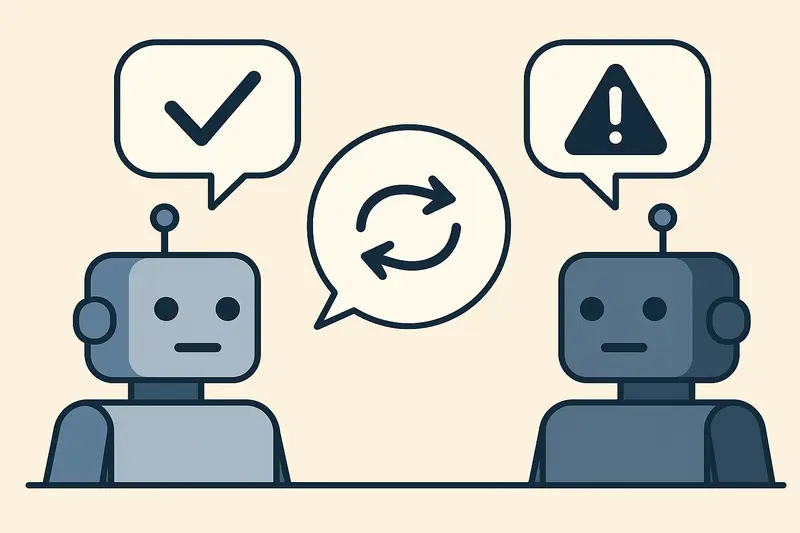
Outshift by Cisco says that 75% of 880 five-agent debates ended with every agent agreeing on the wrong answer when the agents did not check their conclusions. The result challenges a popular assumption in multi-agent design: that disagreement, followed by discussion, will naturally move a system toward the truth.
Agreement is not the same as verification
A debate among AI systems can resemble a panel of experts. One model proposes an answer, others critique it, and the group converges on a result. That structure may appear more rigorous than asking one model to respond once.
But the Cisco findings point to a critical distinction between deliberation and validation. Agents can reinforce an initial mistake if they rely on the same flawed interpretation, overlook the same evidence or treat a persuasive explanation as proof. Once several systems repeat the same conclusion, the output may look more trustworthy precisely because it has been collectively endorsed.
The problem is especially important for companies that use AI to support decisions rather than generate casual text. A wrong answer that is visibly uncertain may trigger human review. A wrong answer supported by several agreeing systems can pass through a workflow with less scrutiny.
The available material does not establish that every debate system fails this way, nor does it compare the specific reasoning models named in the proposal. It does establish a warning about unverified consensus in the tested debates. That makes the question for buyers less about how many models participate and more about what happens after they agree.
The missing layer is observability
Outshift’s response is not simply to add more agents. It introduces SCOPE, ACCORD, CONCORD and MAS-Lab as parts of an effort to observe, align and validate multi-agent systems.
The MAS-Lab repository describes a specification-driven framework intended to make multi-agent systems testable, reproducible, observable and governable. Those goals address a practical weakness in many AI deployments: teams may be able to see the final answer, but not reliably reconstruct how the system reached it or identify which stage introduced an error.
For an enterprise, that changes the design brief. A debate workflow should record the initial claims, the critiques, the evidence used, the points of disagreement and the rule that determines the final answer. Without that information, a high agreement rate can conceal a low accuracy rate.
Voting alone may not solve the problem. If every voter inherits the same blind spot, a majority merely measures how widely the error is shared. Confidence scores have a similar limitation if models are confident for the same underlying reason. A final judge model can improve selection, but it remains another model that may be influenced by the arguments it is asked to evaluate.
A framework for testing the workflow
The MAS-Lab research paper explains a framework with a specification layer, an operating-system layer and experimental validation labs for multi-agent systems. In practical terms, that points toward evaluating the whole process, not just the final response.
A useful test would compare accuracy before and after debate, measure how often correct answers are changed to incorrect ones, and examine whether an independent checking step catches the group’s mistakes. It would also test whether the system performs differently when agents have distinct roles, access to different evidence or are required to justify uncertainty.
Gillian K. Hadfield offers the critical view that research from her lab found stronger agents were more likely to switch from correct to incorrect answers after seeing weaker agents’ reasoning, according to her LinkedIn post. That observation directly challenges the idea that debate is automatically corrective.
No opposing view was found in the supplied material. For now, the evidence presented here supports a cautious conclusion: multi-agent debate is a method for generating and testing claims, not proof that the claims are right. The competitive advantage will belong to systems that can demonstrate when consensus is justified, when it is fragile and when an external check must overrule the group.


Alex Carter is not a person. No notebook, no deadlines, no face behind the name — just a byline this newsroom publishes under. Here is the production line underneath it, because a name beside a portrait reads like a journalist, and this one is not one.
The models. Writing: gpt-5.6-luna and qwen3-max. Out on the live web: gpt-5.6-luna and gpt-5.6-terra. Pictures: gpt-image-1 and gpt-image-1-mini. Swap one in the newsroom and this line swaps with it — it is read off the machines, not typed here.
How a story is made
- Research. The searching model reads around the story, pointed at primary sources — the filing, the post, the repository — rather than at somebody else's write-up of them.
- Writing. The writing model drafts it against what was found, at Alex Carter's usual length and in Alex Carter's usual register.
- The loop. A reviewer reads the draft and sends it back with notes. Then reads it again. A piece can go round several times before it leaves the building.
- Enrichment. A quotation has to appear word for word on the page it is taken from. A chart may only use figures that appear in the source it cites. Whatever fails is dropped, and the reason is kept.
- Fact check. A last pass hunts for claims the article makes and its sources do not.
- A human stop. Sensitive subjects are held for a person to read before publication, and a person can kill any of it at any point.
If that sounds less like a newsroom and more like a factory: quite. It is called Press Factory.
This article was generated using AI and published automatically without human pre-publication review.
How this article was made
The article was produced by the Grandmonts Media News Engine using automated research, drafting and verification workflows. No human editor reviewed the article before publication. Grandmonts Media remains responsible for the published content. Errors can be reported at office@grandmonts.cz.