
In a future data center, Apple silicon may sit inside racks instead of laptops, powering AI systems for companies that want quieter, more energy-efficient machines. A reported 2029 server project suggests Apple is considering a return to enterprise hardware, this time with artificial intelligence at the center.
From Mac hardware to AI infrastructure
Apple is reportedly developing an enterprise AI server built around future M-series Ultra chips, according to The Information in reporting cited by Ars Technica. The machine could arrive as soon as 2029, with configurations containing two or four M8 Ultra processors.
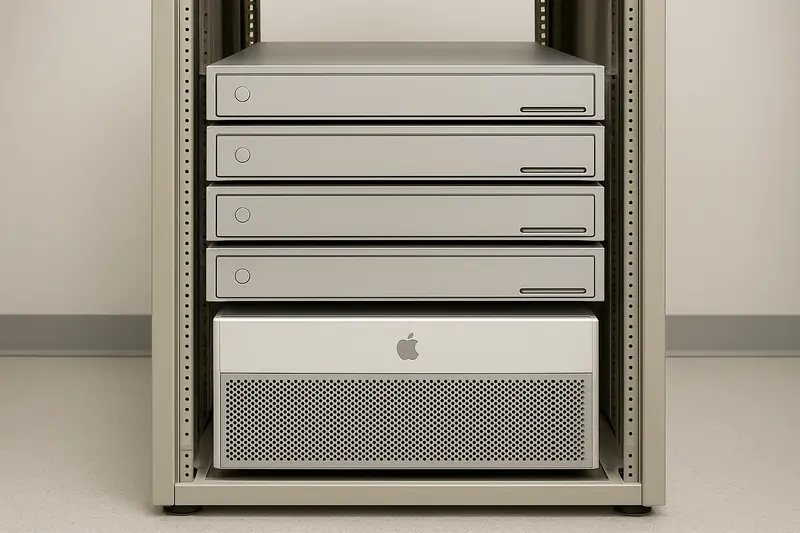
The plan is not final. Apple could cancel or change the project before it reaches customers. If it does launch, however, the system would mark a major shift for a company that left the server business after retiring its Xserve line in 2011.
The opportunity is already visible in an unusual place: the Mac aisle. AI developers and companies have reportedly been buying Mac minis and Mac Studios in significant numbers for workloads such as model experimentation and reinforcement learning. Those machines offer capable Apple silicon in relatively compact, power-efficient designs, making them useful when access to traditional data center accelerators is limited or expensive.
A dedicated server would allow Apple to turn that improvised demand into a formal platform. Instead of placing stacks of desktop computers in a lab, companies could deploy hardware designed for rack environments, with centralized management and enterprise support.
Nvidia technology, Apple ambitions
The reported project may also involve Nvidia data center networking technology, including NVLink Fusion, to connect multiple M8 chips. That possibility is notable because it would combine Apple’s tightly integrated, ARM-based processors with infrastructure associated with Nvidia’s AI ecosystem.
Apple would not necessarily be trying to replace Nvidia’s largest GPU clusters. Its more realistic target could be inference, specialized training and development workloads where energy use, system size and predictable performance matter as much as maximum computing power.
The harder challenge may be everything around the chip. Enterprise buyers need mature software tools, fast networking, serviceable racks, reliable memory supplies and long-term procurement guarantees. Apple would also need to persuade companies that its platform can fit into existing data center operations, rather than function as a powerful but isolated version of a Mac.
A continuing shortage of memory components, driven partly by the global AI construction boom, could further complicate costs and availability. Still, the report points to a larger question: Apple’s AI strategy may eventually extend beyond devices people carry and into the infrastructure that teaches, serves and manages the next generation of intelligent systems.

This article was written with the assistance of an AI system and published automatically.