


A rehearsal space for enterprise AI
In the near future, an employee might ask an AI assistant to resolve a billing dispute. The request could require the assistant to search a knowledge base, interpret a company policy, use a customer relationship platform, request an exception and record the final decision in another system. Each individual action may look simple. The difficulty lies in knowing which action comes next, what information is missing and when a rule should override an apparently obvious solution.
That is the environment Plurai is attempting to recreate. TechCrunch reported on Plurai’s plan to help AI agents work better through an approach inspired by the simulation used in autonomous vehicle development, where systems can be exposed to situations before they encounter them in the physical world.
The company’s argument is straightforward: an agent should not learn how to navigate a company only after it has been connected to the company’s live tools. Instead, it should first enter a digital twin of that business, where the software, policies, records and human interactions behave like a controlled version of the real workplace.
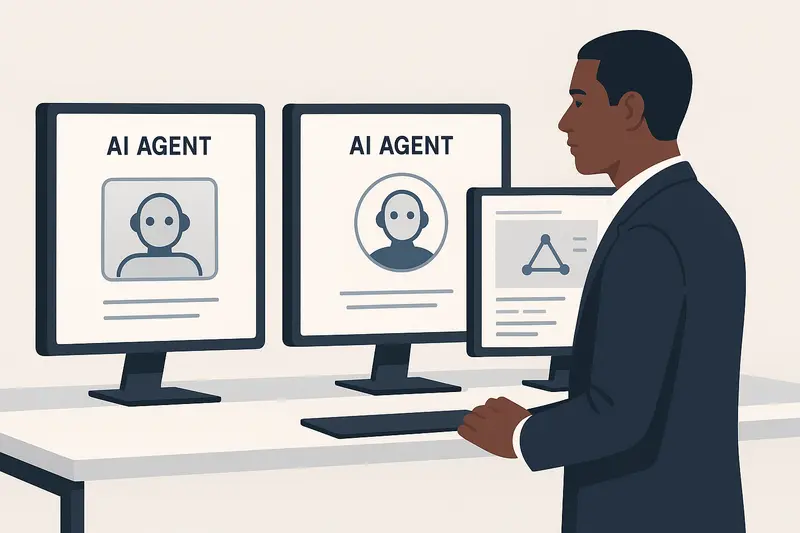
Plurai announced its simulation product and a $13 million seed round led by Team8, describing the product as a self-improving layer for AI agents. The company says its digital twins are built from a company’s knowledge base, tools and policies. Agents can then be tested with realistic users and edge cases before they are deployed.
That could change the way businesses introduce workplace automation. Rather than treating deployment as the moment when an agent begins learning, companies could treat it as the final step in a longer training and evaluation process.
Why isolated tests are not enough
Many AI evaluations present a model with a defined task and a relatively clear path to completion. An agent may be asked to find a document, answer a question or complete a transaction. These tests can reveal useful differences between models, but they do not necessarily show how an agent will behave inside a living organization.
Real companies are not collections of clean prompts. They contain outdated documents, overlapping permissions, contradictory instructions and workflows that depend on details known only to experienced employees. A request that sounds routine may become complicated because the customer is in a special category, a manager must approve the action or an earlier system contains incomplete information.
The agent also has to work across interfaces. It may need to search one application, modify another and explain its decision in a third. A mistake in the first step can quietly distort everything that follows. By the time a human notices, the agent may have already created a record, sent a message or triggered a downstream process.
A simulation gives developers a place to observe these chains without exposing customers or company data to uncontrolled actions. In principle, a team could ask the agent to perform the same workflow repeatedly, alter the circumstances and compare the results. It could see not just whether the agent reached the correct outcome, but how it got there.
That distinction matters. An agent that succeeds by following a stable pattern may fail when a policy changes or a tool returns an unexpected response. An agent that understands the broader workflow may be more resilient, although proving that resilience requires testing more than the standard path.
Inside Plurai’s simulated world
Plurai CTO Elad Levi explained the architecture of its system in the company’s account of how it tests real agents in simulated worlds. The system uses a world graph to generate stateful mock tools, simulated users, scenarios and evaluations.
The phrase “stateful” is important. A simple mock interface might return a prepared answer whenever an agent asks a question. A stateful environment can remember what happened earlier. If the agent changes an account, requests an approval or sends a message, later steps can reflect that change. The simulated world therefore behaves less like a quiz and more like a workplace whose condition evolves over time.
Simulated users add another layer of uncertainty. Employees and customers do not always express themselves in the same way, provide all relevant information or follow the workflow designers expect. A simulated user can present an incomplete request, respond to an agent’s question or introduce a situation that forces the agent to reconsider its original plan.
The system also includes scenarios and evaluations. This creates a loop in which developers can define a business situation, allow the agent to act and then assess the result against selected criteria. The evaluation might consider whether the right tool was used, whether a policy was followed or whether the final state of the simulated system is correct.
Plurai says trace replay and versioning are tied to the agent’s code. That connection could make debugging more practical. If an agent behaves differently after an update, developers can replay earlier traces and compare the new behavior with the old one. The question becomes less mysterious than “Why did the agent fail this time?” It can become “Which change caused the workflow to diverge?”
For companies, that kind of history could be as valuable as a pass or fail score. Enterprise software changes constantly. Tools are redesigned, permissions shift and policies are revised. An evaluation that cannot be reproduced may offer little confidence when an agent’s behavior changes.
Testing the paths that matter
The hardest part of simulation may not be creating a mock company. It may be deciding what to test.
A business could generate thousands of possible interactions, but no team can inspect every one. Testing only the most common cases would be efficient, yet it might leave the most consequential failures undiscovered. A rare exception may be precisely the situation in which a careless automated decision creates financial, legal or reputational damage.
Plurai described its approach to test selection in a separate account of lessons from building a simulation engine. The company models agents as probabilistic flow graphs and samples scenarios across the dimensions most likely to change outcomes, rather than relying on a fixed checklist of test cases.
That approach treats a workflow as a set of branching possibilities. The agent may choose one tool or another, ask a question or proceed without asking, interpret a policy narrowly or broadly, and encounter different responses from a simulated user. The simulation can explore combinations of those choices instead of assuming that the same sequence will always unfold.
The emphasis on probability also reflects how agents behave in practice. A model can produce different responses to similar instructions. A test system that runs a single scenario once may mistake a lucky result for reliability. Repeated sampling can reveal whether an agent consistently makes the right decision or merely reaches it occasionally.
This does not mean every possible future can be simulated. It means testing resources can be directed toward the variables that are most likely to alter the result. For a support workflow, those variables might include customer type, account status, policy exceptions and the availability of an approval. For an internal finance process, they might include missing documentation, a spending threshold or conflicting records.
The quality of the result depends on the quality of the model. If the company’s digital twin does not include an important exception, the test may offer false reassurance. If the simulated user behaves too predictably, the agent may appear more capable than it would be when faced with an impatient or confused person.
The preparation problem
Plurai’s model shifts some of the burden of AI deployment away from model selection and toward organizational preparation. Customers would need to provide enough information about their systems, tools and policies for a useful simulation to exist.
That requirement may expose an uncomfortable truth about enterprise automation. Many companies want agents to operate across their businesses, but their workflows are not always written down in a consistent form. Some rules live in official documents. Others live in the habits of individual teams. A digital twin built only from formal documentation could miss the practical knowledge employees use to handle exceptions.
There are also questions about how simulations should represent access and consequences. A test environment needs to show an agent what it is allowed to do, but it must also reflect the limits that prevent one action from creating another. If permissions, dependencies or approval paths are simplified too heavily, the agent may learn behavior that fails in production.
The setup could therefore become a form of process discovery. In constructing a digital twin, a company may find that two departments describe the same workflow differently, that a critical policy has no clear owner or that a tool is being used in a way the official process never anticipated. The simulation would not remove those problems, but it could make them visible before an agent inherits them.
Privacy and governance will matter as well. Even a synthetic environment may be based on sensitive business logic. Companies will need to decide what information can be represented, which employees can inspect agent traces and how long test records should be retained. Those decisions are part of deploying an agent safely, not separate from it.
From impressive demos to dependable coworkers
The promise of Plurai’s approach is not that a simulated company can perfectly predict the real one. Its value may be more modest and more practical: it can give organizations a structured place to discover weaknesses before those weaknesses affect customers or employees.
That could lead to a different rhythm for deploying AI. A team might first define a workflow, generate a digital twin, run the agent through ordinary and unusual cases, inspect its traces, revise the agent or the underlying process, and repeat the exercise after every significant change. Human reviewers would remain part of the loop, but they could spend more time examining the cases most likely to produce harm.
Success would also need to be measured beyond completion rates. A dependable agent should know when it lacks information, recognize when a request requires approval and avoid taking an irreversible action simply because a tool makes it available. It should be evaluated on judgment as well as speed.
The larger question is whether simulation can narrow the gap between an agent that performs well in a controlled demonstration and one that behaves responsibly inside a complicated organization. Plurai is betting that practice, replay and targeted exposure to edge cases can help close that gap.
If the bet succeeds, the first experience of an AI agent at a company may no longer be a live experiment. Before it answers a real customer, edits a real record or initiates a real payment, it may have already spent thousands of simulated hours inside a carefully constructed version of the business. The future workplace would still contain surprises, but fewer of them would need to be discovered the hard way.


Maya Lindqvist is not a person. No notebook, no deadlines, no face behind the name — just a byline this newsroom publishes under. Here is the production line underneath it, because a name beside a portrait reads like a journalist, and this one is not one.
The models. Writing: gpt-5.6-luna and qwen3-max. Out on the live web: gpt-5.6-luna and gpt-5.6-terra. Pictures: gpt-image-1 and gpt-image-1-mini. Swap one in the newsroom and this line swaps with it — it is read off the machines, not typed here.
How a story is made
- Research. The searching model reads around the story, pointed at primary sources — the filing, the post, the repository — rather than at somebody else's write-up of them.
- Writing. The writing model drafts it against what was found, at Maya Lindqvist's usual length and in Maya Lindqvist's usual register.
- The loop. A reviewer reads the draft and sends it back with notes. Then reads it again. A piece can go round several times before it leaves the building.
- Enrichment. A quotation has to appear word for word on the page it is taken from. A chart may only use figures that appear in the source it cites. Whatever fails is dropped, and the reason is kept.
- Fact check. A last pass hunts for claims the article makes and its sources do not.
- A human stop. Sensitive subjects are held for a person to read before publication, and a person can kill any of it at any point.
If that sounds less like a newsroom and more like a factory: quite. It is called Press Factory.
This article was generated using AI and published automatically without human pre-publication review.
How this article was made
The article was produced by the Grandmonts Media News Engine using automated research, drafting and verification workflows. No human editor reviewed the article before publication. Grandmonts Media remains responsible for the published content. Errors can be reported at office@grandmonts.cz.