


The strategic question surrounding Large 4 is not simply whether Mistral has built a large and capable model. It is whether open weights can deliver the control that governments and companies increasingly want without shifting the cost and complexity of AI onto the buyer.
That distinction matters. A closed API lets an organization rent intelligence from a provider. An open-weight model promises something closer to ownership. It can be inspected, adapted and deployed on infrastructure chosen by the customer. It may also reduce dependence on American cloud platforms and give European institutions more control over sensitive data.
But those benefits are conditional. A model is not sovereign merely because its weights are available. Customers still need the hardware, engineering talent, security processes and support required to turn those weights into a dependable production system. Large 4 will therefore test both Mistral’s technology and the practical meaning of sovereign AI.
A model built around control

In its October 6 announcement, Mistral introduced Large 4 as a one-trillion-parameter natively multimodal open-weight model, with weights scheduled for release by the end of October. The company presents it as a general-purpose system for coding, cybersecurity, finance, manufacturing and visual grounding.
The model is designed to process text and visual information natively rather than treating image capabilities as a separate add-on. That positioning reflects how enterprise AI is evolving. In a factory, a useful system may need to interpret a technical diagram, read an inspection image and generate code or instructions. In finance, it might combine documents, charts and structured information. In cybersecurity, it could examine logs, diagrams and written incident reports within the same workflow.
Mistral says Large 4 has roughly one trillion total parameters, with only a fraction active for any individual request. Its announcement describes 49 billion active parameters and training on 4,000 Nvidia Grace Blackwell GPUs. The architecture is a mixture-of-experts design, meaning the system can route each input to selected parts of the larger network instead of activating every parameter at once.
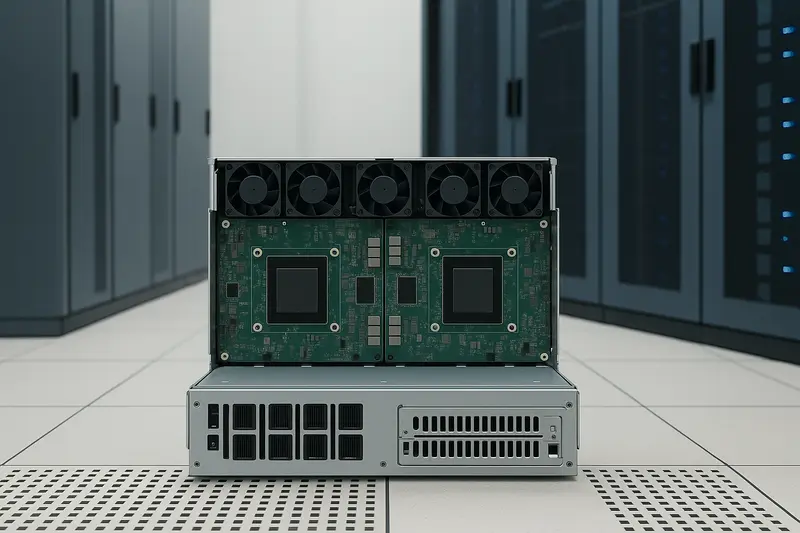
That distinction is central to the business case. A one-trillion-parameter model sounds prohibitively expensive to run, but sparse activation can reduce the computational work required for each response. It does not make the model cheap. Memory, networking, storage and serving infrastructure remain substantial concerns. It does, however, allow Mistral to argue that Large 4 can combine very large model capacity with more manageable inference costs.
Mistral’s model documentation lists slightly different figures. Mistral’s documentation describes Large 4 as an open-weight multimodal mixture-of-experts model with 1.05 trillion total parameters and 52 billion active parameters. It also lists a 1.6-billion-parameter vision encoder, a one-million-token context window and API pricing.
The differences between the announcement and the documentation are not necessarily evidence of a fundamental contradiction. They may reflect updated specifications or different ways of counting components. Still, they highlight why open-weight releases matter. Once independent developers can inspect the model and run it outside Mistral’s hosted environment, the market can assess what the system actually contains and how it behaves under real workloads.
That scrutiny is especially important because Mistral is selling more than performance. It is selling an alternative governance model.
The promise of sovereign AI
The phrase “sovereign AI” has become a shorthand for reducing dependence on foreign technology providers. In practice, it can mean several things: keeping sensitive data inside a national or organizational boundary, controlling where models are hosted, retaining the ability to customize systems, and avoiding the risk that a provider changes prices or access rules.
Open weights address some of those concerns. A company that downloads the model can, in principle, deploy it on its own infrastructure or through a trusted local partner. It can adapt the model to internal terminology and processes. It can also continue operating if a hosted API becomes unavailable or commercially unattractive.
This is a meaningful difference from a closed service. With an API, customers usually receive access to a model, not control over its underlying behavior. They must accept the provider’s retention policies, service limits, pricing and update schedule. An open-weight model offers more room to set those conditions locally.
Yet the word “open” can obscure the practical burden. Weights are only one component of an AI system. A large model still requires specialized accelerators, high-bandwidth networking, software optimization, monitoring, safety testing and ongoing maintenance. The organization that deploys it becomes responsible for those tasks.
For governments and large enterprises, that burden may be acceptable because control has strategic value. A defense contractor, hospital network or public agency may prefer to pay for infrastructure rather than send sensitive information to an external service. Smaller companies may reach a different conclusion. For them, the hosted API can remain cheaper and simpler even if it offers less control.
Large 4 therefore puts a sharper question to the sovereign AI movement. Is sovereignty measured by the legal ability to possess model weights, or by the economic ability to operate them reliably? If the answer is the latter, access to cutting-edge hardware becomes as important as access to the model itself.
The benchmark dispute
Mistral’s own presentation emphasizes Large 4’s capabilities across professional tasks. But the model’s reception has been shaped by comparisons with both American and Chinese systems.
Tom’s Hardware reported that Artificial Analysis ranked Large 4 highly among models outside the United States and China. The publication also reported that Chinese open models performed better overall and that Large 4 cost more per benchmark task than comparable open-weight models.
That result is awkward for Mistral’s positioning. Large 4 may represent a strong European response to the American model leaders, but “best outside the United States and China” is not the same as being the global leader. It suggests that Mistral has narrowed a regional gap without eliminating the competitive advantage held by larger ecosystems.
The cost finding matters just as much as the ranking. If an open model requires more money to complete comparable benchmark tasks, its users may gain control while losing efficiency. A government may accept that tradeoff for security or autonomy. A commercial developer choosing between models is more likely to ask whether the extra cost produces better results in a real application.
Frandroid offered a more critical interpretation. Frandroid compared Mistral’s launch charts with results from Artificial Analysis and Vals.ai, arguing that Large 4 sits in the middle of the broader field and trails leading closed and Chinese models on several tests. It also argued that Mistral’s presentation selectively emphasized favorable comparisons.
That criticism goes to the heart of the announcement. Benchmark selection can shape the perceived position of a model without falsifying any individual result. A system may excel at coding or visual grounding while remaining less impressive in reasoning, instruction following, factuality or cost efficiency. Companies naturally highlight their strongest categories. Buyers, however, need to know how those strengths map onto their own workloads.
The disagreement between Mistral’s presentation and independent evaluations should not be treated as a minor communications issue. It is a test of whether open models can earn trust through reproducibility. If developers can download Large 4, run the same evaluations and inspect the conditions, claims become easier to verify. If results vary substantially across hardware, prompts or serving configurations, the market will need a more careful understanding of what “performance” means.
Open weights do not erase concentration
There is also a wider irony in Mistral’s strategy. Open weights are meant to reduce dependence on a small group of closed providers, but the development of a model at this scale still depends on concentrated access to advanced computing. Mistral’s reported use of 4,000 Grace Blackwell GPUs demonstrates the infrastructure required to compete at the frontier.
That creates two different forms of concentration. Closed models concentrate control in the company that owns the service. Open models can distribute control after release, but training and operating them may remain concentrated among organizations with enough capital and hardware.
Large 4 could still broaden the market. A university, national laboratory or regional cloud provider does not need to reproduce Mistral’s training run to benefit from the released weights. Developers can fine-tune the model, build specialized tools around it or deploy it in environments where sending data to an external API is unacceptable.
However, customization is not free. Fine-tuning consumes compute. Evaluation requires expertise. Deployment requires a team capable of maintaining reliability and security. Enterprise support may ultimately come from Mistral or another vendor, which means open weights can create new commercial dependencies even as they weaken older ones.
The most realistic outcome is therefore not a clean replacement of closed APIs. The market is likely to divide by use case. Closed services will remain attractive where convenience, rapid updates and predictable support matter most. Open-weight models will gain ground where data control, local deployment and customization justify higher operational costs.
The real test begins after release
Large 4’s release will be more important than its preview. Until outside developers can inspect the weights and run the model, most claims remain claims from the company that built it. The release should make it possible to evaluate the system on private infrastructure, compare serving costs and test whether its visual and coding capabilities transfer to practical applications.
Mistral will also need to show that it can support an ecosystem rather than simply publish a large file. Documentation, deployment tools, safety guidance and stable access can determine whether enterprises adopt an open model. A technically impressive model that is difficult to operate may remain a demonstration rather than a platform.
The benchmark disagreement makes that ecosystem especially important. Tom’s Hardware’s account suggests that Large 4 is a significant non-American and non-Chinese competitor. Frandroid’s analysis suggests that Mistral’s public framing may be more flattering than the wider evidence. Both views can be true if the model is strong in selected areas but not dominant overall.
That is why Large 4’s significance extends beyond its parameter count. Mistral is asking the market to believe that openness can be a strategic advantage, not merely a licensing choice. The answer will depend on whether users can achieve meaningful control at an acceptable cost.
If they can, Large 4 could strengthen Europe’s case for sovereign AI and give organizations a credible alternative to closed APIs. If they cannot, open weights may prove to be only partial sovereignty, with the most expensive parts of the AI stack still controlled by a small number of hardware and infrastructure providers. The model’s real test will begin when developers are free to find out.
- VulcanSphere · Public domain


Alex Carter is not a person. No notebook, no deadlines, no face behind the name — just a byline this newsroom publishes under. Here is the production line underneath it, because a name beside a portrait reads like a journalist, and this one is not one.
The models. Writing: gpt-5.6-luna and qwen3-max. Out on the live web: gpt-5.6-luna and gpt-5.6-terra. Pictures: gpt-image-1 and gpt-image-1-mini. Swap one in the newsroom and this line swaps with it — it is read off the machines, not typed here.
How a story is made
- Research. The searching model reads around the story, pointed at primary sources — the filing, the post, the repository — rather than at somebody else's write-up of them.
- Writing. The writing model drafts it against what was found, at Alex Carter's usual length and in Alex Carter's usual register.
- The loop. A reviewer reads the draft and sends it back with notes. Then reads it again. A piece can go round several times before it leaves the building.
- Enrichment. A quotation has to appear word for word on the page it is taken from. A chart may only use figures that appear in the source it cites. Whatever fails is dropped, and the reason is kept.
- Fact check. A last pass hunts for claims the article makes and its sources do not.
- A human stop. Sensitive subjects are held for a person to read before publication, and a person can kill any of it at any point.
If that sounds less like a newsroom and more like a factory: quite. It is called Press Factory.
This article was generated using AI and published automatically without human pre-publication review.
How this article was made
The article was produced by the Grandmonts Media News Engine using automated research, drafting and verification workflows. No human editor reviewed the article before publication. Grandmonts Media remains responsible for the published content. Errors can be reported at office@grandmonts.cz.