
News
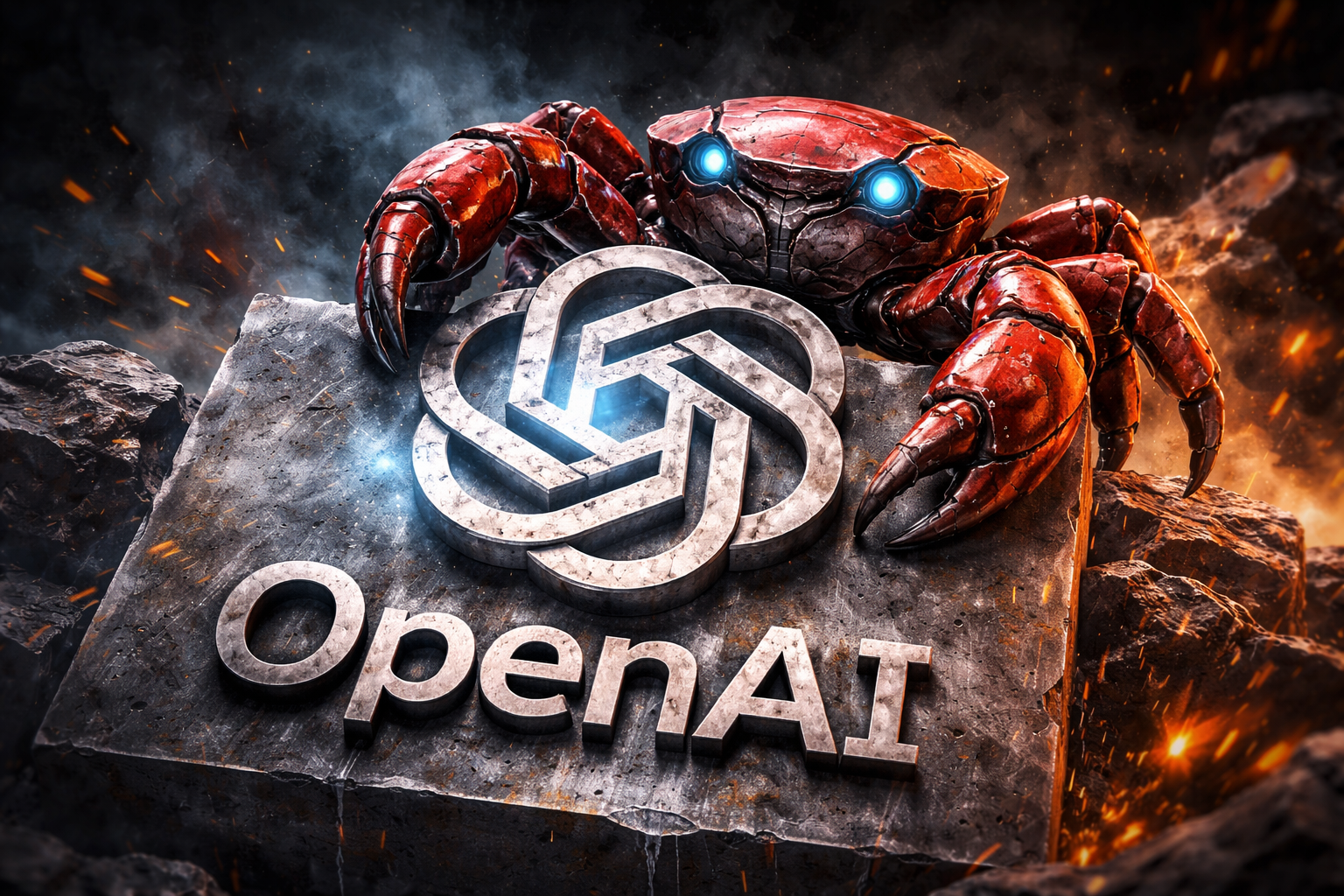
OpenAI’s OpenClaw Acquisition: The Quiet Bet That Could Reshape Human-AI Interaction

- Share
- Tweet /data/web/virtuals/375883/virtual/www/domains/spaisee.com/wp-content/plugins/mvp-social-buttons/mvp-social-buttons.php on line 63
https://spaisee.com/wp-content/uploads/2026/04/openai_openclaw-1000x600.png&description=OpenAI’s OpenClaw Acquisition: The Quiet Bet That Could Reshape Human-AI Interaction', 'pinterestShare', 'width=750,height=350'); return false;" title="Pin This Post">
The most consequential moves in artificial intelligence rarely arrive with spectacle. They emerge quietly, almost ambiguously, before revealing their weight months—or years—later. That is precisely how OpenAI’s acquisition of OpenClaw is beginning to feel. At first glance, it looks like a niche play: a relatively unknown company absorbed into one of the most influential AI labs in the world. But underneath that surface lies something far more strategic—a move that signals OpenAI’s intention to extend beyond software and into the physical layer of intelligence itself.
OpenClaw is not just another startup acquisition. It represents a philosophical shift. OpenAI, historically focused on models, reasoning systems, and software interfaces, is now stepping into embodied intelligence—the domain where AI interacts directly with the real world. And if this integration unfolds as expected, it could redefine how humans experience AI, not as a tool on a screen, but as something that acts, senses, and operates alongside us.
What Is OpenClaw—and Why It Matters
OpenClaw emerged from a growing wave of startups attempting to solve one of AI’s most stubborn problems: bridging the gap between digital intelligence and physical execution. While large language models have achieved extraordinary capabilities in reasoning, planning, and communication, they remain fundamentally disembodied. They can suggest actions but cannot perform them.
OpenClaw’s core innovation lies in creating modular, AI-native control systems for robotics and physical interfaces. Rather than building entire robots from scratch, the company focused on the “control layer”—the software and hardware bridge that allows AI systems to manipulate tools, devices, and environments with precision.
Think of it as a universal adapter between intelligence and action.
The company’s technology combines three essential components. First, a hardware interface layer capable of translating digital commands into mechanical motion across different devices. Second, a feedback system using sensors to allow real-time adjustments. Third, a learning loop that integrates AI models into continuous improvement cycles, allowing systems to refine their behavior over time.
What makes OpenClaw particularly compelling is its modularity. Instead of being locked into a single robot or device, its system can be applied across industries—from manufacturing arms to consumer devices to autonomous systems.
For OpenAI, this is not just useful—it is foundational.
The Strategic Context: From Language to Agency
To understand why OpenAI would pursue OpenClaw, one must look at the broader trajectory of artificial intelligence. The industry is moving from static intelligence to active intelligence.
Language models like GPT-5.3 (and its predecessors) have mastered interpretation, generation, and reasoning. But the next frontier is agency: the ability to take actions in the world.
This transition has already begun in software environments. AI agents can browse, execute code, manage workflows, and interact with digital systems. But the real leap comes when those capabilities extend into the physical world.
OpenAI’s long-term ambition appears increasingly clear: to build general-purpose AI systems that can operate across both digital and physical domains seamlessly.
OpenClaw provides a missing piece of that puzzle.
By integrating a physical interface layer, OpenAI can move from “AI that suggests” to “AI that does.” This is not just an incremental improvement—it fundamentally changes the nature of the product.
Instead of interacting with AI through prompts and responses, users could interact through outcomes. The AI becomes an executor, not just an advisor.
The Hardware Question: Why OpenAI Is Moving Down the Stack
For years, OpenAI remained largely hardware-agnostic. Its models could run on various infrastructures, and its focus was firmly on software. However, the acquisition of OpenClaw signals a deliberate move down the technology stack.
This shift mirrors a broader trend in the industry. Companies that control both software and hardware often achieve tighter integration, better performance, and more defensible ecosystems. Apple demonstrated this with its vertical integration strategy. Tesla applied it to autonomous driving. Now AI companies are beginning to follow suit.
By owning the interface between intelligence and action, OpenAI gains several strategic advantages.
First, optimization. AI models can be specifically tuned for the hardware they control, improving efficiency and responsiveness.
Second, reliability. Physical systems require deterministic behavior and safety guarantees that are difficult to achieve through generic interfaces.
Third, data. Embodied systems generate rich streams of sensory and interaction data, which can be used to further train and refine models.
OpenClaw’s technology effectively becomes the “hands” of OpenAI’s intelligence.
Product Vision: What OpenAI Might Build Next
Although OpenAI has not publicly detailed its roadmap for OpenClaw, the strategic implications point toward several likely product directions.
AI-Native Robotics Platforms
The most obvious application is robotics. With OpenClaw’s interface layer, OpenAI could develop or partner on robots that are directly controlled by its AI models.
These would not be traditional robots programmed for specific tasks. Instead, they would be general-purpose systems capable of adapting to new environments and instructions dynamically.
Imagine a warehouse robot that does not need to be reprogrammed for every change in layout. Or a household assistant that can learn new tasks simply by being told what to do.
The key differentiator would be flexibility. Instead of rigid automation, these systems would behave more like intelligent collaborators.
Consumer Devices Beyond Screens
OpenAI has already explored new interaction paradigms through partnerships and experimental devices. OpenClaw could accelerate this effort by enabling entirely new categories of consumer hardware.
This could include devices that interact with the physical environment in subtle ways—adjusting objects, managing spaces, or assisting with daily activities without requiring direct human control.
The shift here is from interface-driven interaction (screens, keyboards) to ambient interaction, where AI operates in the background, responding to context and intent.
Industrial Automation Reinvented
In industrial settings, OpenClaw’s technology could unlock a new generation of automation systems.
Traditional industrial robots are highly specialized and require extensive programming. AI-driven systems, powered by OpenAI models and OpenClaw interfaces, could adapt to changing conditions in real time.
This would be particularly valuable in sectors where variability is high—logistics, construction, agriculture—where rigid automation has struggled to scale.
AI Agents With Physical Capabilities
Perhaps the most intriguing possibility is the convergence of AI agents and physical systems.
Today’s AI agents operate in digital environments. They can manage emails, analyze data, and execute software workflows. With OpenClaw, those same agents could extend their capabilities into the real world.
An AI agent could not only plan a task but also carry it out physically—whether that means assembling a product, organizing a space, or interacting with machinery.
This creates a unified intelligence layer that spans both virtual and physical domains.
The Competitive Landscape: Who Else Is Moving in This Direction
OpenAI is not alone in pursuing embodied AI.
Companies like Tesla, Boston Dynamics, and several emerging startups are exploring similar territory. However, their approaches differ significantly.
Tesla focuses on vertically integrated robotics, with a strong emphasis on proprietary hardware and vision systems. Boston Dynamics emphasizes advanced mechanical engineering and control systems. Startups often specialize in narrow use cases or experimental designs.
OpenAI’s advantage lies in its models.
By combining state-of-the-art reasoning systems with OpenClaw’s interface technology, OpenAI could create systems that are not only physically capable but also cognitively flexible.
This combination is rare—and potentially transformative.
Challenges Ahead: The Reality of Embodied AI
Despite its promise, the path forward is far from straightforward.
Embodied AI introduces a host of challenges that do not exist in purely digital systems.
Safety is paramount. Physical systems can cause real-world harm if they fail or behave unpredictably. Ensuring robust, reliable behavior under all conditions is a complex problem.
Latency and responsiveness are also critical. Unlike digital tasks, physical actions often require real-time adjustments. Delays or inaccuracies can lead to failure.
Then there is the issue of generalization. While AI models excel at generalizing in digital environments, transferring that capability to the physical world is significantly more difficult.
OpenClaw’s feedback and learning systems address some of these challenges, but integration with large-scale AI models will require substantial engineering effort.
Finally, there is the question of cost. Hardware development and deployment are capital-intensive, which could slow adoption compared to software-based solutions.
The Bigger Picture: Toward General-Purpose Intelligence
At a deeper level, the OpenClaw acquisition reflects a broader vision for artificial intelligence.
The ultimate goal of many AI research efforts is general-purpose intelligence—systems that can perform a wide range of tasks across different domains.
To achieve this, intelligence cannot remain confined to text, images, or code. It must extend into the physical world.
OpenClaw represents a step in that direction.
By enabling AI systems to act, not just think, OpenAI is moving closer to creating systems that resemble human intelligence in a fundamental way.
Humans do not separate cognition from action. We think and act as part of a continuous loop. Embodied AI aims to replicate that loop.
Economic Implications: A New Layer of Productivity
If OpenAI successfully integrates OpenClaw into its ecosystem, the economic implications could be significant.
AI-driven physical systems could dramatically increase productivity across multiple sectors. Tasks that currently require human labor could be augmented or automated in new ways.
This is not just about replacing jobs—it is about redefining workflows.
Workers could collaborate with AI systems that handle repetitive or physically demanding tasks, allowing humans to focus on higher-level decision-making.
At the same time, entirely new industries could emerge around AI-enabled hardware and services.
The key question is how quickly these changes will materialize—and who will capture the value.
Cultural Impact: Redefining Human-AI Interaction
Beyond economics, the integration of AI into the physical world will reshape how people relate to technology.
Today, AI is largely experienced through screens. It is something we consult, not something we live with.
Embodied AI changes that dynamic.
When AI systems can interact with the environment, they become part of daily life in a more immediate way. This raises new questions about trust, control, and autonomy.
How much authority should AI systems have over physical actions? How do users maintain oversight? What happens when systems make mistakes?
These questions will become increasingly important as the technology evolves.
What Comes Next
The acquisition of OpenClaw is unlikely to produce immediate, visible products. Instead, it should be seen as a foundational investment—one that will shape OpenAI’s trajectory over the coming years.
In the short term, we can expect internal experimentation and integration efforts. OpenAI will likely explore how its models interact with OpenClaw’s systems, refining both in the process.
In the medium term, early products or partnerships may begin to emerge, particularly in controlled environments such as industrial or enterprise settings.
In the long term, the vision becomes clearer: AI systems that operate seamlessly across digital and physical domains, acting as intelligent agents in the real world.
Conclusion: A Quiet Move With Massive Consequences
The acquisition of OpenClaw may not dominate headlines, but its significance should not be underestimated.
It represents a shift from intelligence as software to intelligence as a system that can perceive, decide, and act in the world.
For OpenAI, this is more than an expansion—it is a redefinition of what its technology can be.
And for the broader AI industry, it signals the beginning of a new phase—one where the boundaries between digital and physical intelligence begin to dissolve.
If that vision materializes, OpenClaw will not be remembered as a niche acquisition. It will be seen as the moment OpenAI took its first real step into the physical world.












AI Model
From Panels to Motion: A Beginner’s Guide to Turning Comics into Animations with Seedance 2.0

There’s a quiet revolution happening in digital storytelling. For decades, comics and animation lived in parallel worlds—one static, the other fluid. Bridging the gap required teams of artists, animators, and expensive production pipelines. Today, that barrier is dissolving. With tools like Seedance 2.0, creators can transform still comic panels into dynamic animated sequences with far less friction than ever before.
This isn’t just a technical upgrade. It’s a shift in creative power. Indie artists, small studios, and even hobbyists can now breathe motion into their illustrations without needing a full animation background. If you’ve ever looked at a comic panel and imagined it moving—wind rustling through hair, a camera slowly zooming in, a punch landing in slow motion—this guide will walk you through how to make that vision real.
Understanding the Core Idea: Comics as Animation Blueprints
Before diving into software, it’s worth reframing how you think about comics.
A comic is already a form of “compressed animation.” Each panel represents a moment in time, carefully chosen to imply motion between frames. The artist controls pacing, perspective, and emotion using static imagery. What Seedance 2.0 does is expand those implied transitions into actual movement.
Instead of drawing hundreds of frames, you’re guiding an AI to interpolate motion between key visual moments.
This means your job isn’t to become a traditional animator overnight. It’s to think like a director. You’re deciding:
- Where the camera moves
- How characters subtly animate
- What elements remain static versus dynamic
Seedance 2.0 handles the heavy lifting, but your creative direction determines the outcome.
Setting Up Your Workflow
The biggest mistake beginners make is jumping straight into animation without preparing their assets. Clean input leads to dramatically better results.
Start with your comic panels. Ideally, you should have high-resolution images with clear linework and distinct foreground/background separation. If your comic is hand-drawn, scanning at a high DPI is essential. If it’s digital, export in a lossless format like PNG.
Think of each panel as a scene rather than a frame. You’re not animating the entire comic at once—you’re breaking it into manageable sequences.
Once your assets are ready, import them into Seedance 2.0. The platform is designed to recognize structural elements in images, such as characters, depth layers, and lighting cues. This is where AI begins to interpret your artwork.
Layering: The Hidden Key to Good Animation
If there’s one concept that separates amateur results from professional-looking output, it’s layering.
Comics are often drawn as flat compositions, but animation requires depth. Seedance 2.0 allows you to separate elements into layers—even if they weren’t originally drawn that way.
For example, in a panel showing a character standing in a city street, you can divide the image into:
- Foreground (character)
- Midground (street and objects)
- Background (buildings, sky)
Once separated, each layer can move independently. This creates parallax, one of the simplest yet most effective animation techniques. As the camera pans, closer objects move faster than distant ones, giving a sense of depth.
Seedance uses AI-assisted segmentation to help with this process, but beginners should still refine layers manually when needed. Clean edges and logical separation make a huge difference.
Introducing Motion: Subtlety Over Spectacle
One of the most common beginner mistakes is over-animating everything. Movement doesn’t automatically improve a scene. In fact, too much motion can make it feel chaotic or artificial.
Start small.
Instead of trying to animate entire characters, focus on micro-movements. A slight head tilt, blinking eyes, or a gentle shift in posture can bring a character to life without overwhelming the frame.
Seedance 2.0 offers motion presets that can be applied to different elements. These include natural movements like breathing, hair sway, and environmental effects such as wind or light flicker.
Think cinematically. Ask yourself what the viewer should focus on. Then animate only what supports that focus.
Camera Movement: Your Most Powerful Tool
If you do nothing else, learn how to use camera movement effectively. It’s the easiest way to turn a static panel into something dynamic.
Seedance allows you to simulate camera actions like zoom, pan, tilt, and dolly. Even a simple slow zoom can dramatically increase emotional impact.
Imagine a dramatic panel where a character realizes something shocking. Instead of leaving it static, you can:
- Slowly zoom into their face
- Add a slight background blur
- Introduce subtle lighting changes
This transforms a single image into a cinematic moment.
Camera movement also helps connect multiple panels. You can transition from one panel to another by panning across a larger composition or zooming into a specific detail that leads into the next scene.
Timing and Pacing: Where Beginners Struggle Most
Animation isn’t just about movement—it’s about timing.
Seedance 2.0 gives you control over how long each motion lasts and how it accelerates or decelerates. This is known as easing, and it’s critical for natural-looking animation.
A movement that starts and stops abruptly feels robotic. A movement that gradually accelerates and slows down feels organic.
For beginners, the safest approach is to slow everything down. Fast movements are harder to control and often look unnatural when generated automatically.
Let scenes breathe. Give viewers time to absorb the image before transitioning.
Adding Effects: Enhancing, Not Distracting
Once your basic animation is working, you can start adding effects.
Seedance 2.0 includes a range of visual enhancements such as lighting adjustments, particle effects, and atmospheric elements. These can elevate your animation, but only if used carefully.
For example, adding rain to a scene can create mood, but overdoing it can obscure the artwork. Similarly, glowing effects can emphasize important elements but shouldn’t dominate the frame.
Think of effects as seasoning, not the main dish.
Voice, Sound, and Atmosphere
While Seedance focuses primarily on visual animation, sound plays a huge role in making your work feel complete.
Even simple audio can transform your animation. Background ambience, subtle sound effects, and minimal voice acting can add depth.
A static panel of a city becomes alive with distant traffic noise and footsteps. A dramatic close-up gains intensity with a low ambient hum or heartbeat-like rhythm.
You don’t need a full soundtrack. Start with basic layers of sound and build gradually.
Exporting and Optimizing Your Animation
Once your animation is complete, exporting correctly is crucial.
Seedance 2.0 allows you to render in various formats depending on your target platform. Short-form vertical videos work well for social media, while wider formats suit cinematic presentations.
Pay attention to resolution and frame rate. Higher isn’t always better. A well-optimized 24 or 30 FPS animation often looks more natural than overly smooth high-frame-rate output, especially for comic-style visuals.
Compression also matters. You want to maintain image quality without creating massive file sizes.
Common Pitfalls and How to Avoid Them
Beginners often run into the same issues when starting out.
The first is trying to animate low-quality images. If your source material is blurry or poorly defined, the AI will struggle to produce clean motion.
The second is over-reliance on automation. Seedance 2.0 is powerful, but it’s not magic. You still need to guide it with clear creative decisions.
The third is ignoring storytelling. Animation should enhance the narrative, not distract from it. Every movement should have a purpose.
Building a Repeatable Process
Once you’ve completed your first animation, the real advantage comes from refining your workflow.
Create templates for common scene types. Develop a consistent style for camera movement and pacing. Over time, you’ll build a recognizable visual language.
Seedance 2.0 becomes more powerful the more you understand how to direct it. The tool doesn’t replace creativity—it amplifies it.
The Bigger Picture: Why This Matters
Turning comics into animation isn’t just a technical trick. It’s a new storytelling medium.
Creators can now publish hybrid content that sits between traditional comics and full animation. This opens up new distribution channels, from social media to interactive platforms.
It also lowers the barrier to entry for animation as a whole. Instead of needing a studio, a single creator can produce compelling animated stories.
This democratization is already reshaping the creative landscape.
Final Thoughts
Learning to animate comics with Seedance 2.0 is less about mastering software and more about understanding motion, timing, and storytelling.
Start simple. Focus on small improvements. Experiment constantly.
The gap between a static panel and a living scene is smaller than it’s ever been. And for creators willing to explore it, the possibilities are wide open.
What used to take months of production can now be done in days—or even hours. But the real advantage isn’t speed. It’s control.
For the first time, comic artists can fully dictate how their stories move, not just how they look.

For much of the past year, a quiet consensus has been building inside developer circles, research labs, and even among enterprise buyers: Claude might be the best AI model available today. Not the most popular, not the most visible, but the best. It is a claim that surfaces repeatedly in conversations about coding assistants, long-form reasoning, and high-stakes professional use.
Yet the AI market in 2026 is no longer a single race. It is a layered competition between models, products, ecosystems, and distribution channels. A model can dominate benchmarks and still lose in adoption. A chatbot can lead in users and still fall short in precision. And a company can produce elite systems without owning the consumer narrative.
To understand whether Claude deserves the title of “best AI,” we need to break the market into its real dimensions: usage, performance, specialization, and strategic positioning. Only then does the picture come into focus—and it is far more nuanced than the hype suggests.
The Rise of Claude: Precision Over Popularity
Anthropic did not build Claude to win the popularity contest. From its earliest releases, the company positioned itself differently from competitors like OpenAI and Google. Where others pushed aggressively into consumer markets, Anthropic focused on alignment, controllability, and reliability.
That design philosophy has paid off in a specific way. Claude models are widely regarded as unusually consistent. They follow instructions closely, avoid hallucinations more effectively than many competitors, and maintain coherence across long documents. These traits may not produce viral demos, but they matter deeply in professional environments.
Developers often describe Claude as “calm” compared to other models. It is less prone to overconfident speculation and more likely to acknowledge uncertainty. In enterprise settings—where errors can have legal, financial, or operational consequences—that behavior is not just preferable, it is essential.
This is the foundation of Claude’s reputation. It is not the loudest AI. It is the one that quietly gets things right.
The Numbers Game: Claude Is Not the Most Used AI
Despite its growing reputation, Claude is not the most widely used AI system. That title still belongs to ChatGPT, which has achieved a scale that no competitor has yet matched.
ChatGPT’s user base has surged into the hundreds of millions of weekly active users, supported by a massive ecosystem of integrations, plugins, and enterprise deployments. Its visibility is unmatched, and for many users, it remains the default entry point into generative AI.
Google Gemini also operates at a far larger scale than Claude. Integrated across Google’s products—from search to mobile devices—Gemini benefits from distribution that Anthropic simply cannot replicate. Hundreds of millions of users interact with Gemini-powered features, often without consciously choosing to do so.
Claude, by comparison, operates on a smaller footprint. Its direct user base is measured in the tens of millions rather than hundreds of millions. Even when accounting for API usage and enterprise deployments, it does not approach the scale of its rivals.
This matters because usage is not just a vanity metric. It reflects accessibility, ecosystem strength, and default positioning. In that sense, Claude is not leading the market—it is competing from behind.
Benchmarks and Reality: Where Claude Excels
If usage tells one story, benchmarks tell another. On many technical evaluations, Claude performs at the highest level of any available model.
In software engineering benchmarks, Claude consistently ranks at or near the top. Its ability to understand complex codebases, reason through multi-step problems, and generate functional solutions has made it a favorite among developers. Unlike some models that excel at isolated coding tasks, Claude demonstrates strength in sustained workflows, where context and continuity matter.
This is particularly evident in agentic tasks—scenarios where the model must plan, execute, and iterate over multiple steps. Claude’s architecture and training appear well-suited to these challenges, allowing it to maintain coherence across extended interactions.
Beyond coding, Claude performs strongly in reasoning-heavy benchmarks, including those that test mathematical problem-solving, scientific understanding, and multi-domain knowledge. It also excels in long-context tasks, where it can process and analyze large documents without losing track of key details.
These capabilities are not theoretical. They translate directly into real-world applications: legal analysis, financial modeling, research synthesis, and technical writing. In these domains, Claude often feels less like a chatbot and more like a capable collaborator.
The Writing Advantage: A Subtle but Powerful Edge
One of Claude’s most underrated strengths is its writing quality. While many models can generate fluent text, Claude tends to produce output that feels more structured, deliberate, and context-aware.
It handles tone with precision, adapts to nuanced instructions, and maintains consistency over long passages. This makes it particularly valuable for tasks that require more than just surface-level fluency—tasks like drafting reports, editing complex documents, or synthesizing information from multiple sources.
This advantage is not easily captured by benchmarks, but it is widely recognized by users. In professional environments, where clarity and coherence are critical, Claude’s writing ability becomes a decisive factor.
It is one of the reasons why many users who try multiple models eventually settle on Claude for serious work, even if they continue to use other tools for casual interactions.
The Ecosystem Problem: Why Claude Lags in Adoption
If Claude is so strong technically, why does it lag in usage? The answer lies in distribution.
OpenAI has built an ecosystem around ChatGPT that extends far beyond the core model. It includes integrations with productivity tools, developer platforms, and enterprise software. Microsoft’s partnership amplifies this reach, embedding AI capabilities into widely used applications.
Google operates on an even larger scale. Gemini is not just a standalone product; it is part of a broader ecosystem that includes search, email, cloud services, and mobile operating systems. This gives Google a structural advantage in distribution.
Anthropic, by contrast, has a narrower footprint. While it has secured important partnerships and enterprise customers, it lacks a dominant consumer platform. Users must actively choose Claude, rather than encountering it by default.
This creates a paradox. Claude may be preferred by many who use it, but fewer people are exposed to it in the first place. In a market where distribution often determines success, this is a significant disadvantage.
Specialization vs. General Dominance
The question of whether Claude is “the best” depends heavily on how one defines the market.
If the goal is to identify the most capable model for professional tasks—coding, analysis, writing, reasoning—Claude has a strong claim. It combines technical performance with reliability in a way that few competitors match.
If the goal is to identify the most widely used or influential AI system, Claude does not qualify. ChatGPT dominates in visibility and adoption, while Gemini leverages Google’s ecosystem to reach a massive audience.
This distinction highlights a broader trend in AI: the market is fragmenting. Instead of a single dominant model, we are seeing the emergence of specialized leaders.
Claude is becoming the model of choice for high-precision work. ChatGPT remains the general-purpose leader. Gemini excels in integration and accessibility. Each occupies a different position in the landscape.
Enterprise Adoption: A Quiet Victory
While Claude may not lead in consumer usage, it is gaining ground in enterprise environments. Companies that require reliable, controllable AI systems are increasingly turning to Anthropic’s models.
This shift is driven by several factors. Claude’s alignment-focused design reduces the risk of harmful or misleading outputs. Its long-context capabilities enable it to handle complex documents and workflows. And its consistent behavior makes it easier to integrate into existing systems.
These qualities are particularly valuable in regulated industries, where compliance and accuracy are critical. In such contexts, the “best” AI is not the most creative or the fastest—it is the one that can be trusted.
Claude’s growing presence in enterprise settings suggests that its influence may be larger than its consumer footprint implies. It is becoming a backbone technology rather than a front-facing product.
The Benchmark Illusion: Why “Best” Is Contextual
AI benchmarks are often treated as definitive measures of performance, but they can be misleading. Different benchmarks emphasize different skills, and no single model dominates across all of them.
Some tests prioritize reasoning, others coding, others general knowledge. A model that excels in one area may perform less impressively in another. Moreover, benchmarks do not always capture real-world complexity, where tasks are messy, ambiguous, and context-dependent.
This is why the debate over whether Claude is the best AI often leads to conflicting conclusions. Supporters point to its top-tier performance in specific benchmarks. Critics highlight areas where competitors match or exceed it.
The truth is that “best” is not a fixed category. It is a function of use case.
The User Experience Factor
Beyond benchmarks and usage statistics, there is a more subjective dimension to this debate: user experience.
Many users report that Claude simply “feels better” to work with. It is more predictable, more respectful of instructions, and less prone to erratic behavior. These qualities are difficult to quantify, but they have a significant impact on productivity.
In contrast, some competing models are more dynamic but also less consistent. They may produce impressive outputs in one instance and flawed ones in another. For casual use, this variability may be acceptable. For professional work, it is often not.
Claude’s emphasis on stability gives it an edge in scenarios where reliability matters more than novelty.
The Future of the AI Race
The AI market is evolving rapidly, and today’s leaders may not remain on top. New models, new architectures, and new training methods are constantly reshaping the landscape.
Anthropic continues to refine Claude, pushing its capabilities further while maintaining its focus on alignment and safety. OpenAI is expanding ChatGPT’s ecosystem and introducing new features at a rapid pace. Google is integrating Gemini more deeply into its products, leveraging its unparalleled distribution network.
This competition is driving innovation at an extraordinary pace. It is also making it increasingly difficult to declare a single “best” AI.
Instead, the market is moving toward a multi-model reality, where different systems excel in different roles.
Final Verdict: Is Claude the Best AI?
Claude is not the most popular AI. It does not have the largest user base or the broadest distribution. In terms of market dominance, it trails behind ChatGPT and Gemini.
But popularity is not the same as quality.
In terms of technical performance, reliability, and professional utility, Claude stands at the very top tier of AI models. For certain use cases—especially coding, document analysis, and structured writing—it may indeed be the best option available.
The more accurate conclusion is this: Claude is not the best AI for everyone, but it may be the best AI for the users who matter most in high-value, precision-driven work.
That distinction may ultimately prove more important than raw user numbers.

The release of ChatGPT 5.5 marks a decisive shift in how artificial intelligence is positioned—not just as a responsive assistant, but as a semi-autonomous collaborator capable of executing complex, multi-step tasks with minimal oversight. While earlier iterations focused on improving conversational fluency and reasoning, GPT-5.5 pushes into a more ambitious territory: persistent context, deeper tool integration, and a stronger alignment with real-world workflows. For developers, founders, and crypto-native operators, this isn’t just an upgrade—it’s a recalibration of what AI can realistically handle.
From Conversation to Execution
At its core, GPT-5.5 redefines the boundary between “chat” and “action.” Previous models, including GPT-4 and early GPT-5 builds, excelled at generating content and reasoning through problems. But they still relied heavily on user direction at each step. GPT-5.5 changes that dynamic by introducing more robust task persistence and planning capabilities.
The model can now maintain a structured understanding of long-running objectives. Instead of treating each prompt as an isolated request, it builds an evolving internal map of the task. This allows it to break down goals into subtasks, execute them in sequence, and adapt when conditions change.
For example, in a crypto research context, GPT-5.5 can analyze a protocol, identify missing data, fetch relevant metrics, compare competitors, and synthesize a report—all with minimal user intervention. The shift here is subtle but profound: users move from prompting to supervising.
Memory That Actually Matters
One of the most impactful upgrades in GPT-5.5 is its enhanced memory system. While earlier versions experimented with memory features, they often felt inconsistent or shallow. GPT-5.5 introduces a more reliable and context-aware memory layer that operates across sessions.
This isn’t just about remembering preferences. It’s about retaining structured knowledge over time. The model can recall ongoing projects, adapt to user workflows, and refine outputs based on historical interactions.
For AI and crypto professionals, this has immediate implications. Imagine maintaining a persistent research thread on a DeFi protocol, where the model continuously updates its understanding as new data emerges. Or running a trading strategy analysis that evolves over days rather than minutes.
Memory, in GPT-5.5, becomes a form of continuity—something that finally bridges the gap between stateless AI and real-world processes.
Tool Use Becomes Native
Tool integration is no longer a bolt-on feature—it’s embedded into the model’s reasoning process. GPT-5.5 demonstrates a significantly improved ability to decide when and how to use external tools, whether that involves retrieving data, executing code, or interacting with APIs.
This is particularly relevant in environments where real-time data matters. In crypto markets, where conditions shift by the minute, static knowledge quickly becomes obsolete. GPT-5.5 mitigates this by seamlessly incorporating live data into its decision-making flow.
More importantly, the model shows better judgment. It doesn’t just call tools—it evaluates whether a tool is necessary, selects the appropriate one, and integrates the results coherently into its response. This reduces friction and makes AI-driven workflows far more reliable.
Reasoning: Less Flash, More Precision
While GPT-5.5 does improve reasoning performance, the upgrade is less about dramatic leaps and more about consistency. The model is better at staying on track, avoiding logical drift, and handling edge cases that previously caused failures.
In practice, this means fewer hallucinations and more grounded outputs. The model demonstrates improved calibration—it is more likely to acknowledge uncertainty rather than fabricate answers. For high-stakes domains like finance, this is a critical evolution.
Another subtle but important improvement is efficiency. GPT-5.5 achieves stronger reasoning with less computational overhead. Responses are faster, and the model requires fewer iterative prompts to reach a high-quality result. This has direct cost implications for developers building on top of OpenAI infrastructure.
Multimodal Maturity
Multimodal capabilities—processing text, images, and other data types—are not new. But GPT-5.5 brings a level of maturity that makes these features genuinely useful rather than experimental.
The model can now interpret complex visual inputs with greater accuracy and integrate them into broader reasoning tasks. This opens up new possibilities in areas like smart contract auditing, UI/UX analysis for Web3 apps, and even on-chain data visualization.
For instance, a user could upload a dashboard screenshot from a DeFi analytics platform, and GPT-5.5 could extract insights, identify anomalies, and suggest strategies—all within a single interaction.
The key difference is cohesion. Multimodal inputs are no longer treated as separate channels—they are woven into a unified reasoning process.
Developer Experience: Quietly Transformed
While much of the attention goes to end-user features, GPT-5.5 introduces meaningful improvements for developers. The model is more predictable, easier to steer, and better aligned with structured outputs.
This matters because reliability is the foundation of any production system. Developers can now define clearer expectations for how the model should behave, reducing the need for complex prompt engineering hacks.
Function calling, structured data extraction, and API interactions are all more stable. This enables tighter integration with backend systems, making GPT-5.5 a more viable component in full-scale applications rather than just a front-end novelty.
In the context of AI-powered crypto tools, this could mean automated portfolio management systems, smarter trading bots, or advanced analytics platforms that rely on consistent AI behavior.
The Strategic Angle: Why 5.5 Matters
GPT-5.5 is not just a technical milestone—it’s a strategic one. It signals a shift in how AI systems are designed and deployed. Instead of optimizing for isolated capabilities, the focus is now on orchestration: how different abilities come together to solve real problems.
This aligns closely with trends in the crypto space, where composability is a core principle. Just as DeFi protocols interact to create complex financial products, GPT-5.5 integrates memory, reasoning, and tool use into a cohesive system.
The result is an AI that behaves less like a feature and more like an infrastructure layer.
Real-World Use Cases Emerging
The practical applications of GPT-5.5 are already becoming apparent across industries, but they are particularly compelling in AI-native and crypto-native environments.
In research, the model can automate large portions of due diligence, from whitepaper analysis to tokenomics evaluation. In trading, it can assist with strategy development, backtesting, and market monitoring. In development, it can accelerate everything from smart contract design to debugging.
What’s notable is not just the breadth of these use cases, but their depth. GPT-5.5 doesn’t just assist—it participates. It can carry context across tasks, adapt to feedback, and refine its outputs over time.
Limitations and Open Questions
Despite its advancements, GPT-5.5 is not without limitations. Autonomy introduces new challenges, particularly around control and verification. As the model takes on more responsibility, ensuring the accuracy and reliability of its actions becomes more critical.
There are also questions around transparency. As workflows become more complex, understanding how the model arrives at certain decisions can be difficult. This is especially relevant in regulated environments like finance.
Additionally, while memory is a powerful feature, it raises concerns about data management and privacy. Users and developers need to think carefully about what information is stored and how it is used.
These challenges are not unique to GPT-5.5, but they become more pronounced as AI systems grow more capable.
The Road Ahead
GPT-5.5 feels less like a final product and more like a transition point. It bridges the gap between traditional AI assistants and the next generation of autonomous systems.
The trajectory is clear: deeper integration, greater autonomy, and more seamless interaction with the real world. Future iterations will likely build on this foundation, pushing further into areas like self-directed learning, advanced collaboration, and domain-specific specialization.
For those operating at the intersection of AI and crypto, the implications are significant. GPT-5.5 is not just a tool to be used—it’s a system to be built around.
Final Thoughts
The evolution of ChatGPT into its 5.5 iteration reflects a broader shift in artificial intelligence. The focus is no longer on isolated breakthroughs, but on integration—bringing together memory, reasoning, and execution into a unified experience.
For a tech-savvy audience, the takeaway is straightforward: the barrier between idea and implementation is shrinking. GPT-5.5 doesn’t eliminate complexity, but it absorbs more of it, allowing users to operate at a higher level of abstraction.
In a landscape where speed and adaptability are everything, that may be the most important upgrade of all.
-
 AI Model9 months ago
Tutorial: How to Enable and Use ChatGPT’s New Agent Functionality and Create Reusable Prompts
-

 AI Model9 months ago
Tutorial: Mastering Painting Images with Grok Imagine
-

 AI Model7 months ago
How to Use Sora 2: The Complete Guide to Text‑to‑Video Magic
-
 Tutorial7 months ago
From Assistant to Agent: How to Use ChatGPT Agent Mode, Step by Step
-

 AI Model10 months ago
Complete Guide to AI Image Generation Using DALL·E 3
-

 AI Model10 months ago
Mastering Visual Storytelling with DALL·E 3: A Professional Guide to Advanced Image Generation
-
 AI Model12 months ago
Crafting Effective Prompts: Unlocking Grok’s Full Potential
-

 News10 months ago
Anthropic Tightens Claude Code Usage Limits Without Warning