
News
The AI Co-Author Science Cannot Ignore

- Share
- Tweet /data/web/virtuals/375883/virtual/www/domains/spaisee.com/wp-content/plugins/mvp-social-buttons/mvp-social-buttons.php on line 63
https://spaisee.com/wp-content/uploads/2026/05/science-1000x600.png&description=The AI Co-Author Science Cannot Ignore', 'pinterestShare', 'width=750,height=350'); return false;" title="Pin This Post">
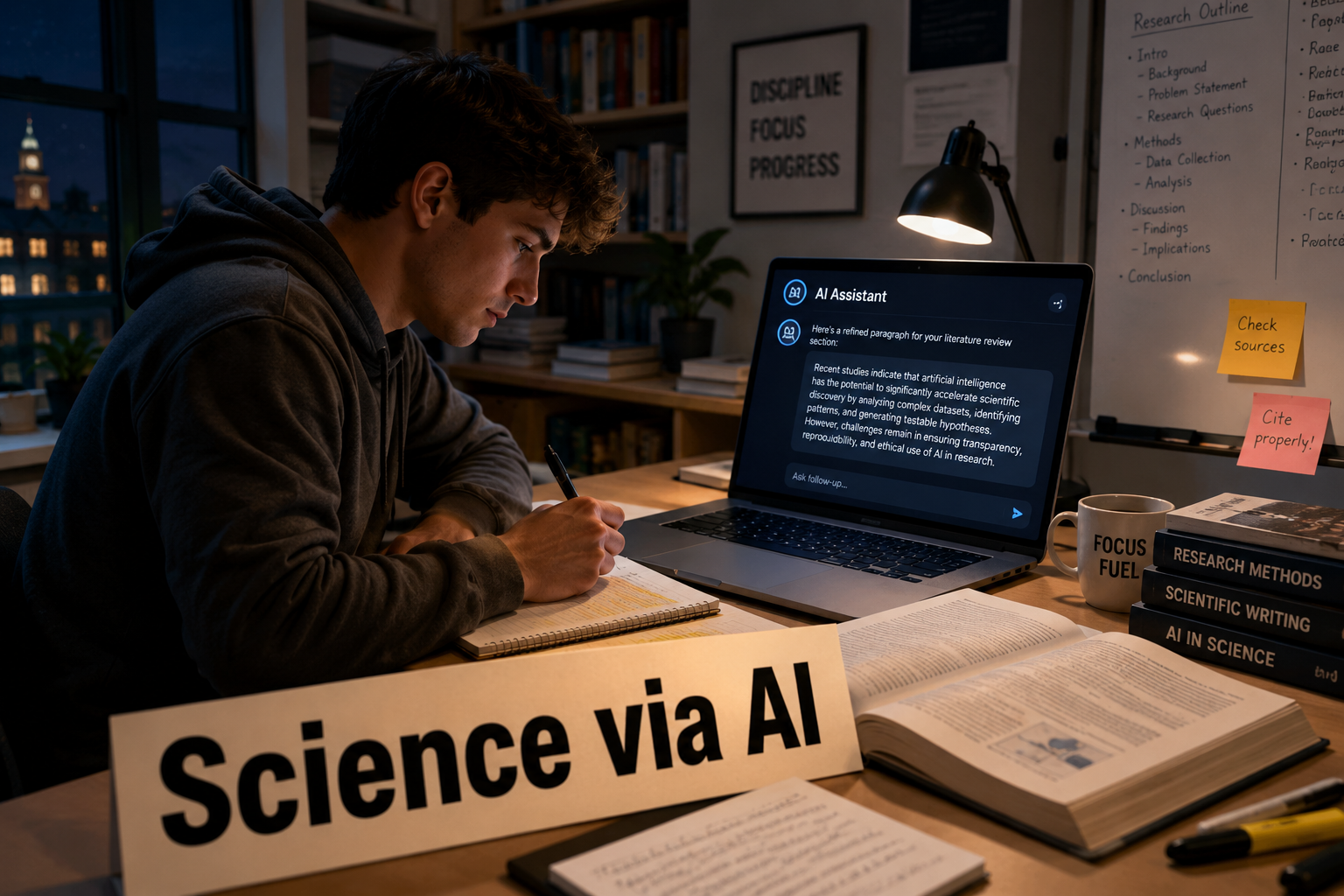
Science has always depended on instruments that extend the limits of human perception. The telescope made distant planets visible. The microscope opened the cellular world. Statistical software turned oceans of measurements into patterns that no mind could hold alone. Artificial intelligence now enters the laboratory and the manuscript draft not as a single new instrument, but as a system that touches nearly every stage of research: reading, coding, designing experiments, analyzing data, writing papers, reviewing submissions and communicating results. The result is not a simple story of cheating machines replacing scholars. It is a deeper shift in how scientific knowledge is produced, filtered and trusted.
AI Is Already Inside the Scientific Workflow
The most visible use of AI in science is text generation. Researchers use chatbots to polish English, rewrite abstracts, summarize literature, draft introductions, produce cover letters, explain code and respond to reviewers. In some fields, especially computer science and biomedicine, the practice has moved from novelty to routine.
Yet writing is only the surface. AI systems are increasingly used to screen papers, extract findings from large literature sets, generate hypotheses, identify protein structures, design molecules, write analysis scripts and assist with statistical interpretation. In laboratories, machine-learning models can help select promising experiments before expensive physical testing begins. In hospitals, AI can flag patterns in imaging or patient data. In climate science, it can accelerate simulations. In materials science, it can search chemical spaces that would be impossible to explore manually.
This makes the current debate difficult. When people ask whether AI is “writing science,” they often mean whether chatbots are producing the prose of academic papers. But science is more than prose. A paper is the final interface of a much larger process. AI can shape the question, the method, the analysis and the narrative. Sometimes it is a harmless assistant. Sometimes it becomes an invisible intellectual partner. Sometimes it is a shortcut that disguises weak work as polished scholarship.
How Much Scientific Text Is Generated by AI?
No one knows the exact share of scientific literature generated by AI. The number depends on the field, the year, the definition of “generated,” and the detection method. A paper lightly edited by ChatGPT is different from a paper whose entire introduction was drafted by a model. A translated manuscript is different from fabricated research generated around public data. Detection tools also make mistakes, especially with non-native English writing, formulaic academic language and heavily edited AI output.
Still, the best evidence suggests that AI-assisted writing has become substantial. Stanford researchers examining large sets of papers and peer reviews reported that about 17.5% of computer-science papers and 16.9% of peer-review text had at least some content drafted or modified by large language models. Their estimate was based not on a simple detector, but on changes in word usage after the release of ChatGPT, particularly the sudden rise of words that LLMs tend to favor.
Another analysis of biomedical abstracts estimated that at least 13.5% of 2024 abstracts were processed with LLMs. The key phrase is “at least.” These studies generally measure detectable traces, not total usage. If an author uses AI for planning, code, translation, or lightly edited prose, the signal may disappear. If a model’s output is carefully revised by a human, detection becomes even harder.
A separate analysis of open-access medical articles found that the monthly share of papers classified as containing AI-generated text rose from 0% in January 2022 to about 11% in March 2025. The same study found that disclosure remained rare: among articles flagged as AI-generated, only a small fraction openly acknowledged AI use.
The picture is therefore clear enough even if the exact percentage is not. AI text in scientific writing is no longer marginal. It is especially common in fast-moving, publication-heavy fields. It is also underreported.
Why Scientists Use Chatbots
The reasons are practical. Scientific publishing rewards speed, volume and fluency. Researchers compete for grants, jobs, promotions and citations. Many are writing in English as a second or third language. Many must produce papers while also teaching, reviewing, managing students and running experiments. A chatbot that can turn rough notes into a polished paragraph in seconds is tempting because it solves a real bottleneck.
For non-native English speakers, AI can be an equalizer. It can reduce the penalty imposed by a publishing system dominated by English. A researcher with strong data and imperfect prose can use a chatbot to make the work clearer. In that case, AI may make science fairer, not weaker.
AI can also help with routine tasks that do not deserve a scientist’s most creative hours. It can draft a plain-language summary, convert a dense paragraph into a clearer one, suggest alternative titles, check consistency in terminology, or produce first-pass code for data cleaning. Used carefully, it is closer to a calculator, spellchecker, statistical package or reference manager than to a ghostwriter.
But the same convenience creates a trap. When AI makes writing effortless, it can encourage writing without thinking. It can produce confident explanations for results the author barely understands. It can fill gaps in reasoning with elegant filler. It can make an ordinary study look more complete than it is. The danger is not only fake science. It is frictionless mediocrity.
Is AI-Generated Scientific Text a Problem?
AI-generated text is not automatically a problem. The problem is undisclosed, unverified or intellectually empty AI use.
A scientist who uses a chatbot to improve grammar, then checks every sentence and remains fully responsible for the claims, is not undermining science. A team that uses AI to summarize thousands of papers before manually verifying the relevant ones may be improving efficiency. A reviewer who uses AI to organize their own notes, without uploading confidential manuscripts or outsourcing judgment, may not be violating the spirit of peer review.
The serious problems begin when AI replaces expertise rather than supporting it. Large language models are designed to generate plausible text, not to guarantee truth. They can hallucinate references, invent mechanisms, misread statistical claims and flatten uncertainty. They often produce prose that sounds balanced while concealing weak logic. In science, style can become camouflage.
There is also a scale problem. Before generative AI, producing a bad paper still required time. Now a low-quality manuscript can be generated quickly from public datasets, templated methods and superficial analysis. Some submissions may not be outright fraudulent, but they add little value and consume editorial attention. Others may be worse: paper-mill products, fabricated literature reviews, invented citations, manipulated images or statistical claims nobody has properly checked.
Peer review was already strained before the chatbot era. AI increases the pressure by raising the volume of plausible-looking submissions. It also threatens the review process itself. If reviewers use chatbots to generate reports without deeply reading the paper, the quality-control layer becomes thinner. A scientific system in which AI drafts the paper and AI drafts the review is not necessarily efficient. It may simply be a machine for producing academic noise.
Trustworthiness Depends on Accountability
The central question is not whether a paper used AI. The central question is whether accountable humans can defend every claim, method, data point and interpretation.
Trustworthy scientific work has several features. The methods are clear. The data are available when possible. The analysis can be reproduced. The limitations are stated honestly. The citations exist and are relevant. The conclusions do not outrun the evidence. AI does not remove the need for any of these standards. If anything, it makes them more important.
A paper can be written in beautiful human prose and still be false. A paper can be edited by AI and still be rigorous. The trust problem arises when AI makes it easier to hide weakness. The reader sees polished language and assumes careful thought. The editor sees a familiar structure and assumes scholarly competence. The reviewer sees fluent explanations and may miss that the references are irrelevant, the statistical model is unsuitable, or the claimed novelty is overstated.
This is why disclosure matters, but disclosure alone is not enough. A sentence saying that ChatGPT helped edit the manuscript does not prove that the work is sound. It only tells us something about the writing process. Journals need policies, but they also need better checks for data integrity, image manipulation, citation accuracy and reproducibility. Universities need to train researchers not only in how to use AI, but in when not to trust it.
The old academic honor system was built around the assumption that writing a paper required sustained engagement with the work. That assumption is weaker now. The new system must focus less on detecting whether a machine touched the prose and more on proving that the science can survive scrutiny.
The Limits of AI Detection
Many institutions are tempted to solve the problem with AI detectors. That is understandable, but risky. Detection tools can provide signals, not verdicts. They are vulnerable to false positives and false negatives. They may misclassify non-native English writing as AI-generated because both can have simplified, formal or predictable phrasing. They can miss AI text that has been revised by a human. They can be gamed through paraphrasing.
This matters because a false accusation can damage a researcher’s career. It also matters because overreliance on detectors can create a false sense of security. A manuscript may pass an AI detector and still contain fabricated data. Another may be flagged for AI-like language while containing excellent, honest science.
The better approach is layered. Editors can use detectors as one input, but not as final evidence. They should combine them with citation checks, statistical review, image screening, data-availability requirements, author contribution statements and targeted questions to authors. A suspicious manuscript should be evaluated for substance: Are the methods coherent? Do the cited papers support the claims? Are the data real? Can the authors explain the analysis?
The scientific community should resist turning prose style into a moral test. The goal is not to punish researchers for using new tools. The goal is to protect the chain of responsibility.
Journal Policies Are Converging
Major publishers have moved toward a common position. AI tools generally cannot be listed as authors because authorship requires responsibility, consent, accountability and the ability to handle conflicts of interest. A chatbot cannot answer for misconduct. It cannot approve a final manuscript. It cannot retract a claim. It cannot be held accountable by an institution.
Publishers also increasingly require disclosure when generative AI is used in manuscript preparation, especially beyond basic grammar correction. Many prohibit AI-generated images unless explicitly allowed, because scientific images are evidence, not decoration. A generated figure can mislead readers if it appears to represent real observations. Peer reviewers are often warned not to upload confidential manuscripts into public AI systems, because doing so may violate confidentiality and data-protection rules.
These policies are evolving. Early reactions were sometimes blunt, including near-total bans. The direction now is more pragmatic: allow some AI assistance, require transparency, keep humans responsible and restrict uses that threaten confidentiality or evidentiary integrity.
This is sensible. A blanket ban would be unrealistic and unevenly enforced. AI is already built into writing tools, search systems, coding environments and data-analysis platforms. The more useful question is not whether AI was used, but how it was used and whether the use affected the scientific claims.
The Risk of Scientific Homogenization
One underappreciated risk is that AI may make scientific writing more uniform. Academic prose is already formulaic. Chatbots tend to amplify this tendency. They prefer safe transitions, balanced paragraphs and familiar phrases. They often smooth away intellectual personality. They can make thousands of papers sound as if they were written by the same careful but unimaginative committee.
This may seem cosmetic, but style affects thought. Strong scientific writing is not merely polished; it is precise. It reflects judgment about what matters, what is uncertain and what is surprising. If AI nudges every argument toward generic phrasing, it can dull the edges of scientific debate.
There is also a citation risk. AI systems may recommend well-known papers over obscure but more relevant ones. They may reproduce dominant framings and marginalize dissenting perspectives. In fields where consensus is still forming, this can narrow the intellectual landscape. Science advances through disciplined disagreement. A literature increasingly mediated by models trained on past literature may become more conservative, more repetitive and less willing to ask strange questions.
AI as a Research Accelerator
The optimistic case remains powerful. AI can accelerate science in ways that are not merely about writing faster. It can help researchers explore vast hypothesis spaces, detect patterns in complex datasets and automate tedious analytical steps. In drug discovery, machine learning can prioritize candidate molecules. In biology, AI can help predict protein structures and interactions. In physics and materials science, it can guide simulations and experimental design. In public health, it can analyze large-scale signals that no individual team could process manually.
Chatbots also make scientific knowledge more accessible within research teams. A biologist can ask for an explanation of a statistical method. A physicist can get help translating an idea into Python. A clinician can summarize a cluster of papers before deciding which ones deserve close reading. Used responsibly, AI can reduce the distance between disciplines.
This may be especially important for early-career researchers and smaller institutions. Elite labs have always had advantages: senior mentors, grant writers, statisticians, professional editors and large networks. AI can provide some support to researchers who lack that infrastructure. It cannot replace mentorship or funding, but it can lower certain barriers.
The future of science with AI, therefore, is not simply darker. It may be faster, more collaborative and more open. But only if speed does not become the main value.
The Coming Shift: From Writing Tool to Scientific Agent
Today’s common chatbot use is mostly conversational. The researcher asks, the model answers. The next phase is more agentic. AI systems will not merely draft paragraphs; they will plan tasks, search databases, run code, compare results, generate figures and suggest next experiments. Some will operate as semi-autonomous research assistants.
This will create new productivity and new hazards. An AI agent that can run analyses may discover errors faster than a human. It may also produce a chain of mistakes too complex for a tired researcher to audit. If a model selects data, cleans it, chooses statistical tests and writes the interpretation, where exactly does human judgment enter? At the final approval stage? That may be too late.
Science will need stronger provenance systems. Future papers may need machine-readable records of how data were processed, which tools were used, which prompts were given, which code was generated and which outputs were manually verified. The traditional methods section may expand into an audit trail.
This could improve science beyond the AI issue. Many current papers are difficult to reproduce because methods are underspecified. AI may force journals to demand clearer workflows, versioned data, shared code and explicit responsibility. The arrival of a risky tool could push the system toward better documentation.
What Should Count as Acceptable AI Use?
A useful boundary is this: AI may assist with expression, exploration and execution, but it should not replace scientific responsibility.
Using AI to polish language is acceptable when the author verifies the final text. Using AI to generate code is acceptable when the code is tested and understood. Using AI to summarize literature is acceptable when key sources are checked directly. Using AI to brainstorm hypotheses is acceptable when the hypotheses are evaluated through proper methods.
By contrast, using AI to invent citations, fabricate data, produce fake peer reviews, generate images presented as observations, or write claims the authors cannot defend is misconduct or close to it. The same applies when researchers hide substantial AI use in contexts where disclosure is required.
The gray area is large. Suppose a chatbot drafts half of an introduction, and the author revises it heavily. Is that editing or ghostwriting? Suppose AI suggests an analysis pipeline that the researcher runs but only partly understands. Is that assistance or abdication? Suppose a reviewer uses AI to produce a first draft of feedback, then edits it carefully. Is that efficient or inappropriate? These questions will not be solved by slogans. They require field-specific norms.
The Human Role Becomes More Important
Paradoxically, AI makes human expertise more valuable. When machines can generate plausible text at scale, the scarce resource is not fluency. It is judgment.
A good scientist knows when a result is too clean, when a model assumption is fragile, when a citation is being stretched, when an effect size matters and when it only looks significant. A good reviewer can sense that a paper’s argument is elegant but hollow. A good editor can distinguish novelty from trend-chasing. These skills are harder to automate than paragraph generation.
The danger is that institutions may reward the wrong thing. If promotion systems continue to emphasize publication counts, AI will inflate the weakest incentives in academia. Researchers will be pushed to produce more papers, faster, with thinner contributions. Journals will receive more submissions. Reviewers will lean more heavily on automation. The literature will grow, but knowledge may not grow with it.
If institutions reward quality, reproducibility, data sharing, careful review and meaningful contribution, AI could become a genuine amplifier. The technology itself does not decide. The incentive system does.
Are AI-Assisted Works Trustworthy?
Some are. Some are not. The presence of AI is neither a stamp of fraud nor a badge of innovation.
A trustworthy AI-assisted paper is one where the human authors remain intellectually present. They understand the methods. They verify the references. They check the analysis. They disclose meaningful AI use according to the rules of the journal. They do not use polished language to overstate uncertain findings. They can answer detailed questions about every part of the work.
An untrustworthy paper is one where AI becomes a laundering mechanism. It turns shallow analysis into formal prose. It invents authority. It hides ignorance. It helps authors produce a manuscript they cannot truly defend. The reader’s problem is that both papers may look similar.
This is why the scientific community should not focus only on AI-generated text. The deeper question is whether the claims are traceable to evidence. Trust must move from style to verification.
The Future: More AI, More Disclosure, More Scrutiny
AI will not disappear from science. It will become more embedded, more capable and less visible. Future word processors, statistical tools, laboratory notebooks and journal platforms will include AI by default. The distinction between “AI-assisted” and “not AI-assisted” may eventually become less meaningful than the distinction between verified and unverified work.
The likely future is a hybrid scientific process. Researchers will use AI for literature mapping, coding, translation, drafting and quality checks. Journals will use AI for screening, plagiarism detection, image forensics, statistical red flags and reviewer matching. Reviewers may use controlled AI tools within secure systems. Readers may use AI to interrogate papers, compare claims against datasets and identify contradictions across the literature.
This future could be better than the present. Imagine reading a paper with an attached verification layer showing where each claim is supported, which data produced each figure, which code generated each result and which parts of the manuscript were AI-assisted. Imagine reviewers spending less time on formatting and more time on conceptual weaknesses. Imagine smaller labs gaining access to analytical support that once required large teams.
But the darker future is also plausible. The literature could be flooded with synthetic papers. Peer review could become an exchange of automated summaries. Real discoveries could be buried under polished noise. Public trust in science could erode if readers come to believe that papers are just machine-generated performances.
The difference between these futures will depend on governance, incentives and culture.
Science After the Chatbot Shock
The chatbot era forces science to clarify what it values. If science is merely the production of papers, AI will produce more of them. If science is the disciplined pursuit of reliable knowledge, AI must be subordinated to that mission.
The right response is neither panic nor blind adoption. Researchers should use AI where it improves clarity, speed and discovery. They should reject it where it weakens understanding, accountability or evidence. Journals should demand transparency without pretending that disclosure solves everything. Universities should teach AI literacy as part of research ethics. Funders and hiring committees should reward fewer, stronger contributions rather than inflated publication volume.
AI can help science think faster, but it cannot decide what is true. It can generate explanations, but it cannot take responsibility for them. It can map the literature, but it cannot replace the skeptical intelligence that turns information into knowledge.
The future of science with AI will be negotiated paper by paper, lab by lab and policy by policy. The best version is not machine-written science. It is human science with better instruments, stronger verification and a renewed respect for the difference between fluent text and reliable truth.











When ByteDance released Seedance 2.0, the reaction was immediate and unusually intense, even by the standards of generative AI. The model did not simply produce another round of glossy, uncanny demo clips. It arrived with synchronized audio, multimodal prompting, cinematic camera movement, more stable characters, and a distribution path through CapCut and Dreamina that most rival AI video systems can only envy. Now, with Seedance 2.5 already in the release conversation, the question is no longer whether ByteDance has built an impressive AI video model. The question is whether Seedance is becoming the first truly mass-market AI video production layer.
From Viral Demo to Serious Creative Infrastructure
Seedance 2.0 represents a sharp shift in ByteDance’s AI video strategy. Earlier video models often impressed audiences for a few seconds, then collapsed under the weight of longer motion, repeated characters, awkward hands, mismatched sound, or inconsistent camera logic. Seedance 2.0 was designed to attack precisely those weaknesses. Its core pitch is not just better image quality, but a unified audio-video generation system that can accept text, images, video clips, and audio clips as inputs, then generate short videos with synchronized sound.
That matters because creators do not work with text prompts alone. A commercial team may have a product shot, a brand mood board, a sample voice, a storyboard frame, and a rough reference clip. A filmmaker may have a character design, a lighting reference, and a desired camera move. Seedance 2.0’s major upgrade is that it tries to treat those materials as part of the same creative instruction rather than separate assets stitched together after generation.
ByteDance says the model can handle up to nine images, three video clips, and three audio clips as reference inputs, while generating short audio-video outputs. The official model card places current direct generation in the 4-to-15-second range, with native 480p and 720p output for the open platform. In practice, that makes Seedance 2.0 less a full film generator than a high-end scene engine: a tool for advertisements, social clips, concept shots, pitch materials, stylized character motion, and rapid previsualization.
The most important improvement is control. AI video has often been dazzling but slippery. You could ask for a shot, but the model decided too much on its own. Seedance 2.0 is built around more directorial prompting: camera movement, lighting, emotion, rhythm, visual effects, motion references, and sound cues. That makes it more relevant to professional users who need repeatable results, not just one lucky generation.
What Seedance 2.0 Actually Upgraded
The most visible upgrade is motion stability. ByteDance has emphasized complex motion scenes, multi-subject interactions, and more physically plausible movement. This is a crucial frontier because human audiences forgive a strange texture faster than they forgive broken motion. A face can be slightly artificial and still pass in a social ad. A dancer’s leg sliding through the floor or a skater landing without weight immediately breaks the illusion.
Seedance 2.0 performs especially well when the task involves camera rhythm and short narrative structure. It can generate multi-shot clips, synchronize sound effects or dialogue more naturally than many earlier systems, and maintain a stronger sense of visual continuity. This is why the model attracted attention not only from AI hobbyists but also from filmmakers, advertisers, and short-form creators. It speaks the language of edited video, not just moving images.
Audio is the second major upgrade. In the first wave of AI video, sound was often an afterthought. Users generated silent clips, then added stock music, synthetic voice, or sound effects in a separate editing workflow. Seedance 2.0 moves closer to native audio-video generation. That means dialogue, sound effects, ambient cues, and music can be generated in relation to what is happening on screen. The result is not always perfect, and distortion can still occur, but the direction is strategically important. The winning AI video platform will not be the one that merely animates images. It will be the one that understands how image, motion, timing, and sound reinforce each other.
The third upgrade is multimodal reference control. Text-to-video is powerful, but it is inefficient for precise creative work. A brand does not want to describe a sneaker from scratch every time. A director does not want to repeatedly explain a character’s face, costume, and posture. Seedance 2.0’s ability to take several kinds of references gives it a more practical workflow. The user can show rather than describe. That is closer to how creative teams actually brief editors, animators, cinematographers, and motion designers.
The fourth upgrade is editing and extension. Seedance is not only a generator of fresh clips; it is moving toward a system that can modify existing video, continue a scene, and respond to targeted instructions. This is where the model becomes more than a novelty. A creator who generates one good shot but cannot revise it has a toy. A creator who can change the background, extend the scene, adjust motion, preserve a subject, and refine the sound has the beginning of a production tool.
Seedance 2.5: The Upgrades Everyone Is Watching
The latest discussion now centers on Seedance 2.5, which ByteDance’s Volcano Engine ecosystem has positioned as the next step beyond impressive short clips. The headline upgrade is native 30-second video generation. That may sound like a simple doubling of length, but in video AI it is a much deeper technical jump.
Five seconds can hide a lot. Fifteen seconds can support a strong visual idea. Thirty seconds begins to resemble a usable ad, a short drama beat, a product demo, a trailer moment, or a complete social video. The challenge is temporal coherence. Over longer clips, AI systems must preserve characters, objects, lighting, spatial layout, motion logic, and camera intent. The longer the clip, the more opportunities there are for faces to drift, props to mutate, backgrounds to flicker, or physics to quietly fail.
Seedance 2.5 is expected to push the model toward longer, more coherent production-style output. Reports around the release window point to native 30-second clips, 4K output, up to 50 multimodal references, and region-level editing. The reference expansion is especially important. Moving from a handful of inputs to dozens of references would change how teams build scenes. A campaign could feed in product angles, color palettes, talent references, camera samples, storyboard panels, audio references, and brand assets in a single workflow. Instead of relying on one prompt to carry the entire creative burden, the model becomes a more structured production partner.
Region-level editing may prove just as important as longer generation. AI video systems are frustrating when one small problem forces a full regeneration. If a logo is wrong, a hand is broken, a background object appears out of place, or a character expression misses the tone, creators need surgical control. The ability to modify part of a frame or scene without destroying the entire shot is essential for professional adoption.
The public rollout, however, remains a moving target. As of early July 2026, the safest reading is that Seedance 2.5 has been announced or previewed, with enterprise beta activity and public access expected in stages rather than universally available at once. That distinction matters. AI video markets are full of “available soon” claims that blur demos, closed betas, API previews, and real consumer access. For creators planning production pipelines, Seedance 2.0 is the current practical model. Seedance 2.5 is the upgrade to watch, but not yet a stable baseline for every user.
Users Are Impressed, but Not Unreservedly Satisfied
User satisfaction around Seedance 2 is best described as polarized. On the creative side, the excitement is real. Early beta feedback highlighted prompt adherence, realistic movement, lighting quality, audio sync, and the usefulness of the model in ideation. Many creators see Seedance as one of the first AI video tools that can produce clips with enough visual energy to compete with edited social content. The viral reaction has been driven by exactly that: Seedance clips often look less like technical demos and more like fragments of actual entertainment.
But satisfaction is not the same as awe. The model can impress users while still frustrating them. Public reviews around Dreamina and CapCut-related experiences are mixed, with complaints often focusing less on raw generation quality and more on platform issues such as billing, credits, watermarks, access limits, and unclear expectations. Small review samples are not enough to define the whole user base, but they do show a familiar pattern in generative AI: users may love the output potential while disliking the commercial wrapper around it.
There is also a creative frustration. Seedance 2.0 is better at motion and coherence than many competitors, but it still makes errors. Characters can drift. Detail stability is not perfect. Audio can distort. Text rendering is not consistently reliable. Multi-subject scenes remain difficult. Longer narrative continuity still requires human editing and careful shot planning. The best Seedance results circulating online often involve skilled prompting, multiple attempts, curation, and post-production. They are not proof that anyone can type one sentence and receive a finished film.
The deeper issue is trust. Users are enthusiastic about what Seedance can create, but professional users also need confidence that a tool will be reliable, legal, and controllable. That confidence was shaken by the copyright controversy surrounding the model’s early release. Clips featuring recognizable celebrities and copyrighted characters created immediate backlash from Hollywood groups, studios, and performers’ representatives. ByteDance later emphasized safeguards against unauthorized likeness and intellectual property use, especially during the CapCut rollout. Still, the incident shaped perception. For some users, Seedance is a breakthrough. For others, it is a warning sign about how fast AI video can collide with rights, consent, and creative labor.
How Many Users Does the Platform Have?
The cleanest answer is that ByteDance has not publicly disclosed a standalone monthly active user number for Seedance itself. That is important because “Seedance users,” “Dreamina users,” “CapCut users,” and “ByteDance AI users” are not the same thing.
The platform advantage comes from CapCut. CapCut is one of the world’s largest video editing apps, and a16z reported it at 736 million monthly active mobile users. That does not mean 736 million people are using Seedance 2.0. It means ByteDance has a distribution channel of extraordinary scale if Seedance is integrated deeply into CapCut and Dreamina workflows.
This is the strategic difference between ByteDance and many AI video competitors. OpenAI, Google, Runway, Kuaishou, Alibaba, PixVerse, and others may build powerful models, but ByteDance already owns a creator platform that millions of people use to edit, caption, remix, and publish videos. CapCut users are already in the workflow. They are not visiting an AI lab out of curiosity; they are making content. That makes Seedance dangerous in market terms. The fastest path to adoption is not always the best model in isolation. It is the best model embedded where creators already work.
Dreamina adds another layer. It gives ByteDance a more AI-native creative surface, while CapCut gives it mainstream editing distribution. For casual creators, Seedance can appear as a feature inside an existing tool. For advanced users, it can become part of a dedicated AI generation workflow. For businesses and developers, BytePlus and Volcano Engine create a path toward API and enterprise use.
This multi-channel strategy is why Seedance matters beyond benchmarks. A model can top a leaderboard and still fail commercially if users cannot access it, afford it, or integrate it. ByteDance is trying to solve the distribution problem and the workflow problem at the same time.
Is Seedance 2.0 the Best AI Video Model on the Market?
The honest answer is: in some categories, yes; overall, not unconditionally.
Artificial Analysis currently ranks Dreamina Seedance 2.0 720p at the top among text-to-video models with audio and image-to-video models with audio. It also leads image-to-video without audio, while text-to-video without audio is led by HappyHorse-1.0, with Seedance still among the top group. These leaderboards are based on blind user preference comparisons, which makes them useful because they reflect what people prefer when judging outputs directly.
But leaderboards do not settle the entire market. AI video quality depends heavily on the prompt, the desired style, the output format, whether audio matters, how much control the user needs, and whether the workflow requires editing, character consistency, or commercial safety. A model can win on cinematic motion and lose on reliability. It can dominate short clips and struggle with longer continuity. It can generate beautiful shots while failing legal or brand-safety requirements.
Seedance 2.0’s strongest case is native audio-video generation, prompt-driven cinematography, multimodal reference use, and short-form visual impact. It feels especially strong for social ads, concept scenes, stylized storytelling, product visualization, creator content, and fast previsualization. Its weakness is not that the model is unimpressive. Its weakness is that professional production demands a complete system: rights management, repeatability, editing precision, cost predictability, team collaboration, resolution, and platform reliability.
Seedance may be one of the best models available today for generating compelling short audio-video clips. It is not yet a universal replacement for production teams, nor is any competitor. The market is still too young, too unstable, and too use-case dependent for a single winner.
The Competitors: Sora, Veo, Kling, Runway, HappyHorse, PixVerse and Open Models
Seedance’s rise has to be understood inside a much wider AI video race.
OpenAI’s Sora 2 remains one of the most visible competitors, especially because OpenAI understands consumer product design and social distribution. Sora’s strength is narrative realism, creator-friendly sharing, and the broader OpenAI ecosystem. It is not just a model; it is a cultural product. That matters because AI video is partly a technical market and partly an attention market.
Google’s Veo 3 and Veo 3.1 are formidable on visual quality, prompt understanding, and enterprise credibility. Google also benefits from integration across Gemini, YouTube-adjacent workflows, cloud infrastructure, and professional media relationships. Veo’s advantage may be less about viral chaos and more about controlled, high-trust generation for brands, agencies, and businesses that need guardrails.
Kuaishou’s Kling 3.0 is another major competitor, particularly strong in motion quality, character animation, and creator adoption. Kling has repeatedly been treated as one of the most practical AI video tools for users who want strong movement and accessible workflows. For many creators, Kling may feel easier or more predictable than Seedance, even if Seedance wins on specific audio-video benchmarks.
Runway remains important because it has focused on creative professionals for longer than most rivals. Its strength is not only generation, but editing, visual effects workflows, and a user base of artists who already think in production terms. Runway’s challenge is distribution at ByteDance scale. ByteDance has CapCut. Runway has professional credibility. Those are different advantages.
Alibaba’s HappyHorse has emerged as a serious benchmark competitor, particularly in text-to-video without audio. That makes it one of the models to watch closely. If HappyHorse continues improving while Alibaba connects it to broader cloud, commerce, and content infrastructure, it could become a major force in China and beyond.
PixVerse, Wan, LTX, HunyuanVideo, and other open or semi-open systems also matter because not every creator wants a locked proprietary tool. Open-weight and API-friendly models can become attractive for studios, startups, and developers who need customization, cost control, or local experimentation. They may not always beat Seedance on raw preference rankings, but they can win in flexibility.
The real market is therefore not “Seedance versus one rival.” It is a layered race between consumer apps, professional tools, enterprise APIs, open models, editing platforms, and rights-safe commercial systems.
Copyright Is Not a Side Issue
The copyright backlash around Seedance 2.0 is not a footnote. It is central to the future of AI video. The model went viral partly because users generated clips involving recognizable characters and celebrity likenesses. That created immediate legal and reputational pressure. Reuters reported that ByteDance had suspended parts of its global launch plan after disputes with major studios, while ByteDance said it would strengthen safeguards.
For everyday users, restrictions can feel annoying. A creator wants to test a reference face, a famous character style, or a recognizable cinematic universe. For studios, actors, and rights holders, the same capability looks like mass infringement at machine speed. For platforms, it creates a liability problem. For advertisers, it creates brand-safety risk.
This is why Seedance 2.5’s rumored or reported connection to licensed IP workflows is strategically important. The long-term solution for AI video may not be looser prompting. It may be licensed generation: approved characters, approved styles, revenue sharing, consent-based likeness use, and traceable provenance. If ByteDance can combine high-quality generation with legal creative templates, it could turn a controversy into a business model.
The same challenge applies to every competitor. OpenAI, Google, Runway, Kling, and others all face the same pressure. The best model will not merely be the one that generates the most convincing celebrity imitation. It will be the one that gives users enough creative power while keeping platforms, brands, artists, and rights holders inside a workable legal framework.
What Seedance Means for Creators and Businesses
For creators, Seedance 2.0 changes the economics of experimentation. A short-form producer can test visual concepts faster. A small brand can prototype campaign ideas without booking a studio. A filmmaker can explore camera language before committing to a shoot. A game team can create mood sequences or animated world concepts. A media team can create social-first visual assets with less manual editing.
But the tool does not eliminate creative judgment. In fact, it increases the value of taste. When anyone can generate motion, the scarce skill becomes knowing what to generate, which result to keep, how to refine it, how to edit it, and how to avoid generic AI aesthetics. Seedance can lower production friction, but it cannot define a brand voice or invent a compelling story on its own.
For businesses, the opportunity is speed. Product demos, localized ads, internal communications, social variants, pitch videos, and concept tests can all move faster. The risk is inconsistency. Companies will need guidelines for prompts, brand assets, legal approvals, watermark policies, disclosure, and quality control. AI video will not simply enter marketing departments as a magic button. It will enter as a new production layer that needs governance.
For agencies and studios, Seedance is both useful and disruptive. It can accelerate previsualization and reduce low-level production costs. It can also pressure traditional service models built around manual iteration. The likely outcome is not that AI video instantly replaces professional teams. It is that professional teams using AI video will outpace teams that refuse it.
The Verdict: Seedance Is a Front-Runner, Not a Finished Revolution
Seedance 2.0 is one of the strongest AI video models on the market, especially where synchronized audio, multimodal prompting, short-form cinematic output, and motion stability matter. Its leaderboard performance supports the hype, and its integration into CapCut and Dreamina gives ByteDance a distribution advantage that few competitors can match.
Yet the model is not flawless, and the platform story is still complicated. Standalone Seedance user numbers are not public. User satisfaction is enthusiastic but uneven. Reviews and community discussions point to friction around credits, watermarks, platform policies, and expectations. The copyright controversy remains a serious constraint. Seedance 2.5 promises major upgrades, but public access and independent testing still need to catch up with the claims.
The most realistic conclusion is that Seedance is not simply “the best AI video model” in a permanent sense. It is one of the leading systems in a market that is changing almost monthly. Its biggest advantage may not be technical alone. It is the combination of model quality, audio-video generation, creator workflow, and ByteDance distribution.
If Seedance 2.5 delivers 30-second coherent clips, richer references, 4K output, and precise editing at scale, ByteDance could move AI video from viral spectacle into everyday production. That would not end the competition. It would raise the floor for everyone else. Sora, Veo, Kling, Runway, HappyHorse, PixVerse, and open models will all keep pushing. But Seedance has already forced the market to respond.
The next phase of AI video will not be won by demo clips. It will be won by the platform that gives creators control, gives businesses legal confidence, gives users predictable value, and turns generation into a repeatable workflow. Seedance 2.0 has made ByteDance a front-runner in that race. Seedance 2.5 will show whether it can stay there.

Europe has spent the past decade trying to become the world’s conscience for technology. In privacy, competition, platform accountability and artificial intelligence, Brussels has written the rulebooks that other governments study, copy or complain about. But in the age of artificial intelligence, being the rule-maker is no longer enough. The uncomfortable reality is that the United States and China are racing ahead in AI capability, infrastructure, capital formation and commercial deployment, while Europe is still trying to prove that it can regulate without suffocating its own innovators. The risk is not that Europe will have no role in the AI era. The risk is worse: Europe may become the market everyone sells into, the jurisdiction everyone complies with, and the continent that uses powerful systems designed, trained and monetized somewhere else.
The AI Race Has Become an Industrial Race
For years, artificial intelligence was discussed as a research field, then as a software trend, then as a consumer app phenomenon. That framing now feels outdated. AI has become an industrial race. It is about data centers, energy grids, chip supply chains, venture capital, procurement, talent migration, model distribution, cloud platforms and national security. A frontier AI company is not merely a clever team of engineers with a good algorithm. It is a capital-intensive infrastructure business operating at the intersection of software, semiconductors and geopolitics.
That shift immediately favors the United States and China. The United States has the hyperscalers, the venture market, the chip ecosystem, the enterprise buyers and the world’s deepest concentration of AI labs. OpenAI, Anthropic, Google DeepMind, Meta, Microsoft, Nvidia, Amazon and xAI are not isolated companies; they are part of an economic machine that can convert research breakthroughs into global products almost instantly. China, despite export controls and restricted access to the most advanced chips, has scale, state direction, huge domestic demand, aggressive engineering cultures and a willingness to mobilize industrial policy around strategic technologies.
Europe has talent, universities, industrial champions and regulatory credibility. But AI leadership now requires the ability to turn those ingredients into companies of global scale. That is where Europe keeps stumbling. The continent produces excellent researchers and promising startups, but too often the path from laboratory to global platform runs through American cloud providers, American investors, American acquisition offers or American distribution channels.
The Numbers Tell a Brutal Story
The investment gap is not a rounding error; it is the core of the story. Stanford’s latest AI Index shows U.S. private AI investment reaching $285.9 billion in 2025. China’s private investment figure was far smaller, though private data almost certainly understates the extent of China’s state-backed AI effort. The same report also shows that the U.S. remains the dominant producer of top-tier models, while China has effectively closed much of the performance gap with American systems.
Europe is not absent from AI, but it is not operating at the same altitude. A handful of European firms, most notably France’s Mistral AI, have demonstrated that the continent can produce technically credible and commercially relevant AI players. There are also strong signs in applied AI, defense technology, robotics, enterprise software, biotech and industrial automation. But frontier AI is unforgiving. A company that is merely “promising” can be obsolete within a year if it lacks compute, capital and distribution.
This is the central problem with Europe’s AI position. The continent has many pieces of the puzzle but lacks the integrated machine that turns them into dominance. In the United States, a breakthrough model can be funded by venture capital, trained on hyperscaler infrastructure, distributed through enterprise cloud contracts and embedded into productivity software used by hundreds of millions of people. In China, a breakthrough can be pushed through giant platforms, state-linked industrial networks and mass-market applications. In Europe, a breakthrough often has to navigate fragmented markets, cautious investors, complex procurement rules, smaller funding rounds and overlapping regulation.
Brussels Knows How to Regulate. Does It Know How to Build?
The European Union’s AI Act is a landmark law. It creates a risk-based framework, bans certain uses, imposes obligations on high-risk systems and introduces rules for general-purpose AI models. In principle, this is not irrational. AI is powerful, opaque and increasingly embedded in sensitive areas such as hiring, finance, education, healthcare, policing and critical infrastructure. A democratic society has a legitimate interest in preventing abuse.
The problem is not that Europe regulates. The problem is that regulation has become Europe’s default technology strategy. Brussels often acts as if setting the standards is the same as shaping the future. It is not. Standards matter most when they are attached to industrial power. The United States can influence AI because its companies build the platforms. China can influence AI because its state and corporate ecosystems deploy the technology at scale. Europe can influence AI through law, but law without innovation eventually becomes a defensive instrument.
There is a difference between being a referee and being a player. Europe has become exceptionally good at refereeing digital markets. It is much less convincing when it has to field a team.
The AI Act may become a model for other jurisdictions, just as the General Data Protection Regulation did in privacy. But Europe should be careful about celebrating that too loudly. GDPR made Europe influential in privacy governance, but it did not create European cloud giants, European social networks, European search engines or European mobile ecosystems. A regulation can export values. It does not automatically export companies.
The Compliance Trap
The European technology debate often treats regulation as free. It is not. Every compliance obligation consumes money, legal attention, engineering time and executive focus. Large incumbents can absorb those costs. Startups cannot. This matters because the AI economy rewards speed. The companies that win are not always the companies with the most elegant theory; they are the companies that ship, learn, iterate, scale and lock in distribution before rivals catch up.
For a large American platform, a new compliance regime is annoying but manageable. It can hire lawyers, policy teams, auditors and technical specialists. For a European startup trying to raise a Series A, those same requirements can be existential. The company may delay product launches, restrict features, avoid high-risk sectors or relocate to a jurisdiction with simpler rules and larger capital pools.
This is the paradox of European digital policy. Rules designed to restrain Big Tech can sometimes strengthen Big Tech by raising the cost of entry. When compliance becomes a fixed cost, scale becomes even more valuable. The giants can afford regulation; challengers may not survive it.
AI makes that paradox sharper. A startup building a frontier model already faces extreme compute costs. It already has to compete for scarce engineers. It already needs access to high-quality data and enterprise customers. Adding regulatory uncertainty on top does not make the company more European; it may make it less viable.
America Builds the Platforms
The United States has its own problems. Its AI ecosystem is highly concentrated. Its leading companies are burning extraordinary sums on compute. Data center expansion is colliding with energy constraints and climate commitments. The relationship between AI labs and cloud providers raises antitrust and dependency questions. American policy is also inconsistent, swinging between techno-optimism, national security anxiety and regulatory fragmentation.
Yet none of this changes the basic fact that America is building. Its AI companies dominate global mindshare. Its chips power much of the training boom. Its cloud providers host the infrastructure. Its software companies are embedding AI into office tools, coding environments, search, design platforms, customer service, cybersecurity and enterprise workflows. Its capital markets are willing to finance enormous losses in pursuit of platform control.
This willingness to fund ambition is a strategic asset. Many European debates still evaluate startups through the lens of near-term sustainability, disciplined spending and early revenue. Those are good instincts in normal markets. Frontier AI is not a normal market. It resembles earlier infrastructure races: railroads, telecom networks, semiconductor fabs, cloud computing. The upfront losses can be enormous, but the winners set the terms for everyone else.
The U.S. advantage is not simply that it has more money. It has a system that tolerates the kind of irrational-seeming ambition that platform shifts require. Europe often asks whether a startup’s business model is sensible. Silicon Valley asks whether it can become unavoidable.
China Builds Under Constraint
China’s AI rise is different but equally important. U.S. export controls have limited Chinese access to advanced Nvidia chips, forcing Chinese firms to optimize aggressively and build domestic alternatives. That pressure has not stopped China; in some ways, it has sharpened its engineering culture. Chinese labs have pushed hard on efficiency, open models, reasoning systems and application-layer deployment.
The significance of China’s AI progress is not just technical. It shows that constraints do not automatically produce stagnation if a country has scale, urgency and industrial coordination. China’s firms can test AI across massive consumer platforms, logistics systems, manufacturing networks, e-commerce ecosystems and public-sector use cases. The country has a huge base of engineers and a strategic view of AI as a pillar of national power.
Europe also faces constraints, but they are of a different kind. They are not only external, such as chip access or global competition. They are internal: fragmented markets, fragmented capital, fragmented procurement, fragmented energy policy, fragmented languages and fragmented political authority. China’s challenge is to innovate under pressure. Europe’s challenge is to innovate despite its own procedural drag.
Europe’s Strengths Are Real
The bleakest version of the argument says Europe is finished in AI. That is too simplistic. Europe has genuine strengths. It has world-class universities, deep mathematical and engineering talent, strong public research institutions, advanced manufacturers, pharmaceutical giants, automotive expertise, aerospace know-how, energy technology, robotics capability and semiconductor equipment leadership through ASML. Europe also has a social model that, at its best, can create trust in technology deployment.
Those strengths matter because the next stage of AI will not be only about chatbots. It will be about applying models to factories, hospitals, laboratories, logistics networks, grids, defense systems, legal workflows, public administration and scientific discovery. In those domains, Europe has domain knowledge that pure software companies often lack.
The question is whether Europe can convert that domain knowledge into AI-native products and platforms before American and Chinese companies do it for them. Industrial AI could be Europe’s opening. A German manufacturer, a French energy company, a Danish pharmaceutical group or a Dutch semiconductor supplier does not need to copy Silicon Valley’s consumer app playbook. Europe can win by building AI systems deeply embedded in complex, regulated, high-value industries.
But this opportunity has a deadline. If European companies wait too long, the intelligence layer will be supplied by foreign platforms. The factory may be European, the workers may be European and the customer may be European, but the model, cloud, chip and operating layer may be American or Chinese. That is not sovereignty. It is high-end dependency.
The Compute Problem
AI leadership requires compute. Compute requires chips, data centers, energy, cooling, financing and permitting. This is where Europe’s ambitions often collide with physical reality. The European Commission’s AI Continent Action Plan, AI Factories and proposed gigafactory initiatives show that policymakers understand the problem. Plans to expand compute infrastructure and give startups access to supercomputing resources are steps in the right direction.
But the scale of the challenge is enormous. The United States has a massive data center base and hyperscalers that can deploy infrastructure at breathtaking speed. China has state-backed capacity and a strategic imperative to reduce dependence on foreign chips. Europe is trying to build shared infrastructure across multiple member states while also managing energy costs, permitting rules, sustainability goals and budget constraints.
The danger is that Europe builds compute as a public program rather than as an innovation flywheel. AI factories must not become impressive facilities that are difficult for startups to use. Researchers and founders need cloud-like access, fast onboarding, predictable pricing, modern tooling and integration with the software stacks they already use. A supercomputer that looks powerful in a press release but feels inaccessible to a startup is not a competitive advantage.
Compute policy must be judged by one question: does it help European AI companies train, fine-tune, deploy and serve models faster than before? If the answer is no, it is infrastructure theater.
The Capital Gap Is a Strategic Weakness
Europe’s capital problem is older than AI. The continent has savings, wealth and sophisticated financial institutions, but it has struggled to channel enough risk capital into high-growth technology companies. Pension funds, insurers and banks remain more conservative than their American counterparts. Public markets are fragmented. Exit opportunities are weaker. Scaling companies often look to the U.S. for deeper funding and higher valuations.
In AI, this gap becomes decisive. Training frontier models and building AI infrastructure can require billions, not millions. Even application-layer AI companies may need large rounds to hire talent, buy compute, acquire data and expand internationally. If European startups cannot raise at competitive scale, they will either stay small, sell early or move.
This has consequences beyond startup culture. Capital determines ownership. Ownership determines where strategic decisions are made, where profits accumulate, where talent clusters and where ecosystems deepen. If Europe invents but others finance, Europe will not capture the full value of its own innovation.
The continent does not need to mimic Silicon Valley in every respect. But it does need a serious capital markets union, more late-stage funding, faster public procurement, stronger stock option regimes and institutional investors willing to back technological risk. Europe cannot lecture founders about sovereignty while starving them of scale capital.
Regulation Without Procurement Is Empty
One of the most underused tools in Europe is public procurement. Governments are huge buyers. They operate hospitals, courts, tax systems, transport networks, energy infrastructure, schools and defense agencies. If Europe wants domestic AI companies to grow, public institutions should become demanding early customers.
This does not mean protectionism for weak products. It means using procurement strategically. The U.S. technology sector benefited enormously from defense, research and government contracts. China uses state demand to accelerate domestic champions. Europe often treats procurement as a compliance process rather than an innovation instrument.
A European AI startup should not have to spend two years navigating public tenders before getting a meaningful deployment. Public-sector AI adoption should be safe, transparent and accountable, but it also has to be fast enough to matter. Otherwise, European governments will eventually buy foreign systems because those are the only products mature enough to deploy.
The irony would be painful: Europe regulates AI to preserve autonomy, then imports AI because its own procurement systems helped prevent domestic firms from scaling.
The Talent Question
Europe produces talent, but it does not always retain or empower it. Top AI researchers and engineers go where they can work on the most ambitious problems with the best tools, the strongest peers and the largest rewards. That has historically meant the United States. Increasingly, China also offers scale and national priority, though with different political constraints.
Europe can attract talent, especially as some researchers become wary of U.S. immigration uncertainty, political volatility or the concentration of power in a handful of tech giants. But talent will not move for slogans. It will move for opportunity. That means access to compute, competitive compensation, stock options that actually work, fast company formation, vibrant labs and a culture that celebrates builders rather than treating them as future compliance risks.
The cultural dimension is underrated. Europe often admires innovation in the abstract and distrusts innovators in practice. Entrepreneurs are praised when they create jobs, but questioned when they become too profitable, too disruptive or too ambitious. AI will force Europe to decide whether it wants champions or merely well-behaved suppliers.
The Cost of Falling Behind
The negative consequences of Europe’s AI lag could be severe. The first is productivity. Europe’s growth problem is already serious, and AI may become one of the main tools for improving output in services, manufacturing, science and administration. If European firms adopt AI slowly or depend on expensive foreign platforms, the productivity gap with the U.S. could widen.
The second consequence is strategic dependency. AI will sit inside cybersecurity, defense, intelligence, energy systems, financial markets and critical infrastructure. A continent that cannot build or control key AI systems will struggle to make independent geopolitical choices. Sovereignty is not only about flags and laws. It is about operational capacity.
The third consequence is value extraction. If the dominant AI platforms are foreign, European data, customers and workflows may generate profits elsewhere. Local businesses could become distribution channels for someone else’s intelligence layer. This is already familiar from cloud computing and digital advertising. AI could repeat the pattern at an even deeper level.
The fourth consequence is regulatory irrelevance. Europe’s rules matter because Europe is a rich market. But if the technological frontier moves too far away, rule-making power may erode. Companies comply with important markets, but they shape their deepest strategies around the places where innovation, capital and infrastructure live. A Europe that only regulates may find itself consulted politely and bypassed practically.
The Regulatory Paradox
None of this means Europe should abandon regulation. That would be a false choice. Unregulated AI can produce real harms: discrimination, surveillance abuse, misinformation, labor disruption, fraud, unsafe automation and concentration of power. The point is not that rules are bad. The point is that rules must be paired with capacity.
The best version of European AI policy would combine trust and acceleration. It would simplify compliance for startups, clarify obligations quickly, create regulatory sandboxes that actually help companies ship, open public data responsibly, fund compute access, deepen capital markets and use procurement to scale domestic solutions. It would distinguish between a two-person startup experimenting with an industrial model and a trillion-dollar platform deploying AI to hundreds of millions of users.
Europe needs proportionality. It also needs urgency. A law that arrives too slowly can be irrelevant. A compliance process that is too complex can become a moat for incumbents. A safety framework that does not understand engineering reality can push experimentation elsewhere.
The goal should not be deregulation for its own sake. The goal should be intelligent regulation that makes Europe the best place to build trustworthy AI, not merely the hardest place to deploy risky AI.
Industrial AI Is Europe’s Best Shot
Europe is unlikely to beat the United States by building a larger consumer AI platform in the near term. It is also unlikely to match China’s state-driven scale. But Europe can compete where it is already strong: industrial systems, enterprise software, scientific AI, health, mobility, robotics, energy and defense.
This is not a consolation prize. The application of AI to the physical economy may be more valuable than consumer chat interfaces. AI that reduces drug discovery timelines, optimizes power grids, improves factory yield, automates engineering design, detects cyberattacks or manages logistics has enormous economic value. Europe has the companies and domain expertise to lead in these areas.
But leadership will require a different mindset. Industrial incumbents must stop treating AI as a pilot project or public relations feature. They need to become aggressive buyers, partners and investors. Startups need access to real operational data, not just innovation labs. Governments need to make it easier to share data safely across sectors. Universities need clearer paths for commercialization. Investors need to back deep technical teams before American funds do.
Europe’s AI opportunity is not to become a weaker copy of Silicon Valley. It is to build an AI stack for the real economy. But that still requires speed, capital and ambition.
The Political Temptation to Blame Big Tech
European politicians often frame the AI debate around American Big Tech dominance. There is truth in that critique. The market power of U.S. platforms is enormous. Their control over cloud infrastructure, chips, data and distribution raises legitimate competition concerns. But blaming Big Tech can become a substitute for building alternatives.
The uncomfortable question is why Europe did not produce more of these platforms itself. The answer is not only predatory American capitalism. It is also Europe’s fragmented markets, cautious funding, weaker scale-up culture, slower procurement and regulatory complexity. Antitrust enforcement may restrain abuses, but it will not by itself create European AI champions.
Europe must be honest about this. A continent cannot fine its way to technological leadership. It cannot investigate its way to compute capacity. It cannot consult its way to frontier models. Enforcement may protect markets, but only builders create new ones.
What a Serious Pivot Would Look Like
A serious European pivot would start with a simple principle: every AI rule should be matched by an AI growth measure. If policymakers impose obligations on AI developers, they should also expand access to compute. If they demand transparency, they should provide legal clarity on training data. If they worry about foreign dependence, they should help domestic firms win public and private customers. If they want startups to stay, they should make stock options, cross-border hiring and company formation dramatically easier.
Europe should also move from fragmented national projects to continental scale. Twenty-seven small AI strategies will not compete with the United States or China. Europe needs shared infrastructure, interoperable data spaces, unified startup rules and procurement pathways that let a company sell across the single market without rebuilding its legal and commercial structure in every country.
The proposed “EU Inc” style approach to startup formation points in the right direction. So do AI factories and gigafactory plans, if they become usable by real companies rather than trapped in bureaucracy. The question is execution. Europe is excellent at announcing frameworks. The AI race will reward deployment.
Not Cooked Yet, But Running Out of Time
The phrase “Europe is cooked” is too fatalistic, but it captures a real frustration. Europe is not short of intelligence, values or technical ability. It is short of speed, scale and confidence. It has spent years proving that it can regulate the digital world. Now it must prove that it can build in it.
The U.S. and China are not waiting for Europe to find its balance. American firms are embedding AI into the global software layer. Chinese firms are closing performance gaps and pushing efficient models into mass deployment. Both ecosystems understand that AI is not just another technology sector. It is a lever of economic power.
Europe can still matter, but not by regulation alone. It needs to turn its industrial base into an AI advantage, its research into companies, its savings into risk capital, its public sector into a launch customer and its values into product features rather than paperwork. The future will not be shaped only by those who write the rules. It will be shaped by those who build the systems everyone else has to use.
Europe’s choice is becoming brutally clear. It can remain the world’s most sophisticated technology regulator, or it can become a serious AI power. It may not have much longer to pretend those are the same thing.

Claude Sonnet 5 arrives at a moment when web design no longer means what it meant even two years ago. The modern designer is not simply arranging pixels, and the modern front-end developer is not simply translating mockups into components. The work now lives in the messy middle: brand systems, responsive logic, conversion copy, accessibility, micro-interactions, analytics hooks, authentication flows, design handoff, and the constant pressure to ship something polished before the market moves on. That is exactly where Anthropic wants Claude Sonnet 5 to matter. The question is not whether it can generate a decent landing page. Many models can do that. The real question is whether it can compress the entire web design cycle enough to feel meaningfully different. The answer is yes, with an important caveat: Claude Sonnet 5 looks genuinely efficient for web design when the task is structured, iterative, and tied to real product work. It is less convincing when “design” means pure taste, original brand direction, or final creative judgment.
The Efficiency Claim Is Not Just About Speed
When people call an AI model “efficient,” they often mean it responds quickly or costs less per token. That is part of the story, but for web design it is not the whole story. A cheap model that produces five broken pages is not efficient. A fast model that needs constant correction is not efficient. A visually impressive prototype that collapses when connected to real data is not efficient either.
Claude Sonnet 5’s efficiency claim is more interesting because it is tied to agentic behavior. Anthropic describes the model as its most agentic Sonnet model yet, designed to plan, use tools such as browsers and terminals, and operate across multi-step workflows that previously required larger, more expensive models. For web design, that distinction matters. The bottleneck in professional web work is rarely a single HTML section. It is the chain of decisions between a vague idea and a usable interface.
A typical web project requires someone to turn a brief into a structure, turn the structure into a screen, turn the screen into responsive states, turn the responsive states into maintainable code, test the result, fix the obvious bugs, refine the copy, and then repeat the process after feedback. Earlier AI coding tools were helpful in pieces. They could write a component, suggest layout ideas, or explain why a build failed. The promise of Sonnet 5 is that it can stay with the job for longer, rather than dropping the thread halfway through.
That is why the “crazy efficient” label is not totally misplaced. If a model can reliably maintain context across a design system, a component library, a product requirement, and a codebase, efficiency compounds. It is not saving thirty seconds on a button. It is removing handoff friction from the whole workflow.
Why Web Design Is a Perfect Test Case
Web design is one of the harshest practical tests for a general-purpose AI model because it blends subjective and objective work. A web page can compile and still be ugly. It can look beautiful and still be unusable. It can satisfy a prompt and still violate accessibility rules. It can match a screenshot but fail on mobile. It can follow brand colors while missing the emotional tone of the product.
This is why web design exposes the difference between simple code generation and useful production assistance. A model that merely writes Tailwind classes is not enough. The better model understands hierarchy, state, rhythm, spacing, progressive disclosure, navigation logic, conversion intent, content structure, and implementation constraints. It also knows when to ask whether a modal should really be a modal, whether a hero section needs three calls to action, or whether the dashboard table should become cards on mobile.
Claude models have historically been strong at long-form reasoning and structured output, which helps in this kind of work. Sonnet 5 appears to push that further by improving the model’s ability to pursue a plan. In web design, that can mean creating a landing page and then remembering to add empty states, error states, keyboard navigation, analytics events, loading skeletons, and a sensible component breakdown. Those details are where teams usually lose time.
The model’s advantage is not that it has taste superior to a senior designer. It does not. The advantage is that it can keep generating plausible, organized, technically coherent options at high speed. In the early and middle stages of web design, that is often enough to change the economics of the project.
From Prompt to Prototype, the Real Gain Is Iteration
The most obvious use case is prompt-to-prototype. Give Claude Sonnet 5 a description of a SaaS homepage, a crypto dashboard, a checkout flow, a developer documentation portal, or an AI product landing page, and it can produce a coherent first pass. That first pass will usually include a layout, copy, visual hierarchy, sections, interaction states, and front-end code. In tools that support previews or artifacts, the user can inspect the result directly rather than reading static code.
But the first pass is not where the value peaks. The value appears in the second, third, and fourth pass. Web design is rarely a straight line. A founder asks for “more premium.” A designer says the spacing feels generic. A developer says the component structure will be annoying to maintain. A marketer says the hero is not explaining the product fast enough. A product manager asks for a second version aimed at enterprise buyers. Traditionally, each of those comments creates another loop between tools and people.
Sonnet 5 is efficient because it can absorb those changes conversationally and apply them across a whole artifact or codebase. Ask it to make the pricing page feel more enterprise-grade, reduce visual noise, add a comparison table, preserve the existing design tokens, and make the mobile version less cramped. The model can revise the page in one pass, or at least get close enough that the human reviewer is editing rather than rebuilding.
That is a very different experience from using AI as a snippet machine. The best web design workflows with Sonnet 5 treat it less like a junior developer waiting for isolated tickets and more like a tireless design engineer who can be given a direction, a constraint, and a repo.
The Claude Design Connection
Claude Sonnet 5 also lands in a broader Anthropic product context. Claude Design, introduced earlier in 2026 as a research preview, is aimed directly at visual creation, prototypes, wireframes, decks, mockups, marketing collateral, and design-system-aware exploration. It can ingest brand context, work from prompts or files, refine through conversation, and hand off to Claude Code. That matters because the web design question is not only about the raw model. It is about the workflow around the model.
For many teams, the future stack may look less like “designer makes Figma file, engineer recreates it” and more like “team explores in a generative design workspace, exports or hands off the winning direction, and then uses an agentic coding tool to turn it into shippable front-end work.” Sonnet 5 fits naturally into that shift because it is built for the execution layer. It may not replace a dedicated design model or a human creative director, but it can carry a design idea into working code with less translation loss.
This is especially relevant for small teams. A solo founder or two-person startup often cannot afford separate specialists for UX, brand, front-end architecture, and copy. Sonnet 5 does not magically supply all of those skills at senior level, but it gives a small team a credible baseline across them. A founder can ask for three homepage directions, choose one, turn it into a React page, request mobile refinements, generate onboarding screens, and then ask for a component map. That does not eliminate design expertise, but it reduces the penalty for not having a full design department on day one.
For agencies, the benefit is different. The agency does not need AI to make “a website.” It needs faster exploration, faster alternates, faster presentation assets, and faster conversion of approved concepts into front-end scaffolds. Sonnet 5 is valuable when it becomes a multiplier for senior staff, not a replacement for them.
Where It Feels “Crazy Efficient”
The model feels most efficient in four web design scenarios.
The first is high-volume landing page production. Marketing teams constantly need pages for product launches, webinars, reports, token campaigns, waitlists, feature announcements, and paid acquisition tests. These pages often share patterns: hero, social proof, product explanation, CTA, FAQ, pricing, lead form, and legal footer. Sonnet 5 can generate these quickly and adapt them to different audiences. The efficiency comes from producing usable variants without starting from a blank canvas every time.
The second is design-system implementation. If a team already has components, tokens, naming conventions, and layout rules, Sonnet 5 can work inside those constraints. That is when the model becomes far more useful. Instead of inventing random styling, it can reuse real components, follow existing conventions, and produce code that looks like it belongs in the product. This is one of the biggest differences between impressive demos and professional work. AI-generated web pages are easy. AI-generated web pages that fit your existing product are harder. Sonnet 5’s long-context and agentic strengths are relevant here.
The third is conversion from rough idea to interactive prototype. Product teams often need to test a flow before committing engineering resources. Sonnet 5 can help build clickable prototypes, dashboard shells, onboarding flows, settings pages, and admin screens rapidly. The result may not be final production code, but it can be good enough for internal review, user testing, investor demos, or stakeholder alignment. That has real economic value because it shortens the path from conversation to something people can react to.
The fourth is front-end debugging and refinement. Web design work does not end when the page looks right on a large screen. Someone has to fix overflow, hydration errors, broken component props, inconsistent spacing, missing aria labels, theme mismatches, and layout regressions. Sonnet 5’s coding improvements matter here because design efficiency is often lost in cleanup. A model that can inspect, modify, test, and iterate through a codebase is far more useful than one that only creates the initial mockup.
The Cost-Performance Argument
Sonnet 5’s strongest business case is not that it is the most powerful Claude model. Anthropic positions higher-tier models such as Opus and Fable for more demanding work. The argument for Sonnet 5 is that it offers a strong balance of intelligence, speed, and cost. That balance is exactly what web design teams need because design iteration can burn through a large amount of model usage.
A one-off prompt does not reveal much about cost. Real design work involves many turns. You ask for a page. Then you ask for a more premium version. Then you ask for mobile fixes. Then you paste errors. Then you ask it to split the page into components. Then you ask for a light theme. Then a dark theme. Then accessibility improvements. Then copy changes. Then integration with a form library. The costs compound across iterations.
A model that is close enough to a flagship for most front-end tasks but cheaper to run can be more practical than the absolute best model. This is the classic middle-model advantage. You reserve the most expensive model for the hardest architecture, strategy, or ambiguous debugging tasks, while using Sonnet for the bulk of high-throughput production. In web design, where most work is iterative rather than singularly profound, that may be the right trade.
This is why Sonnet 5 could become a default model for design engineering workflows. Not because it wins every benchmark, but because it lives in the zone where capability and cost meet day-to-day usage.
Benchmarks Help, But They Do Not Settle the Design Question
The early numbers around Sonnet 5 are encouraging for coding and agentic tasks. Its reported improvements over Sonnet 4.6 on agentic coding, terminal work, tool use, and computer-use-style evaluations suggest a model better suited to multi-step execution. That supports the idea that it can help with front-end development and web design implementation.
Still, benchmarks do not fully answer whether a model is good at web design. A software benchmark might reward resolving a GitHub issue, passing tests, or completing terminal tasks. Those are important, but web design quality also includes taste, clarity, emotional fit, information hierarchy, and how well the page communicates a product’s promise. There is no simple benchmark for whether a pricing page feels trustworthy or whether a fintech dashboard reduces cognitive load.
This is where users should be careful with hype. Sonnet 5 can be highly efficient without being a complete design authority. It can produce many competent directions, but a human still needs to select the right one. It can follow a design system, but someone needs to define that system. It can improve accessibility, but someone should still audit the result. It can write persuasive copy, but someone needs to know whether that copy is true, compliant, and strategically sound.
In short, benchmarks support the efficiency story, but they do not replace product judgment.
The Difference Between “Good Design” and “Shippable Design”
One of the most common mistakes in AI web design is confusing visual completeness with shipping readiness. A generated page can look finished in a screenshot while hiding serious problems. The layout might not survive real content. The components might be too tightly coupled. The colors might fail contrast checks. The animation might hurt performance. The design might ignore localization. The copy might overpromise. The form might lack validation. The page might be inaccessible to keyboard users. The generated code might introduce dependencies the team does not want.
Claude Sonnet 5 reduces some of these risks because it is better at sustained, technical work than earlier mid-tier models. It can be asked to audit its own output, refactor components, add tests, check accessibility concerns, and align with conventions. But it does not eliminate review. It makes review more important because the volume of output increases.
This is the paradox of efficient AI design. The faster the system generates, the more valuable human judgment becomes. The human’s role shifts from producing every artifact manually to directing, filtering, testing, and approving. A designer becomes more like an editor and systems thinker. A front-end developer becomes more like an architect and reviewer. A product manager becomes more responsible for asking sharper questions.
Sonnet 5 is efficient when that human-in-the-loop model is working. It is dangerous when teams treat generated output as automatically production-ready.
How It Changes the Designer’s Role
For designers, Sonnet 5 is both useful and uncomfortable. It automates parts of the work that used to signal craft: rapid layout exploration, visual variants, first-pass copy, and interactive prototypes. A designer who once spent hours creating options can now generate a broad field of possibilities in minutes.
But the deeper design role remains intact. Good designers do not merely generate screens. They understand users, constraints, market positioning, brand emotion, and the difference between a page that looks modern and a page that changes behavior. Sonnet 5 can propose a dashboard layout, but it does not know the political context inside an enterprise customer’s procurement team. It can create a crypto exchange landing page, but it does not inherently know what level of risk disclosure is appropriate for a regulated market. It can design an AI assistant onboarding flow, but it does not automatically understand where user trust breaks down.
The designers who benefit most will be those who can direct the model with precision. Instead of asking for “a better homepage,” they will ask for a version that increases trust for security-conscious CTOs, reduces hero-section abstraction, uses fewer gradients, foregrounds compliance proof, and keeps the existing component system intact. That kind of prompt is design direction. The model supplies acceleration, not taste leadership.
How It Changes the Front-End Developer’s Role
For front-end developers, Sonnet 5 may be even more disruptive. It can generate components, refactor layouts, diagnose errors, wire up state, and work through multi-file changes. In the context of web design, that means developers may spend less time translating obvious UI patterns and more time enforcing architecture, performance, maintainability, and integration quality.
The most productive use is not to ask Sonnet 5 to create a full app blindly. It is to give it a real repo, clear constraints, and a narrow objective. For example, “Create a responsive pricing comparison page using our existing Card, Button, Badge, and Toggle components. Do not add new dependencies. Match the spacing scale in theme.ts. Include monthly and annual states. Add accessible labels. Keep the copy neutral and enterprise-focused.” That is the kind of instruction that turns the model into a practical collaborator.
The weaker approach is to ask for “a beautiful SaaS website” and accept whatever comes back. That may produce a polished demo, but it usually creates cleanup work later. Sonnet 5 rewards specificity. The more context it has about the system, the better its efficiency becomes.
The Web Design Sweet Spot: Design Engineering
The role most obviously amplified by Sonnet 5 is the design engineer. Design engineering sits between visual design and front-end implementation. It cares about how things look, how they behave, and how they are built. It is the discipline of turning ideas into interfaces that feel good and survive production.
Sonnet 5 is well aligned with that role because it can move between language, structure, and code. It can write UX copy, generate a component hierarchy, propose interaction logic, implement a responsive layout, and then explain the trade-offs. It is not perfect at any one of those tasks, but it is unusually useful across all of them.
This cross-functional flexibility is the source of the efficiency. A specialist tool might beat Sonnet 5 in a narrow area. A dedicated visual design platform may offer better canvas control. A specialized code model may outperform it on certain programming tasks. A human copywriter may produce sharper messaging. But Sonnet 5 can carry context across these boundaries. For teams trying to move quickly, that connective tissue matters.
What It Still Gets Wrong
Despite the excitement, Sonnet 5 is not a magic web designer. It can still produce generic aesthetics. It may default to familiar SaaS visual tropes: glowing gradients, rounded cards, oversized hero text, vague productivity claims, dashboard mockups, and testimonial blocks that feel interchangeable. Without strong direction, AI web design often converges on the same polished sameness.
It can also overbuild. Ask for a simple page, and it may create an elaborate component system. Ask for an animation, and it may add unnecessary complexity. Ask for a dashboard, and it may invent data structures that look plausible but do not match the product. This is not always a failure of intelligence. It is a failure of constraint. AI models tend to fill gaps with probability. Professional design often requires refusing unnecessary elements.
There are also risks around dependencies and maintainability. Even strong coding models may suggest libraries a team does not use, create inconsistent patterns, or produce code that works in isolation but does not match the repo’s long-term architecture. For production web design, teams should require dependency discipline, accessibility checks, responsive testing, and code review.
Finally, brand originality remains a human challenge. Sonnet 5 can apply a brand system, but inventing a distinctive brand from scratch is a different problem. It can generate options, but the decision about what a company should feel like belongs to people who understand the market, the audience, and the stakes.
The Best Way to Use It for Web Design
The most efficient Sonnet 5 workflow starts with context, not a blank prompt. Give it the product positioning, target audience, design system rules, examples of existing pages, technical stack, and business goal. Then ask for a plan before asking for code. This lets the model expose its assumptions early.
The next step is constrained generation. Instead of requesting a whole website, ask for one page or one flow. Then ask for variants with clear differences. One version might optimize for enterprise trust. Another might optimize for developer adoption. A third might optimize for consumer simplicity. This creates useful creative range without turning the process into chaos.
After selecting a direction, ask the model to implement using existing components and no new dependencies unless approved. Then ask it to audit the result for accessibility, mobile layout, performance, and consistency with the original goal. Finally, have a human review the output as if reviewing a pull request from a capable but overly eager teammate.
That last phrase is the right mental model. Claude Sonnet 5 is not an intern. It is too capable for that comparison. But it is also not a creative director, product owner, and senior engineer rolled into one. Treat it as a fast design engineer that needs direction and review, and the efficiency gains become real.
Is It Worth Switching From Older Sonnet Models?
For web design work, the case for switching from older Sonnet models is strong. The improvements in agentic behavior, coding, tool use, and sustained execution are directly relevant to front-end workflows. If a previous model could generate a nice component but struggled to carry changes across a page, Sonnet 5’s better follow-through should be noticeable.
The more interesting comparison is with higher-tier models. Should teams use Opus or Fable instead? For the hardest tasks, maybe. If the work involves deep architecture, extremely ambiguous debugging, complex product reasoning, or high-stakes enterprise systems, a stronger model may justify the higher cost. But for everyday web design iteration, Sonnet 5 looks like the more practical default. It is strong enough for most tasks and efficient enough for repeated use.
That matters because web design is not a single genius moment. It is a sequence of small decisions. The best model for that workflow is not always the most powerful model. It is the model you can afford to use repeatedly without hesitation.
The Verdict
So, is Claude Sonnet 5 really crazy efficient for web design? Yes, if by web design you mean the modern, practical workflow of turning ideas into prototypes, prototypes into components, and components into refined product experiences. It is especially efficient for landing pages, product flows, design-system-based front-end work, rapid UX variants, and cleanup tasks that connect design intent to production code.
But the word “crazy” needs discipline. Sonnet 5 is not a replacement for taste. It is not a guarantee of originality. It is not a substitute for accessibility review, brand strategy, user research, or senior engineering judgment. It is efficient because it reduces friction across the web design pipeline, not because it removes the pipeline entirely.
The best way to understand Claude Sonnet 5 is as a compression engine for design engineering. It compresses the distance between brief and prototype. It compresses the distance between prototype and code. It compresses the distance between feedback and revision. For teams that already know what they are trying to build, that compression can feel dramatic.
For teams that do not know what they want, it will simply generate more uncertainty faster.
That is the real answer. Claude Sonnet 5 is genuinely efficient for web design when guided by clear intent, strong constraints, and human review. It is not magic. But in the hands of a founder, designer, or front-end engineer who knows how to direct it, it may be one of the most useful web creation tools Anthropic has released so far.
-
 AI Model11 months ago
Tutorial: How to Enable and Use ChatGPT’s New Agent Functionality and Create Reusable Prompts
-

 AI Model11 months ago
Tutorial: Mastering Painting Images with Grok Imagine
-

 AI Model9 months ago
How to Use Sora 2: The Complete Guide to Text‑to‑Video Magic
-

 AI Model1 year ago
Complete Guide to AI Image Generation Using DALL·E 3
-

 AI Model1 year ago
Mastering Visual Storytelling with DALL·E 3: A Professional Guide to Advanced Image Generation
-

 Tutorial9 months ago
From Assistant to Agent: How to Use ChatGPT Agent Mode, Step by Step
-

 News12 months ago
Anthropic Tightens Claude Code Usage Limits Without Warning
-
 AI Model1 year ago
Crafting Effective Prompts: Unlocking Grok’s Full Potential