
News
The Global AI Surge: Who’s Using It and Why It Matters


- Share
- Tweet /data/web/virtuals/375883/virtual/www/domains/spaisee.com/wp-content/plugins/mvp-social-buttons/mvp-social-buttons.php on line 63
https://spaisee.com/wp-content/uploads/2026/02/ai_stats-1000x600.png&description=The Global AI Surge: Who’s Using It and Why It Matters', 'pinterestShare', 'width=750,height=350'); return false;" title="Pin This Post">
The rise of artificial intelligence has been one of the defining technological stories of the 21st century. In just a few years, AI has gone from being a niche tool for data scientists to a ubiquitous utility embraced by millions for work, learning, creativity, and play. Large Language Models (LLMs) like ChatGPT and Claude have become household names, embedded in everyday tasks and transforming workflows around the world. But how many people actually use AI? And for what purposes? Understanding the scope of global AI adoption reveals a shifting digital landscape where the boundaries between human intelligence and machine assistance are blurring.
AI Goes Global: A Snapshot of Worldwide Adoption
As of the end of 2025, an estimated 16.3 percent of the global population actively uses artificial intelligence tools in some form. That figure represents over 1.3 billion people and reflects a steep rise from the previous year, where AI adoption was measured at around 15.1 percent. The growth trajectory suggests not only increasing awareness but also expanding accessibility, particularly as mobile integration and language localization improve.
In terms of platform-specific engagement, OpenAI’s ChatGPT leads the pack. By late 2025, ChatGPT boasted monthly active users equivalent to approximately 10 percent of the adult population worldwide. This rapid scale has not gone unnoticed. It signals not only curiosity but also a growing dependence on AI tools for real-world problem-solving.
While overall usage continues to climb, it is important to understand that AI engagement varies dramatically by region and demographic. High-income nations show far higher adoption rates than developing countries, largely due to differences in digital infrastructure, internet access, and educational exposure. Nevertheless, momentum is building everywhere. According to one multinational survey, 53 percent of global respondents reported that AI had already changed their lives in the past three to five years, and a remarkable 67 percent believed that AI would alter their lives even more dramatically in the near future.
The Working World: AI as a Silent Partner in Productivity
When it comes to professional environments, AI is no longer confined to IT departments or experimental labs. It has quietly infiltrated the everyday tasks of knowledge workers, customer service agents, marketers, and even legal teams. A global workforce survey conducted in 2025 found that approximately 58 percent of employees in 47 countries actively use AI at work. Among these, one-third reported weekly interaction with AI tools. Interestingly, many of these interactions remain covert; employees often use AI-generated content without informing their supervisors, highlighting both the practical utility and ethical ambiguity of workplace AI.
In the United States alone, around 40 percent of adults have reported using AI for professional tasks. Younger workers in particular are leading the charge. Adults under 30 are substantially more likely to incorporate AI into their daily workflows, using tools to brainstorm ideas, draft content, automate repetitive tasks, and analyze data.
Beyond individuals, corporate entities are integrating AI into their operational cores. Data from 2024 showed that 78 percent of businesses globally had adopted AI in at least one process, with that number rising sharply year over year. This shows that AI is moving from the realm of optional innovation to strategic necessity.
Learning with Machines: The New Face of Education
Nowhere is AI adoption more rapid than in education. Among students, particularly in high-income nations, AI tools have become a standard part of the learning toolkit. In early 2025, an Ipsos study revealed that 87 percent of teenagers aged 12 to 17 had used AI either at school or at home. These tools were employed for everything from writing assignments to conducting research and even developing creative projects.
In Central Europe, particularly in the Czech Republic, similar trends emerged. A 2025 study found that 72 percent of students reported using AI in some form. Most used it for homework assistance, while a smaller portion admitted to using it to cheat or complete assignments dishonestly. Still, these figures point to an irreversible trend: AI is reshaping the learning process.
Education institutions are responding in kind. Teachers are now incorporating generative AI tools into lesson plans, while universities are beginning to offer entire courses focused on AI literacy. The next generation is growing up alongside intelligent machines, and that will have a profound impact on the way future societies understand knowledge, creativity, and intellectual labor.
AI for Fun and Leisure: The Entertainment Revolution
Entertainment and personal use remain the most common forms of AI interaction among the general population. In countries like the Czech Republic, where national polling on AI adoption has been robust, two-thirds of adults who had used AI reported doing so primarily for entertainment or leisure. Watching AI-generated videos, using chatbots for playful conversation, or employing AI for storytelling and music creation are now routine experiences.
In the United States, data reflects a similar pattern. Around 60 percent of adults reported using AI to search for information, whether for fun or practical reasons. Many also used AI for drafting emails, organizing calendars, or planning travel. These applications straddle the line between productivity and entertainment, blurring the traditional categories of tech use.
The most active demographic in this space is again the youth. Among adults under 30, about three-quarters reported using AI for information, idea generation, or content creation. The line between entertainment and utility becomes increasingly ambiguous for this group, especially as AI becomes embedded in social media platforms, game engines, and streaming services.
Business Integration: AI as Infrastructure
Corporate adoption of AI is surging, not merely as a cost-cutting tool but as a critical enabler of strategic growth. Surveys conducted in 2025 indicate that 88 percent of companies now use AI in at least one business function. Moreover, 72 percent have adopted generative AI tools, reflecting the influence of LLMs on decision-making, customer service, content creation, and software development.
Large enterprises in Europe and North America report the highest adoption rates. Eurostat data from 2025 shows that over half of all large European firms had integrated AI into their operations. That number is expected to rise as more companies discover the return on investment provided by AI in automating routine work, improving customer experience, and enabling better data-driven insights.
Yet challenges remain. While big companies can afford dedicated AI teams and robust governance structures, small and mid-sized firms often struggle with implementation. The lack of in-house expertise, unclear regulatory environments, and concerns about data privacy continue to be major hurdles.
Still, the message is clear: AI is no longer a fringe experiment. It is a core feature of modern business, akin to the adoption of the internet in the 1990s.
Generational Divide: A Tale of Two Futures
The adoption curve for AI has revealed a striking generational divide. While young people are largely enthusiastic early adopters, older adults have shown more skepticism and slower engagement. This divide is not just about age but also about exposure and familiarity. Young users, especially those who grew up during the smartphone era, tend to see AI as a natural extension of their digital lives.
Among teenagers and young adults, AI is not a novelty; it is an expectation. They use AI for everything from studying to expressing themselves online. Their comfort with AI tools suggests that tomorrow’s workforce will not only accept AI’s presence but demand its integration into tools and platforms.
By contrast, older adults often approach AI with caution. Concerns about misinformation, data privacy, and job displacement are more pronounced among this demographic. However, as user interfaces become more intuitive and AI tools become embedded in familiar products like smartphones and search engines, even the most skeptical users are beginning to explore AI applications.
Looking Ahead: The Implications of Mass Adoption
As AI continues its global ascent, the implications for society are profound. The diffusion of LLMs and other generative tools is reshaping how people think, work, and interact. Entire industries are being reconfigured around intelligent automation. Jobs are evolving rather than disappearing, and new roles centered on AI supervision, ethics, and prompt engineering are emerging.
In education, AI may soon become a co-teacher rather than a supplementary tool. In business, it is already a competitive differentiator. In entertainment, it is expanding the boundaries of creativity itself. The question is no longer whether people will use AI, but how they will use it responsibly.
From a policy perspective, governments around the world are grappling with the challenge of regulating an industry that moves faster than legislation. Ensuring equitable access, protecting individual privacy, and avoiding algorithmic bias are among the critical priorities facing regulators.
Despite these concerns, the direction is clear. AI has crossed the threshold from emerging technology to foundational infrastructure. Its users now span every demographic, geography, and profession. Whether to boost productivity, enrich learning, enhance creativity, or simply have fun, billions of people are now living in a world shaped by artificial intelligence.
Conclusion: A Defining Technology for a Defining Era
The global AI landscape in 2026 is marked by explosive growth and remarkable diversity in use. From office workers using it to summarize reports to students relying on it for homework help, and from musicians co-creating with generative algorithms to businesses streamlining customer service with intelligent chatbots, AI has found a place in nearly every human endeavor.
Sixteen percent of the world’s population now uses AI actively, a figure that continues to grow. As we move deeper into the decade, the lines between machine assistance and human capability will blur even further. The conversation is shifting from access to alignment: how do we ensure this powerful technology reflects our values, serves our goals, and elevates our collective potential? The answer lies not just in the algorithms, but in the people who use them—globally, daily, and increasingly, without even noticing.











News
The AI Cold War Is No Longer About Who Builds the Best Model. It Is About Who Controls the Future Stack
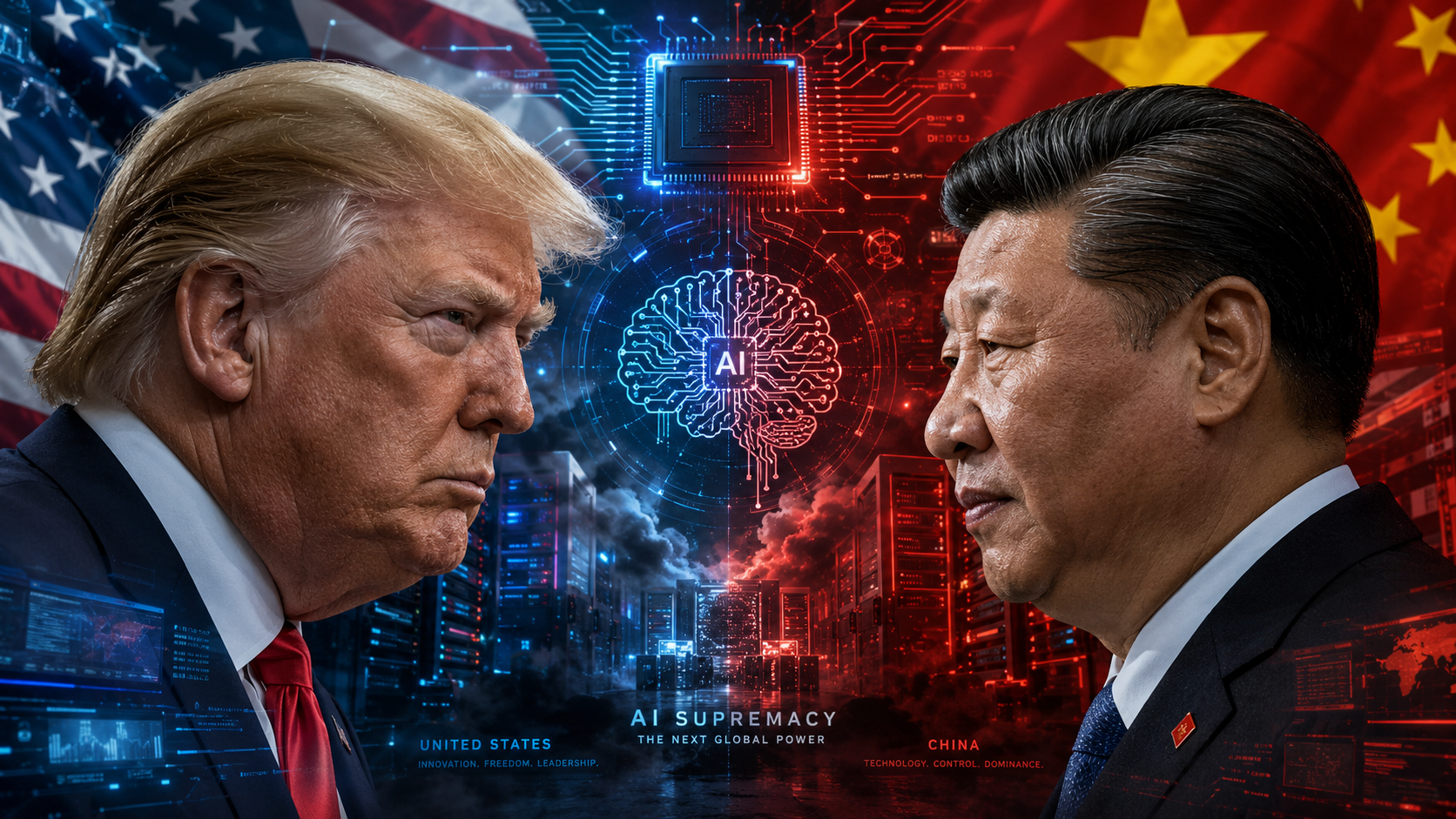
The technology war between the United States and China has entered a more serious phase. For years, the contest was described as a race: who could train the largest model, attract the best engineers, publish the most papers, or build the most advanced chip. That framing is now too narrow. The AI rivalry has become a struggle over the entire industrial stack beneath artificial intelligence: semiconductors, cloud infrastructure, capital flows, data, energy, talent, model weights, corporate acquisitions, and even the legal right to move knowledge across borders.
The United States still has the stronger hand at the very top of the AI economy. It dominates frontier model companies, advanced chips, cloud computing platforms, venture capital, and the commercial ecosystem that turns AI into global products. China, however, has moved faster than many in Washington expected. Its leading models have closed much of the performance gap, its companies have become remarkably efficient under hardware constraints, and Beijing is now using its own version of export controls to stop strategic AI assets from leaving the country. The result is not a simple story of American dominance or Chinese catch-up. It is a contest between two different systems of technological power.
The New Front Line: From Chips to Knowledge
The first phase of the AI technology war was hardware-centric. Washington understood that modern AI depends on enormous compute capacity, especially high-end GPUs and advanced networking systems. Beginning in 2022, the United States tightened export controls on advanced semiconductors and chipmaking equipment to slow China’s access to the most powerful AI infrastructure. Those controls targeted the physical foundation of frontier AI: Nvidia accelerators, semiconductor manufacturing tools, and the technical pathways that allow Chinese firms to train very large models.
That strategy has not disappeared. In fact, it has intensified. In late May 2026, the U.S. Commerce Department clarified that export restrictions on advanced AI chips apply not only to Chinese firms inside China, but also to Chinese-headquartered entities operating through overseas subsidiaries. The move was designed to close a loophole that allegedly allowed Chinese companies to route advanced Nvidia Blackwell-class chips through third countries such as Malaysia. Reuters reported that the guidance specifically addressed concerns that Chinese companies were using foreign units to obtain hardware that would otherwise require export licenses.
But the battlefield has widened. China is no longer merely responding to U.S. chip controls by complaining about unfair treatment or accelerating domestic chip development. Beijing is building a mirror-image control system of its own. Instead of focusing only on imported chips, China is increasingly focused on preventing the outward transfer of Chinese AI technology, founders, datasets, engineering teams, and intellectual property.
That is the context behind the claim that China recently “prohibited the sale of AI tech.” The precise answer is more nuanced. China has not announced a blanket ban on selling all AI technology abroad. What it has done is far more targeted and strategically important. On June 1, 2026, China’s State Council published new outbound investment regulations, effective July 1, 2026, that expand state scrutiny over overseas deals involving Chinese investors, technology, data, services, and national security. The rules require authorization for transfers of restricted Chinese goods, technologies, services, or related data, and they can affect sensitive sectors including artificial intelligence, according to Reuters.
In practical terms, that means Beijing is asserting control over the sale, relocation, acquisition, or foreign use of strategically important AI assets. It is not “AI cannot be sold” in a universal sense. It is closer to this: AI technology that China considers sensitive cannot be transferred abroad, packaged into overseas deals, or moved through corporate restructuring without state approval.
That distinction matters. A broad ban would be economically self-defeating. A strategic approval regime gives Beijing leverage.
The Manus Signal: China Draws a Red Line
The immediate trigger for this tougher posture was the Manus case. China ordered Meta to unwind its acquisition of Manus, an AI startup originally founded in China and later associated with Singapore operations. Reuters reported in April 2026 that Beijing blocked the deal on national security grounds, signaling that Chinese-origin AI companies cannot easily escape Chinese oversight simply by relocating abroad or accepting foreign acquisition offers.
This is a major escalation because it targets not only products but corporate identity. If a company was founded by Chinese engineers, developed technology in China, used Chinese talent networks, or built strategic AI capabilities before shifting overseas, Beijing may still treat it as part of China’s national technology base. The message to founders is unmistakable: incorporation geography will not necessarily erase regulatory geography.
For Silicon Valley, this changes the logic of AI acquisitions. Buying a Chinese-origin AI startup is no longer just a matter of negotiating price, shareholder approval, and foreign investment review in the buyer’s home jurisdiction. It may now require navigating Chinese national security review even when the company has moved operations abroad. For Chinese founders, the implications are equally serious. Relocation to Singapore, Dubai, London, or San Francisco may not be enough to separate a high-value AI business from Chinese state oversight.
This is where the AI war begins to look less like a trade dispute and more like a technology sovereignty conflict. Both countries increasingly view AI companies as strategic infrastructure. The United States does not want China to access the most advanced compute. China does not want the United States to absorb Chinese AI talent, agents, models, and intellectual property through acquisitions.
The old globalization bargain said technology should flow to wherever capital, talent, and markets can use it most efficiently. The new AI bargain says strategic technology belongs first to the state.
Which Country Is Better in AI?
The answer depends on what “better” means.
If better means frontier AI capability, commercial scale, cloud infrastructure, chip design, and global platform power, the United States remains ahead. American firms still define much of the frontier: OpenAI, Google DeepMind, Anthropic, Meta, xAI, Microsoft, Amazon, and Nvidia sit at the center of the global AI economy. The U.S. has the deepest venture capital markets, the strongest hyperscale cloud providers, the most influential enterprise software ecosystem, and the dominant supplier of advanced AI accelerators.
The 2026 Stanford AI Index reported that U.S. private AI investment reached $285.9 billion in 2025, far above China’s $12.4 billion in private AI investment. The same report found that the United States produced 59 notable AI models in 2025, compared with China’s 15.
Those numbers tell a powerful story. America’s AI ecosystem is not just a research machine; it is a capital machine. It can fund multiple trillion-dollar-scale bets at once: frontier models, AI chips, data centers, robotics, defense AI, enterprise agents, biotech AI, and consumer assistants. China has enormous state support, but the U.S. private market still allocates risk capital at a scale no other country matches.
But if better means speed of catch-up, cost efficiency, deployment discipline, industrial integration, and resilience under pressure, China deserves more credit than many Western observers gave it two years ago. Stanford’s 2026 AI Index found that the performance gap between the best U.S. and Chinese models has effectively closed, with U.S. and Chinese models trading places at the top of rankings since early 2025. As of March 2026, the top U.S. model led by only 2.7 percent, according to Stanford’s technical performance analysis.
That is the most important fact in the debate. The United States is still ahead overall, but China has narrowed the model-performance gap dramatically. The AI war is no longer a contest between one country with frontier models and another country stuck generations behind. It is a contest between a richer, more globalized U.S. AI system and a more constrained but increasingly efficient Chinese AI system.
DeepSeek changed perceptions. Its reasoning models demonstrated that Chinese labs could achieve world-class performance despite chip restrictions and with far lower reported training costs than many U.S. frontier efforts. Reuters later reported that DeepSeek said its R1 model cost $294,000 to train, using 512 Nvidia H800 chips, though the full economics of earlier research, talent, experimentation, and infrastructure are more complex than a single training-run figure suggests.
The lesson was not that compute no longer matters. Compute still matters enormously. The lesson was that constraints can force algorithmic efficiency. Chinese labs learned to squeeze more performance from less hardware through mixture-of-experts architectures, reinforcement learning techniques, inference optimization, model distillation, and aggressive engineering discipline.
So which country is better? Today, the United States is better positioned to lead the frontier AI economy. China is better than expected at closing gaps, scaling applications, and adapting under pressure. America has the superior stack. China has the superior urgency.
America’s Strength: The Full AI Stack
The U.S. advantage starts with semiconductors. Nvidia remains the central company of the AI era because its GPUs, networking systems, software libraries, and developer ecosystem are deeply embedded in frontier AI. Even when Chinese companies build competitive models, many still depend directly or indirectly on Nvidia hardware, or on architectures shaped by Nvidia’s ecosystem.
The U.S. also benefits from its cloud giants. Microsoft Azure, Amazon Web Services, Google Cloud, Oracle, and specialized AI infrastructure providers create a compute marketplace that allows startups to scale quickly. The biggest American labs can raise tens of billions of dollars, secure long-term compute contracts, and deploy models globally through existing software channels.
Then there is talent. The United States remains the top magnet for elite AI researchers, engineers, founders, and graduate students. Its universities, immigration history, startup culture, and compensation levels give it a structural advantage. Even when geopolitical tensions make immigration harder, the U.S. still has a uniquely powerful ability to turn international talent into globally dominant companies.
Most importantly, America commercializes AI faster at the global level. Its AI companies are not limited to domestic platforms. They plug into enterprise software, developer tools, advertising systems, consumer apps, cybersecurity products, defense contractors, financial services, healthcare, and media workflows across many countries. The U.S. model is messy, expensive, and sometimes chaotic, but it is extremely good at turning frontier research into products.
That commercial flywheel is hard to replicate. A frontier model is not enough. You need distribution, trust, payment rails, enterprise relationships, APIs, cloud integration, chips, developer communities, legal teams, and brand power. The U.S. has all of these.
China’s Strength: Efficiency, Scale, and State Coordination
China’s AI ecosystem has different strengths. It has a vast domestic market, deep engineering talent, large internet platforms, strong manufacturing capacity, and a state willing to coordinate capital, regulation, and industrial policy around strategic goals.
China’s publication and patent output is formidable. Stanford’s 2026 AI Index found that China leads in AI publication volume, citations, and patent grants, while the U.S. retains advantages in higher-impact patents and notable models. That distinction captures the broader pattern: China is massive in research production and increasingly competitive in applied AI, while the U.S. remains stronger at frontier commercialization and globally influential platforms.
China also has a deployment advantage in certain sectors. Industrial AI, robotics, logistics, surveillance systems, fintech, e-commerce, smart manufacturing, and autonomous systems all benefit from China’s enormous domestic data flows and dense manufacturing base. AI is not only about chatbots. It is also about optimizing factories, ports, electric vehicles, batteries, drones, supply chains, and consumer platforms. In those areas, China’s connection between software and hardware manufacturing is a serious strategic asset.
The Chinese system can also move quickly when the state defines a priority. Data centers, domestic GPU alternatives, AI chips from Huawei and others, state-backed compute clusters, and local government AI programs can be mobilized through policy direction. The downside is inefficiency, duplication, political interference, and the risk that companies optimize for state approval rather than global competitiveness. But in a technology war, state coordination can compensate for market weakness.
China’s biggest weakness remains advanced semiconductors. Despite progress in domestic chip design and manufacturing, China still trails the U.S.-aligned semiconductor ecosystem that includes Nvidia, AMD, Broadcom, Cadence, Synopsys, ASML, TSMC, Samsung, SK Hynix, Applied Materials, and Tokyo Electron. AI is a software revolution built on a hardware bottleneck, and that bottleneck still favors Washington and its allies.
Export Controls Are Becoming Mutual
For years, export controls were mostly discussed as an American weapon. Washington controlled chips. Washington controlled semiconductor tools. Washington controlled access to dollar capital and U.S.-origin technology. That era is over.
China has learned from the American playbook. It has used export controls on critical minerals and rare earth-related supply chains, and now it is extending tighter oversight to outbound technology, data, services, and investments. Reuters reported earlier in 2026 that Beijing’s export-control regime had become more mature and more explicitly modeled on lessons from Western controls, including the extraterritorial logic of U.S. rules.
The new Chinese outbound investment regulation is important because it blends multiple concepts into one policy architecture. It is not just about whether a company can invest overseas. It is about whether that investment involves controlled technology, sensitive data, strategic services, or personnel arrangements that might transfer know-how abroad. Legal analysis by Morrison Foerster described the new regime as materially expanding China’s outbound direct investment controls and integrating technology export licensing, export controls, and data-transfer compliance.
This could affect more than mergers and acquisitions. It may affect joint labs, overseas subsidiaries, licensing agreements, technical consulting, employee secondments, model deployment partnerships, data-sharing arrangements, and founder relocations. The Chinese state is trying to close the gap between formal ownership and practical control. In AI, knowledge often walks out the door in the head of an engineer, not in a shipping container. Beijing knows this.
The U.S. is doing something similar in reverse. Its outbound investment program identifies semiconductors and microelectronics, quantum information technologies, and artificial intelligence as national security categories of concern involving China, Hong Kong, and Macau. Washington does not only want to stop chips going to China; it also wants to stop American capital and expertise from helping China build strategic capabilities.
Both countries are now trying to regulate invisible flows: capital, code, model knowledge, training methods, data pipelines, and human expertise. That is much harder than regulating physical exports.
What China’s New Restrictions Could Mean
The most immediate impact will be on cross-border deals. Western companies will become more cautious about acquiring Chinese AI startups, hiring entire Chinese AI teams, or investing in companies with Chinese-origin technology. Lawyers and compliance teams will treat China-linked AI assets as politically sensitive by default.
This may reduce exit opportunities for Chinese founders. In the old model, a successful AI startup could sell to a U.S. platform, move to Singapore, raise dollar funding, and become part of the global tech ecosystem. Under the new model, those pathways become riskier. Beijing wants to prevent the best Chinese AI assets from being absorbed into American platforms.
The second impact will be on venture capital. U.S. investors may become less willing to fund China-origin AI companies if they cannot be sure that intellectual property, equity rights, data rights, or future acquisitions will be enforceable. Chinese startups may turn more heavily toward domestic capital, Gulf capital, or state-backed funding. That could reduce their global flexibility but increase their alignment with Beijing’s strategic priorities.
The third impact will be on talent mobility. The new rules do not simply concern software licenses. They also point toward tighter control over technical personnel and cross-border knowledge transfer. This does not mean every Chinese AI engineer will be unable to work abroad. But for sensitive projects, companies may face stricter scrutiny over whether overseas employment, consulting, training, or team relocation amounts to technology transfer.
The fourth impact will be on AI model availability. If China classifies certain AI systems, model weights, agent architectures, speech technologies, synthetic media tools, or interface technologies as restricted, foreign firms may need approval to use them commercially outside China. China has already maintained catalogues of technologies that are prohibited or restricted from export, and CSET’s translation of China’s updated catalogue shows that such regimes are part of a broader export-control architecture.
The fifth impact will be geopolitical signaling. China is telling Washington: if you can restrict our access to chips, we can restrict your access to our AI talent and technology. That does not create symmetry, because the U.S. still controls more of the high-end AI hardware stack. But it creates bargaining power. AI restrictions may become chips in broader negotiations over trade, tariffs, Taiwan, data security, rare earths, cloud access, and investment.
The Risk of a Split AI World
The deeper danger is that the U.S.-China AI war fragments the global AI ecosystem. Instead of one open research environment, the world may move toward two partially separated AI spheres.
In the American sphere, models may be built on Nvidia and AMD hardware, U.S. cloud platforms, Western enterprise software, English-first data ecosystems, and regulatory standards shaped by the U.S. and its allies. In the Chinese sphere, models may run increasingly on domestic chips, Chinese cloud platforms, Mandarin-first and Global South deployment channels, and governance rules shaped by Beijing.
This split will not be clean. Companies will still find ways to interact. Open-source models will cross borders. Researchers will publish. Chips will leak through gray markets. Multinational companies will operate in both systems. But the direction is toward controlled interdependence rather than open globalization.
That matters for AI safety and innovation. Fragmentation can reduce trust, slow collaborative research, and encourage secrecy. If each side believes the other is racing toward military or intelligence advantage, both sides have incentives to deploy systems before they are fully understood. AI competition can become self-accelerating: controls produce workarounds, workarounds produce tougher controls, and tougher controls produce more nationalist technology policy.
The irony is that export controls can both slow and strengthen a rival. U.S. chip controls have limited China’s access to the most advanced compute, but they have also forced Chinese firms to become more efficient and more determined to build domestic alternatives. Chinese restrictions on AI technology transfers may protect national assets, but they may also make Chinese startups less attractive to global partners and less integrated into international markets.
The Business Consequences
For companies, the lesson is simple: AI strategy is now geopolitical strategy.
A firm choosing an AI vendor is not only choosing model performance. It is choosing jurisdictional exposure. A U.S. company using Chinese AI models may face data, security, sanctions, procurement, or reputational concerns. A Chinese company using U.S. AI infrastructure may face export restrictions, service interruptions, or compliance uncertainty. A European, Middle Eastern, Indian, or Southeast Asian company may find itself pressured by both sides.
This will accelerate demand for sovereign AI. Governments and large enterprises will increasingly want models trained, hosted, and governed within trusted jurisdictions. Cloud regions, data localization, domestic model providers, and national compute initiatives will become more important. The AI market will not be purely global; it will be regionalized by law, trust, and strategic alignment.
It will also change valuations. AI companies with clean ownership, secure chip access, domestic regulatory support, and low geopolitical exposure may command premiums. Companies with ambiguous China-U.S. ties, restricted technology, sensitive datasets, or uncertain export status may trade at discounts. In AI, compliance risk is becoming core business risk.
For investors, the key question is no longer only “How good is the model?” It is also “Can this company legally scale across borders?” A technically brilliant model trapped inside regulatory walls may be less valuable than a slightly weaker model with global distribution.
The Military Shadow
The U.S.-China AI race cannot be separated from defense. Both governments understand that AI will shape intelligence analysis, cyber operations, drone swarms, logistics, targeting support, electronic warfare, satellite interpretation, autonomous systems, and command decision tools. Even when a model is commercially trained, its capabilities may be dual-use.
That is why both sides treat frontier AI as national security infrastructure. Washington fears that advanced chips will improve China’s military modernization. Beijing fears that Chinese AI startups, talent, and agents could be absorbed into U.S. platforms and eventually strengthen American strategic power.
This military shadow makes compromise difficult. In ordinary trade disputes, countries can negotiate market access or tariffs. In AI, the disputed asset may be a capability that neither side wants the other to possess. The closer AI moves toward autonomous agents, automated research, cyber capability, and military decision support, the harder it becomes to treat it as normal commerce.
The Verdict: America Leads, China Is Closing, and the War Is Just Beginning
So, which country is better?
The United States is still better positioned overall. It leads in frontier infrastructure, private investment, global AI companies, high-end chips, cloud platforms, developer ecosystems, and commercial deployment. Its advantage is broad and structural.
China is not ahead, but it is no longer safely behind. It has narrowed the model-performance gap, shown striking efficiency under constraint, built a huge research base, and begun using state power to retain strategic AI assets. Its weakness in advanced semiconductors remains serious, but its software and engineering capabilities are strong enough to make the race genuinely competitive.
China’s recent move does not mean all AI technology sales are banned. It means AI has moved into the category of strategic national assets whose transfer abroad may require approval or may be blocked. The Manus case shows that Beijing is willing to intervene even after a deal is done. The new outbound investment rules show that this is becoming a formal system, not a one-off reaction.
The bigger meaning is clear. The AI war is shifting from “Who can buy the best chips?” to “Who controls the full lifecycle of intelligence production?” That lifecycle includes chips, data, energy, models, talent, companies, capital, and deployment. The U.S. has spent years trying to deny China access to the most powerful AI hardware. China is now trying to deny the U.S. access to strategic Chinese AI knowledge.
The winner will not be the country with a single best chatbot in a benchmark table. The winner will be the country that can sustain the most complete AI ecosystem: hardware, software, talent, capital, energy, regulation, trust, and global adoption.
Right now, that country is still the United States. But the margin is thinner than Washington would like, and China’s latest restrictions show that Beijing has stopped playing defense. The AI cold war has become a two-sided contest of technological containment. And unlike the original Cold War, the front line runs through startups, chips, cloud contracts, research labs, app stores, venture deals, and every company trying to decide whose intelligence layer it can trust.
AI Model
Google’s Gemini Omni Flash Enters the AI Video Wars: Who Should Use It, and When Seedance 2.0, Runway, Sora, Kling or Firefly Is the Smarter Choice

AI video has crossed a threshold. The old question was whether a model could produce a beautiful five-second clip without melting hands, warping faces or forgetting what a camera was supposed to do. The new question is more strategic: which model belongs inside a real production workflow? Google’s Gemini Omni Flash, ByteDance’s Seedance 2.0, Runway, Sora, Kling, Luma, Pika, Adobe Firefly and Synthesia are no longer chasing the same user. They are splitting the market into distinct creative territories: cinematic ideation, multimodal editing, social-video speed, enterprise explainers, brand-safe marketing, avatar-based training and full audio-video generation.
The Big Shift: From Prompt-to-Video to Conversation-to-Video
Google’s Gemini Omni Flash matters because it reframes the AI video tool as less of a generator and more of a creative operating layer. Google describes Omni Flash as a model that can create and edit video from text, image, audio and video inputs, with high-resolution video and audio as output. It is distributed through Gemini, YouTube and Google Flow, and Google positions conversational editing as one of its defining traits.
That distinction is important. Most video tools still behave like slot machines with increasingly good odds. You enter a prompt, maybe attach a reference image, generate a clip, then regenerate until the model approximates your intention. Omni Flash points toward a different interface: a model that can understand what is already in the clip, accept layered references and respond to iterative instructions. For creators, that means less time rewriting prompts and more time directing.
Seedance 2.0 is moving in the same direction, but from a different cultural and product base. ByteDance presents Seedance 2.0 as a unified multimodal audio-video model supporting text, image, audio and video inputs, with strong motion stability, synchronized audio-video generation and director-level control over lighting, performance, shadows and camera movement. Its technical materials describe support for short audio-video generation and multiple reference assets, including images, videos and audio clips.
The result is an unusually direct contest. Omni Flash is Google’s bet on reasoning, ecosystem integration and conversational editing. Seedance 2.0 is ByteDance’s bet on multimodal control, motion, entertainment fluency and fast creator workflows. They overlap, but they do not feel identical.
What Gemini Omni Flash Is Best For
Gemini Omni Flash is best suited for creators and teams who need a flexible video generation layer that can reason across multiple inputs. The natural user is not only a filmmaker, but a creative strategist: someone who has a mood board, a product photo, a rough clip, a soundtrack idea and a written concept, then wants the model to synthesize those inputs into a coherent video.
This makes Omni particularly attractive for agencies, YouTube creators, product marketers, educators and small production teams already living in Google’s ecosystem. If a team uses Gemini for planning, Google Flow for visual development and YouTube as the publishing environment, Omni Flash reduces friction. The tool’s advantage is not merely that it can generate video. The advantage is that it sits close to the places where ideas, references and distribution already happen.
The most compelling use case is iterative concept development. A creative director can begin with a rough brand idea, generate a short visual direction, then refine the tone through conversation. “Make it less futuristic and more documentary.” “Keep the same character, but change the environment.” “Use the uploaded product shot as the hero object.” “Turn the pacing into something suitable for a YouTube pre-roll.” That kind of workflow is exactly where prompt-only tools feel brittle.
Omni Flash is also well suited for knowledge-grounded videos. Google says Omni combines Gemini’s reasoning with generative media capabilities and can generate videos grounded in real-world knowledge. That does not mean it should be trusted blindly for factual claims, but it does mean the model is designed for more context-aware generation than purely aesthetic video models. For explainers, visual metaphors, educational shorts and product demonstrations, that could become a meaningful differentiator.
Another good fit is video-to-video editing. The market has plenty of tools that can create a clip from scratch, but fewer that can take an existing clip and let the user manipulate it conversationally without forcing a full manual editing workflow. For social teams and smaller studios, this matters because most real work starts from something: a phone video, a rough animatic, a product render, a testimonial, a stock shot or a previous AI generation.
Where Omni Flash May Not Be the Best Choice
Omni Flash is not automatically the right tool for every video job. Its current positioning emphasizes short-form generation, multimodal inputs and conversational editing. That makes it powerful for ideation and controlled edits, but less obviously ideal for long-form structured production, enterprise avatar training, highly brand-safe commercial campaigns or specialized cinematic workflows where another tool has deeper production controls.
If your main task is producing a polished training video with a presenter speaking in multiple languages, Synthesia is usually a better fit. Synthesia is built around AI avatars, scripts, voiceovers, localization, enterprise security and LMS-style distribution rather than cinematic scene generation.
If your highest priority is brand safety and legal comfort for commercial marketing assets, Adobe Firefly deserves serious consideration. Adobe explicitly positions Firefly around commercial safety, permissioned training data and IP protection for qualifying plans. That does not make Firefly the most cinematic model in every situation, but for enterprise marketing departments, legal departments often matter as much as frame quality.
If your goal is a multi-shot cinematic sequence with consistent characters, locations and objects, Runway remains one of the strongest specialist choices. Runway’s Gen-4 was built around world consistency, using references and instructions to preserve characters, locations, objects, style and cinematographic language across scenes. For directors trying to build a sequence rather than a standalone clip, that consistency layer is not a luxury. It is the difference between a demo and a usable production asset.
Gemini Omni Flash vs Seedance 2.0
The cleanest way to compare Omni Flash and Seedance 2.0 is to say that Omni feels like a multimodal creative assistant, while Seedance feels like a multimodal video engine.
Omni’s likely strength is interpretive control. It is designed around Gemini’s reasoning, conversational editing and integration into Google Flow. For users who want to steer a video through natural language and combine references without building a complicated production pipeline, Omni is highly attractive. It is the model to reach for when the brief is still evolving and the creator wants to shape the result through dialogue.
Seedance 2.0’s strength is production momentum. ByteDance emphasizes audio-video joint generation, motion stability and director-level control. Its technical materials are unusually specific about supported durations, reference inputs and native resolutions. It also benefits from ByteDance’s cultural understanding of short-form video. That matters. TikTok-style content is not only about image quality; it is about rhythm, motion, visual punch and immediate recognizability.
For creators making social-first entertainment, Seedance 2.0 may feel more native. It is likely to shine in anime-inspired clips, dynamic camera moves, stylized character action, viral short scenes and fast-turnaround creative experimentation. If a creator wants to generate multiple energetic concepts in a style closer to social media and entertainment fandoms, Seedance is hard to ignore.
For brand teams, Omni may be easier to justify, especially if they already trust Google’s stack. Google’s advantage is ecosystem, enterprise familiarity and potential integration into broader Gemini workflows. A marketing team may prefer Omni for product explainers, platform-native YouTube experiments, concept boards and iterative edits. A creator studio may prefer Seedance for punchier short-form sequences where motion and audio-visual energy matter more than corporate workflow integration.
The risk profile also differs. Seedance 2.0 has already attracted copyright and likeness controversy because users reportedly generated videos involving protected entertainment properties and celebrity-like content. Omni has faced similar concerns in early coverage around recognizable copyrighted characters, which means neither model can be treated as a legal free-for-all. The practical lesson is simple: use these systems for original concepts, licensed materials and approved references, not for imitation of protected franchises or real people without permission.
How Runway Fits Into the Picture
Runway remains the tool for creators who think like filmmakers. Its biggest advantage is not that it can produce attractive clips; many tools can now do that. Its advantage is production vocabulary. Gen-4’s emphasis on consistent characters, objects and locations makes it useful for storyboards, short films, music videos, commercials and previsualization.
Use Runway when continuity is the priority. If the same character must appear across a city street, an apartment, a close-up and a car interior, Runway’s consistency features are directly relevant. If a director needs a controlled camera language, a coherent world and an aesthetic that survives across multiple shots, Runway is often a better choice than more general-purpose tools.
Omni Flash may compete with Runway as Google Flow matures, especially because Omni’s conversational editing could reduce the need for manual prompt surgery. But Runway has a head start with professional creators and a brand built around film-adjacent workflows. For serious narrative production, Runway remains one of the default tools to test.
How Sora Fits Into the Picture
OpenAI’s Sora 2 occupies a different space. OpenAI described Sora 2 as a flagship video and audio generation model with improved physical accuracy, realism, controllability, synchronized dialogue and sound effects. However, OpenAI has also changed the availability and product structure around Sora over time, which complicates its practical role for creators depending on region, account type and access.
Strategically, Sora matters because it shaped expectations for physically plausible AI video. It pushed the market toward longer, more coherent generated scenes and made “world simulation” part of the video-generation conversation. But availability matters. A tool that is technically impressive but not accessible in a stable production environment is less useful than a slightly weaker tool that a team can actually deploy.
Use Sora when it is available inside the workflow you are using and when realism, physics and synchronized audio are central. Do not build an entire production plan around it without confirming access, policy limits and export constraints. In 2026, the best video tool is not always the most famous model; it is the one that can reliably deliver inside your pipeline.
How Kling Competes
Kling has become one of the strongest names for motion, character action and social-video realism. Its recent positioning around broad multimodal capabilities, character consistency and audio makes it a natural competitor to both Seedance and Google. While official claims should always be tested in production, Kling’s reputation among creators has been built on fluid motion, cinematic movement and strong handling of human subjects.
Kling is worth using when motion is the brief. Dancing, sports, fight choreography, expressive body movement, camera sweeps and dynamic scenes often expose weaknesses in video models. If a model can maintain anatomy and motion under stress, it becomes valuable for entertainment, ads and creator content. Kling is also a good candidate when lip-sync and talking characters are required, though teams should compare outputs against Synthesia when the task is formal presenter video rather than cinematic dialogue.
Compared with Omni Flash, Kling may feel more specialized around kinetic generation. Compared with Seedance 2.0, it competes more directly in the social-entertainment lane. The decision often comes down to taste, access, pricing and whether the platform gives enough control over characters and references.
How Luma Ray Fits Into the Picture
Luma’s Ray line has leaned into realism, physics, high-fidelity motion and fast creative iteration. Luma positions Ray around stronger realism, physics, character consistency and instruction following, with recent versions adding higher-resolution generation, faster performance and lower cost.
Luma is a strong choice for visual exploration. It is especially useful when a team wants cinematic realism without building a heavy editing workflow. Product shots, atmospheric scenes, architecture, natural motion, camera exploration and visually rich concept clips are all good fits.
Use Luma when you want high-fidelity visual output quickly and do not need the deepest conversational editing layer. Omni Flash is more attractive when you need to keep talking to the model and refine an existing idea through multiple modalities. Luma is attractive when the priority is visual beauty, speed and motion coherence.
How Pika Fits Into the Picture
Pika is best understood as the playful social-video tool. It is not trying to be the most enterprise-safe platform or the deepest cinematic production suite. Its appeal is immediacy, effects and shareability. Pika’s public positioning emphasizes quick transformations, image-to-video generation and prompt-driven animation.
Use Pika when the job is a viral effect, a quick meme-like transformation, a playful product teaser or a social post that benefits from novelty. Do not use Pika as the first choice for a regulated enterprise campaign, long-form narrative continuity or a serious training library. It is strongest when speed and delight matter more than exact directorial control.
Compared with Omni Flash, Pika is lighter and more entertainment-oriented. Compared with Seedance, it is less of a full multimodal production model and more of a fast creative effects playground. That is not a weakness. It is a clear use case.
How Adobe Firefly Fits Into the Picture
Adobe Firefly is the tool for cautious professionals. It may not always generate the flashiest clip, but its value proposition is unusually clear: commercial safety, brand integration and professional creative workflows. Adobe positions Firefly around licensed and permissioned content sources, making it especially relevant for companies that need stronger assurances around commercial use.
That makes Firefly a serious option for enterprises, agencies, financial institutions, healthcare companies and global brands. In those environments, the key question is not “can this model make a cool video?” It is “can we publish this without creating legal, compliance or reputational risk?”
Use Firefly when the video is going into a paid campaign, a brand system or a corporate channel where provenance matters. Use Omni or Seedance earlier in the ideation phase if they help generate bolder concepts, then move into Firefly or Adobe’s broader suite when the asset must satisfy brand and legal constraints.
How Synthesia Fits Into the Picture
Synthesia should not be compared directly with Omni Flash as a cinematic generator. It is solving a different problem: scalable business communication. Synthesia is built for AI avatars, voiceovers, scripts, translation, templates and enterprise deployment. It is the right tool when the output needs to look like a presenter-led explainer, onboarding module, sales enablement video or compliance training asset.
Use Synthesia when the script matters more than the scene. If a company needs to turn a long policy update into a clean internal video in multiple languages, Omni Flash is not the obvious answer. Synthesia is. If an HR team needs consistent avatar-led training across markets, Synthesia is far more practical than a cinematic generator.
Omni could eventually generate more visually imaginative explainer scenes around a topic, but Synthesia remains stronger for repeatable, governed, human-presenter workflows.
The Practical Decision: Which Tool Should You Use?
For Gemini Omni Flash, the ideal user is a creator, marketer, educator or production team that wants multimodal generation plus conversational editing. Use it when you have mixed inputs and an evolving brief. Use it for YouTube concepts, product videos, educational shorts, rapid ad variations, video-to-video edits and creative development inside the Google ecosystem.
Use Seedance 2.0 when you need energetic, multimodal short-form generation with strong motion and audio-video integration. It is especially suitable for entertainment creators, social-first studios, music-video experiments, anime-style concepts, character-driven short scenes and creators who want to feed the model multiple references.
Use Runway when you need cinematic continuity. It is the better bet for multi-shot scenes, consistent characters, production-style previsualization and serious narrative experiments.
Use Kling when motion, action, bodies and expressive character performance are the priority. It is worth testing for dance, sport, stylized action and dialogue-heavy social clips.
Use Luma when you want visual realism, smooth motion and polished cinematic exploration without overcomplicating the workflow.
Use Pika when you want fast, playful, highly shareable effects.
Use Adobe Firefly when commercial safety, brand governance and legal comfort are the deciding factors.
Use Synthesia when the job is presenter-led business video, training, localization or internal communications at scale.
The Bottom Line
Google’s Gemini Omni Flash is not just another video generator. It is part of the industry’s move toward multimodal creative agents: systems that accept messy inputs, understand context, generate video with audio and let users edit through conversation. That makes it one of the most important tools for teams that want flexibility rather than a single-purpose clip machine.
But the market has matured enough that no single model should be treated as universal. Seedance 2.0 may be better for fast, vivid, entertainment-native generation. Runway may be better for narrative continuity. Firefly may be better for brand-safe campaigns. Synthesia may be better for corporate training. Pika may be better for viral effects. Luma may be better for polished visual exploration. Kling may be better for dynamic motion.
The smartest creators in 2026 will not choose one AI video tool and defend it like a religion. They will build a stack. Omni Flash belongs near the center of that stack for multimodal ideation and conversational editing. Seedance belongs near the edge where culture, motion and speed collide. The rest of the tools fill specialized roles. The winner is not the model with the loudest demo. It is the workflow that gets from idea to publishable video with the fewest compromises.

When Anthropic announced Claude Mythos Preview, it did not sound like a normal model launch. There was no simple productivity pitch, no friendly promise that workers would save a few hours a week, and no polished demo about drafting emails or summarizing meetings. Instead, Anthropic introduced a model that can find and exploit serious software vulnerabilities with a level of autonomy that immediately unsettled the cybersecurity world. Mythos is not just another AI assistant. It is a warning shot: artificial intelligence is now moving from writing code to breaking it, auditing it, weaponizing it, and eventually rebuilding the security foundations of the entire software industry.
What Anthropic Actually Announced
Anthropic’s announcement centered on Claude Mythos Preview, a powerful unreleased AI model with unusually strong cybersecurity capabilities. The model was introduced through Project Glasswing, a controlled access program designed to let selected organizations use Mythos defensively before similar capabilities become widely available across the AI industry.
The central claim was striking: Mythos can identify subtle vulnerabilities in important software systems, including bugs that survived years of human review, automated testing, and conventional security tooling. Anthropic said the model had found zero-day vulnerabilities in major operating systems and browsers, and that some of those flaws were old, deeply buried, and serious.
This is not the same as a coding assistant finding a missing input validation check in a small web app. Anthropic described Mythos as capable of developing sophisticated exploits, chaining multiple vulnerabilities, and performing complex reasoning across large codebases. In practical terms, that means the model can move beyond “this code looks risky” and toward “this bug can be turned into a working attack.”
That is the part that changed the conversation.
For years, AI coding tools have been framed mostly as accelerators for developers. They autocomplete functions, explain APIs, generate tests, and help junior programmers move faster. Mythos belongs to a different category. It is an AI system that can reason about software as an adversary would. It can inspect code, find weak points, and understand how those weak points might be exploited.
The announcement therefore landed in two ways at once. For defenders, it was promising. For attackers, it was terrifying. For the software industry, it was a preview of a new equilibrium.
Why Project Glasswing Exists
Project Glasswing is Anthropic’s attempt to control the rollout of these capabilities before the broader market catches up.
The logic is simple: if frontier AI models can dramatically lower the cost of finding and exploiting vulnerabilities, then responsible companies should give defenders a head start. Instead of releasing Mythos broadly to anyone with a subscription and an API key, Anthropic initially gave selected partners access under security constraints.
Those partners include major technology companies and organizations that manage critical infrastructure. Reuters reported that companies such as Amazon, Microsoft, and Apple were among the major tech firms permitted to use Mythos for cybersecurity purposes. Anthropic has also described Project Glasswing as focused on foundational systems that represent a large part of the shared cyberattack surface.
That phrase matters. The modern digital economy runs on common infrastructure. Operating systems, browsers, cloud services, open-source libraries, encryption libraries, media tools, networking stacks, developer frameworks, and container platforms are used everywhere. A single vulnerability in one widely deployed component can expose millions of devices, companies, and users.
Project Glasswing is built around the idea that these systems must be hardened before offensive actors gain access to comparable tools. In other words, Anthropic is trying to create a defensive window.
That window may be short.
Anthropic has indicated that similarly capable AI systems may become available from other providers within months. Whether those models come from commercial labs, open-source communities, state-backed programs, or specialized cyber groups, the direction is clear: AI-assisted vulnerability discovery is becoming cheaper, faster, and more accessible.
Project Glasswing is not just a product initiative. It is a race.
How Big Tech Used Mythos to Fix Security Bugs
The most important early use of Mythos has been defensive code analysis.
Large technology companies operate enormous codebases. Their systems include legacy code, internal tools, external products, cloud infrastructure, operating systems, firmware, APIs, browser components, developer platforms, and endless dependencies. No human security team can manually audit all of it with perfect coverage.
Traditional security tools help, but they have limits. Static analyzers can flag suspicious patterns. Fuzzers can crash programs by throwing unexpected inputs at them. Dependency scanners can identify known vulnerable packages. Human researchers can reason deeply about subtle logic errors. But many vulnerabilities sit between these categories. They require context, patience, multi-step reasoning, and creativity.
That is where Mythos changes the equation.
A model like Mythos can read code at scale, reason about intent, notice strange interactions, and propose exploit paths. It can help teams search for bug classes across large repositories. It can examine old assumptions. It can connect a small memory-management issue in one file with a privilege boundary in another. It can help reproduce crashes and turn vague risk into actionable patches.
For big tech companies, the immediate value is not merely that Mythos finds bugs. It is that it can change the speed of security work.
A vulnerability lifecycle normally has several stages. Someone discovers a bug. The team verifies it. Engineers reproduce it. Security experts assess severity. Developers build a fix. Testers check for regressions. Coordinators prepare disclosure. Customers or users eventually patch.
AI can accelerate many parts of that chain. It can help discover vulnerabilities, generate proof-of-concept reproductions in controlled environments, suggest patches, write regression tests, search for related bugs, and draft internal security advisories.
Used properly, this gives defenders scale.
A company like Microsoft or Amazon does not need AI because it lacks security talent. It needs AI because even elite security talent cannot manually review every system, every dependency, every edge case, every day. Mythos gives those teams another layer of automated reasoning.
The key word is “another.” It does not replace human security engineers. It changes what they spend time on.
The 10,000-Flaw Shock
One of the most striking reported details is that Project Glasswing partners identified more than 10,000 high- or critical-severity security flaws.
The number is both impressive and uncomfortable.
On one hand, it suggests the defensive use case is real. If selected organizations can use Mythos to find serious vulnerabilities before attackers do, that is an enormous benefit. Many of the world’s most important systems are held together by old code, complex dependencies, and assumptions that were made before AI-scale vulnerability discovery existed.
On the other hand, the number raises a brutal question: how many serious vulnerabilities are sitting in production software right now, waiting to be found by whoever has the best AI model?
This is the uncomfortable truth behind Mythos. It does not create the insecurity of modern software. It reveals it.
For decades, software has grown faster than our ability to secure it. Companies shipped features. Developers reused libraries. Infrastructure became layered and global. Open-source maintainers became responsible for components used by governments and multinationals. Security debt accumulated quietly.
Mythos makes that debt visible.
That visibility can be good, but only if organizations can respond. Finding 10,000 severe flaws is useful only if there is enough engineering capacity to triage, patch, test, deploy, and monitor fixes. Otherwise, AI-powered discovery creates a new bottleneck: not bug finding, but bug fixing.
This may become one of the defining challenges of the next decade in cybersecurity.
When Will Mythos Be Released?
The answer depends on what exactly we mean by “Mythos.”
Anthropic has said it does not plan to make Claude Mythos Preview generally available. That specific preview model is being handled carefully through Project Glasswing and vetted access.
However, Anthropic has also signaled that Mythos-class models are expected to become available more broadly, with additional safeguards. Reuters reported that Anthropic aims to bring Mythos-class capabilities to customers in the coming weeks. At the same time, Project Glasswing access is expanding from roughly 50 organizations to about 200 partners across more than 15 countries.
So the practical answer is this: the exact preview version is restricted, but broader access to models in the same capability class is expected soon, under safeguards and likely with different levels of permission depending on the customer, use case, and security controls.
This staged release strategy reflects the central tension. Anthropic wants customers to benefit from advanced cybersecurity capabilities, but it does not want to hand offensive exploit automation to anyone who asks.
That is why release will likely be gradual, controlled, and policy-heavy. Expect access controls, usage monitoring, red-team policies, restrictions on exploit generation, enterprise vetting, and possibly different capability tiers. Customers may be allowed to use the model for internal code review and defensive testing, but blocked from generating certain classes of offensive instructions or working exploit chains outside approved environments.
Whether those safeguards will be enough is the billion-dollar question.
What Mythos Can Change
Mythos could change cybersecurity in the same way large language models changed software development: not by replacing professionals overnight, but by shifting the baseline of what a single person or team can do.
The first major change is speed. Vulnerability discovery that once took weeks could take hours. A security team could ask the model to inspect a codebase overnight and return with suspected flaws, exploitability analysis, and suggested fixes. That compresses the defensive cycle.
The second change is coverage. Many organizations have too much code and too few security experts. Mythos-like systems could continuously scan internal repositories, old services, open-source dependencies, container images, firmware, infrastructure-as-code templates, and API implementations. Instead of periodic audits, security review becomes continuous.
The third change is depth. Earlier AI coding tools were useful but often shallow. They could spot common mistakes but struggled with deep exploitability. Mythos appears to push further into multi-step reasoning: how a bug becomes a crash, how a crash becomes control, how control becomes privilege escalation, and how multiple weaknesses can be chained.
The fourth change is democratization. This is both the opportunity and the risk. A smaller company without a large security department could use AI to perform audits that once required expensive consultants. But a malicious actor with access to similar tools could also become far more capable.
The fifth change is software design. If AI can find subtle vulnerabilities at scale, developers may need to write code differently. Security cannot remain something added at the end. It must be built into architecture, testing, code review, dependency management, and deployment pipelines.
In that sense, Mythos is not just a security product. It is pressure on the entire software production model.
The Impact on Programmers
For programmers, Mythos-class AI will be both a tool and a judgment.
Developers are already used to AI writing code. The next phase is AI criticizing code with adversarial precision. That changes the developer workflow. A programmer may no longer submit code only to human reviewers and unit tests. They may submit it to an AI security reviewer that asks uncomfortable questions.
What happens if this input is malformed? What if two threads race here? What if this parser receives a file with a corrupted header? What if this boundary check passes but the next allocation overflows? What if this library behaves differently on one architecture? What if this function is safe alone but unsafe when called after a state transition?
That kind of review will make programming more rigorous.
It may also make programming more stressful. Developers will face a higher standard. Bugs that once sat unnoticed for years may be caught before merge. Code review may become less about style and more about attack surfaces. Teams may expect engineers to understand not only whether code works, but whether it can be broken.
This does not mean every programmer must become an elite exploit developer. But it does mean security literacy will become more valuable. Developers who understand memory safety, input validation, authentication boundaries, concurrency, dependency risk, sandboxing, and secure design will have an advantage.
AI will write more code. Mythos-like systems will break more code. The best programmers will be the ones who can use both forces responsibly.
The End of “Security Later”
The traditional development model often treats security as a late-stage checkpoint. Build the feature, test the feature, ship the feature, then audit when necessary. That model already looked outdated. Mythos may finish it off.
If AI can find vulnerabilities quickly, companies will not be able to plead ignorance. Boards, regulators, customers, and insurers may start asking whether organizations used advanced AI security testing before deployment. Secure development could become a legal and commercial expectation.
This will push security earlier in the lifecycle. Product managers will need to consider abuse cases before building. Architects will need to design for isolation and least privilege. Developers will need secure coding defaults. CI/CD pipelines will include AI security agents. Release gates will include exploitability analysis. Incident response teams will use AI to search for related flaws after a vulnerability is discovered.
The industry phrase is “shift left,” meaning move security earlier in development. Mythos could shift security not just left, but everywhere.
Security review will become continuous, automated, and adversarial.
The Impact on Cybersecurity Jobs
The cybersecurity job market will not disappear, but it will change.
Entry-level vulnerability scanning and basic triage may become more automated. Tasks that involve looking for common bug patterns, drafting initial reports, reproducing simple issues, and checking known configurations will increasingly be handled by AI agents.
But higher-level security work becomes more important. Organizations will need people who can validate AI findings, prioritize risk, coordinate patches, understand business impact, design secure systems, manage disclosure, and respond to adversarial use of similar tools.
The valuable security professional will be less like a manual scanner and more like an orchestrator of automated security systems.
This mirrors what is happening in software engineering. AI does not eliminate the need for programmers. It changes the ratio between typing code and making decisions. Similarly, Mythos-like systems will reduce some manual security work while increasing demand for people who can manage scale, judgment, and consequences.
There will also be new roles. AI security workflow engineers. Vulnerability triage specialists. Model-assisted red-team operators. Secure AI deployment auditors. AI exploitability analysts. Policy engineers for cyber-capable models. Internal model-use risk officers.
The industry will need people who understand both software security and AI behavior. That hybrid skill set is about to become extremely valuable.
The Offensive Risk
The central danger is obvious: the same model that helps defenders find vulnerabilities can help attackers find them too.
Anthropic has been unusually direct about this. Mythos-class capabilities lower the expertise required to discover and exploit serious bugs. A non-expert with access to the right model and tools could potentially perform work that once required a skilled vulnerability researcher.
This is why controlled rollout matters.
The nightmare scenario is not merely that advanced AI helps elite hackers. Elite hackers already exist. The bigger concern is scale. AI could let many more actors perform more sophisticated attacks more quickly. Criminal groups could scan targets faster. State-backed teams could automate exploit development. Ransomware operators could move from known vulnerabilities to fresh ones. Smaller adversaries could punch above their weight.
The economics of offense could change.
Historically, finding a valuable zero-day required rare talent, time, and money. If AI reduces those barriers, the number of exploitable discoveries could rise sharply. Even if most findings are noisy, a small percentage of real critical bugs would be enough to overwhelm defenders.
This is why some experts worry about an unstable transition period. In the long run, AI may strengthen defense. In the short run, offense may benefit first because attackers need only one working path, while defenders must secure everything.
Why Defenders Might Eventually Win
Despite the risks, there is a strong argument that AI ultimately favors defenders.
Defenders control the codebases, infrastructure, logs, deployment pipelines, and patching processes. They can integrate AI into development workflows. They can scan continuously. They can use AI to generate tests, harden systems, and monitor behavior. They can share vulnerability intelligence across trusted networks. They can build better defaults.
Attackers need secrecy. Defenders can build institutions.
This is the optimistic case behind Project Glasswing. Give responsible organizations access first. Let them harden critical software. Create guardrails. Develop best practices. Build detection systems. Share information. Use the model to reduce the global attack surface before similar capabilities spread.
But this only works if organizations act quickly. AI finding bugs is not enough. The hard work is patching them safely, deploying updates, and changing engineering culture.
The defender advantage is real only if defenders can move.
What It Means for Open Source
Open source may be one of the biggest beneficiaries and one of the biggest stress points.
Many critical systems depend on open-source projects maintained by small teams or volunteers. These projects often lack the resources of big tech companies, yet they sit inside enterprise software, cloud systems, mobile apps, government infrastructure, and industrial tools.
Mythos-like systems could help open-source maintainers find and fix vulnerabilities they would never have had time to discover manually. That is the upside.
The downside is volume. If AI tools generate thousands of vulnerability reports, maintainers may be flooded. Some reports will be real. Some will be duplicates. Some will be false positives. Some will include exploit details that create disclosure risks. Under-resourced projects could be overwhelmed by AI-generated security work.
This creates a governance challenge. The industry may need new systems for AI-assisted vulnerability disclosure, triage funding, maintainer support, and coordinated patching. Large companies that rely on open source may need to fund security remediation more seriously.
Mythos may expose a truth the industry has avoided for years: critical infrastructure cannot depend on unpaid maintainers absorbing infinite security responsibility.
What It Means for the IT Industry
For the broader IT industry, Mythos accelerates the move toward autonomous security operations.
Enterprise IT teams already face too many alerts, too many tools, too many endpoints, too many cloud configurations, and too many dependencies. AI systems that can reason across code, logs, infrastructure, and threat intelligence may become central to security operations.
In practical terms, companies will start expecting AI to help with vulnerability management, penetration testing, incident response, code review, patch prioritization, configuration hardening, and compliance evidence. Security products will race to integrate Mythos-like capabilities. Cloud platforms will offer AI security copilots. DevOps tools will become more security-aware. Insurance companies may ask whether AI-driven testing is part of the organization’s controls.
This could reshape vendor competition. Traditional security tools that only flag known issues may look outdated. The new benchmark will be reasoning: can the tool understand whether a vulnerability is exploitable in this specific environment, under these permissions, with these dependencies, and these compensating controls?
Security will become less about dashboards and more about autonomous investigation.
The Programmer Becomes a Security-Critical Role
The long-term implication for programmers is clear: writing insecure code will become harder to excuse.
AI will make code generation faster, which means more code will be produced. More code usually means more bugs. But AI security review will also make it easier to catch those bugs. The programmer’s role shifts from pure author to supervisor of machine-generated systems.
A developer may use one AI to implement a feature, another AI to write tests, another AI to review performance, and a Mythos-class system to attack the result. The human engineer sits in the middle, deciding what is correct, what is safe, and what is acceptable.
This makes judgment more important than syntax.
The best developers will not be those who simply produce the most code. They will be those who can design systems that remain understandable, testable, auditable, and resilient under adversarial pressure. Simplicity becomes a security advantage. Clear boundaries become valuable. Memory-safe languages gain momentum. Formal verification becomes more attractive for critical systems. Secure-by-default frameworks become market winners.
Mythos pushes programming toward engineering discipline.
Regulation and Guardrails
Mythos also raises a policy problem that governments cannot ignore.
If a model can help discover and exploit zero-days, should it be reviewed before release? Who gets access? What safeguards are required? How should companies report internal use? How should governments balance national security risks with the need to maintain technological leadership?
These questions are no longer theoretical.
A model with advanced cyber capabilities sits at the intersection of commercial AI, national security, critical infrastructure, and software supply-chain risk. Governments will likely pressure AI labs to evaluate and disclose dangerous capabilities before deployment. Companies will push back against slow approval processes that could harm competitiveness. Security agencies will want access. Civil society will worry about surveillance and abuse.
The result will be messy.
But some form of governance is inevitable. Cyber-capable AI models are not ordinary SaaS products. They can affect the security of banks, hospitals, power grids, communications networks, transportation systems, and governments. Even if the model is built by a private lab, its misuse could have public consequences.
The challenge is building rules that do not freeze innovation while still preventing reckless release.
The Most Important Change: Security Becomes an AI Race
The deeper story is not Mythos alone. It is the beginning of an AI race in cybersecurity.
Every major AI lab will push models toward stronger coding, reasoning, tool use, and autonomy. Those same improvements will naturally improve cyber capability. Even if a company does not intentionally build an “AI hacker,” better models will become better at finding vulnerabilities because vulnerability discovery is a form of code reasoning.
That means the industry cannot treat Mythos as a one-off anomaly. It is a preview.
Soon, multiple models may be capable of advanced security research. Some will be closed and controlled. Some may be open. Some will be embedded in developer tools. Some will be used by states. Some will be adapted by criminals.
The question is not whether this capability spreads. It will. The question is whether defenders can use it faster and more responsibly than attackers.
Project Glasswing is Anthropic’s answer. It may not be perfect, but it recognizes the urgency of the transition.
The Bottom Line
Mythos could become one of the most consequential AI systems announced this year, not because it writes better emails or generates prettier demos, but because it changes the balance of power in software security.
It shows that AI can now operate in territory once reserved for elite vulnerability researchers. It can inspect complex code, discover subtle flaws, and in some cases reason toward working exploits. That makes it dangerous. It also makes it invaluable.
For big tech companies, Mythos is a chance to harden massive codebases before attackers get comparable tools. For programmers, it is a sign that security review will become deeper, faster, and more automated. For IT teams, it points toward a future of AI-driven vulnerability management and continuous defense. For the cybersecurity industry, it raises the standard for what tools must do. For governments, it creates a new regulatory frontier.
The impact will not be limited to security teams. Mythos will influence how software is designed, written, tested, deployed, insured, regulated, and maintained. It will make some workflows obsolete and some skills more valuable. It will punish companies that move slowly and reward those that integrate AI security into the development lifecycle.
The most important lesson is simple: the age of human-speed cybersecurity is ending.
Software is now being analyzed by machines that can think like developers and attackers at the same time. That is unsettling, but it may also be necessary. The world runs on code that is too large, too old, and too complex for humans to secure alone.
Mythos is the moment the industry saw that clearly.
-
 AI Model10 months ago
Tutorial: How to Enable and Use ChatGPT’s New Agent Functionality and Create Reusable Prompts
-

 AI Model10 months ago
Tutorial: Mastering Painting Images with Grok Imagine
-

 AI Model8 months ago
How to Use Sora 2: The Complete Guide to Text‑to‑Video Magic
-
 Tutorial8 months ago
From Assistant to Agent: How to Use ChatGPT Agent Mode, Step by Step
-

 AI Model11 months ago
Complete Guide to AI Image Generation Using DALL·E 3
-

 AI Model11 months ago
Mastering Visual Storytelling with DALL·E 3: A Professional Guide to Advanced Image Generation
-

 News11 months ago
Anthropic Tightens Claude Code Usage Limits Without Warning
-
 AI Model1 year ago
Crafting Effective Prompts: Unlocking Grok’s Full Potential