
AI Model
Kimi K3 Is Not a Frontier Killer—But Its Chaotic Launch Just Redrew the AI Map

- Share
- Tweet /data/web/virtuals/375883/virtual/www/domains/spaisee.com/wp-content/plugins/mvp-social-buttons/mvp-social-buttons.php on line 63
https://spaisee.com/wp-content/uploads/2026/07/kimi_k3-1000x600.png&description=Kimi K3 Is Not a Frontier Killer—But Its Chaotic Launch Just Redrew the AI Map', 'pinterestShare', 'width=750,height=350'); return false;" title="Pin This Post">
Only days after its debut, Kimi K3 had already achieved two things most artificial intelligence models never manage. It entered serious conversations about the world’s most capable systems, and it pushed its creator’s computing infrastructure close enough to the limit that Moonshot AI stopped accepting new consumer subscriptions.
The combination inevitably generated dramatic claims. K3 was described as a Chinese answer to Claude Fable 5 and OpenAI’s GPT-5.6 Sol. Screenshots of benchmark rankings suggested that it had beaten both. Developers praised its ability to create polished interfaces and sustain complex coding sessions, while frustrated users reported slow responses, interrupted tasks and difficulty accessing the service.
The reality is more nuanced, but arguably more important. Kimi K3 has not conclusively displaced Fable 5 or GPT-5.6 Sol as the strongest general-purpose model. It has, however, reached the same competitive tier in several valuable areas. That alone represents a major change in the global AI market.
A 2.8-Trillion-Parameter Bet on Scale
Moonshot AI describes Kimi K3 as a 2.8-trillion-parameter model with native visual understanding and a context window of one million tokens. That context capacity allows it, at least theoretically, to process enormous code repositories, document collections and extended agent histories in a single workflow.
The 2.8-trillion figure should not be interpreted as 2.8 trillion parameters operating on every response. K3 uses a mixture-of-experts architecture containing 896 specialist components, of which only 16 are activated for each token. This sparse design allows Moonshot to expand the model’s total capacity without paying the full computational cost of running every part simultaneously.
K3 also introduces architectural techniques called Kimi Delta Attention and Attention Residuals. In practical terms, these are intended to improve the way information moves through the model, particularly across very long sequences and deep networks. Moonshot claims the resulting system converts training and inference compute into capability about 2.5 times more efficiently than the earlier Kimi K2 generation.
The important word remains “claims.” Moonshot had not yet published the complete K3 technical report at the time of writing, and the full model weights were scheduled for release by July 27, 2026. Until those files, licensing terms and detailed training disclosures are available, K3 is accessible primarily as a hosted product and API rather than as a model the broader research community can fully inspect.
Calling it an open model is therefore best understood as a commitment that is still being completed.
Is Kimi K3 Really Comparable to Fable 5 and GPT-5.6 Sol?
Yes, provided “comparable” means that K3 belongs in the frontier conversation. No, if the term is being used to suggest that it is consistently equal or superior across every important category.
Moonshot’s own launch material is unusually direct on this point. The company says K3’s overall performance still trails Anthropic’s Claude Fable 5 and OpenAI’s GPT-5.6 Sol. That admission matters because it contradicts the most exaggerated interpretation of the launch.
Independent testing broadly supports Moonshot’s assessment. Artificial Analysis gave Kimi K3 a score of 57 on its Intelligence Index. GPT-5.6 Sol scored 59, while Claude Fable 5 remained in first place with 60. A three-point range between the three models is small enough to justify describing K3 as near-frontier, but it does not make them interchangeable.
The differences become clearer when individual workloads are examined.
On GDPval-AA v2, an evaluation intended to measure practical agent performance, K3 achieved an Elo rating of 1,668. That placed it behind GPT-5.6 Sol at 1,748 and Fable 5 at 1,760. For broad agentic execution, the two American systems therefore retained an advantage.
On AA-Briefcase, which focuses on extended professional and knowledge-work tasks, K3 performed considerably better. It placed second overall, behind Fable 5 but ahead of GPT-5.6 Sol. Its analytical-quality score was effectively tied with Fable 5, although GPT-5.6 Sol continued to lead in presentation quality.
This is the pattern that defines K3. It is not universally dominant, but it is close enough to the leaders that the winner may depend on the type of work being performed.
The Coding Result That Triggered the Hype
The most powerful argument for K3 comes from front-end development.
On the preliminary WebDev leaderboard operated by Arena, Kimi K3 entered first place with a score of 1,679. Claude Fable 5 followed at 1,631, while GPT-5.6 Sol using a coding harness scored 1,618. K3 reportedly ranked first in six of the seven front-end categories measured.
That is not a trivial result. Front-end development combines programming, visual judgment, instruction following and iterative correction. Models must do more than produce syntactically valid code. They need to understand layout, branding, interaction design and the relationship between a screenshot and an implementation.
K3 appears particularly strong when coding is connected to visual feedback. Moonshot has positioned it for game development, web interfaces, computer-aided design and other tasks in which the model can inspect an image or rendered output before revising its work.
Still, the WebDev result was marked preliminary and was based on a much smaller number of votes than some established models had accumulated. Leaderboards can move as more users evaluate a new system. A first-place debut is significant evidence, but it is not a permanent verdict.
K3 also performed strongly in Moonshot’s internal kernel-optimization experiment, where models were asked to improve low-level software used to run computations on graphics processors. Moonshot reported that K3 was competitive with Fable 5 and substantially ahead of GPT-5.6 Sol in that particular setup.
Because the test was designed and reported by Moonshot, it should carry less weight than a fully independent evaluation. Different models were also tested through different agent harnesses in portions of Moonshot’s suite, making clean comparisons more difficult. The result is promising, but it should not be treated as proof that K3 is categorically better at coding.
Powerful Does Not Mean Predictable
Early benchmark results also reveal weaknesses.
Artificial Analysis found that K3’s accuracy improved substantially over its predecessor on an omniscience-style knowledge test. At the same time, its measured hallucination rate increased from 39 percent for K2.6 to 51 percent for K3 in that evaluation.
A hallucination occurs when a model presents incorrect or unsupported information as if it were reliable. The result does not mean that half of all K3 responses will be false. It does show that greater reasoning power and larger scale do not automatically produce better factual discipline.
This distinction matters for companies considering K3 for research, financial analysis, legal workflows or autonomous business agents. A model can be excellent at constructing a complex solution while remaining unreliable about particular facts inside that solution. Production deployments will still require source checking, constrained tools and human review.
K3 can compete with frontier models in capability. That does not remove the operational controls required around frontier models.
Did Moonshot Really Run Out of Capacity?
The traffic story is real, although some descriptions of it have been misleading.
Within approximately 48 hours of K3’s release, requests reportedly exceeded Moonshot’s forecasts and approached the limits of the company’s available computing clusters. Moonshot responded by temporarily pausing new consumer subscriptions and directing available capacity toward existing paid users.
This was not a universal shutdown, nor was it a blanket reduction applied to every subscriber. Existing paying customers were supposed to remain unaffected. Moonshot said new subscription places would reopen in batches as additional capacity became available.
The company also announced plans to divide future subscriptions into a general Kimi membership and a separate Kimi Code membership. That structure should help Moonshot allocate computing resources according to workload. A short conversational request and a coding agent operating for hours do not impose comparable infrastructure costs.
K3 is especially demanding because it uses reasoning by default, with maximum thinking effort initially selected. Agentic coding can generate repeated model calls, long outputs and large context transfers. A single developer running an extended autonomous task may consume far more computation than hundreds of people asking simple questions.
The capacity problem therefore says something about both popularity and product design. K3 attracted more users than Moonshot expected, but each serious user may also have been exceptionally expensive to serve.
Popularity Is Not the Same as Superiority
Demand alone cannot establish that K3 is the best model in the world.
New releases often receive large bursts of traffic from developers, researchers, investors and content creators testing the latest system. K3 also arrived with an unusually compelling narrative: a Chinese model approaching the American frontier, an eventual open-weight release, a first-place coding result and API pricing below some premium competitors.
That combination was almost engineered to go viral.
Infrastructure limits provide another part of the explanation. Moonshot is competing in an environment shaped by restricted access to advanced AI chips. Building a model and operating it at consumer scale are different challenges. A company may possess the research capacity to train a frontier system without having enough hardware to serve millions of unpredictable, computation-heavy requests immediately after launch.
The subscription pause should consequently be interpreted as credible evidence of unexpectedly strong demand, not as a benchmark.
It is also a warning about K3’s economics. The earlier wave of Chinese AI models was associated with aggressively low prices. K3 costs $3 per million uncached input tokens and $15 per million output tokens through Moonshot’s API. Cached input is substantially cheaper, but the standard rates represent a clear increase over the previous Kimi generation.
Independent estimates suggest K3’s average cost per evaluated task is close to GPT-5.6 Sol’s, despite its lower headline token rates. The reason is that K3 can produce large amounts of reasoning text. A cheaper token does not guarantee a cheaper completed job when the model uses more tokens to reach the answer.
K3 is competitive on value, but it is not another nearly free AI miracle.
The Business Stakes Behind the Launch
The infrastructure crunch arrives at a strategically important moment for Moonshot AI.
The company is seeking additional capital while preparing for a possible Hong Kong listing. Its ability to convert K3’s technical reputation into stable revenue will influence how investors value the business. Pausing new subscriptions protects the experience of existing customers, but it also temporarily closes the door on some of the demand generated by the launch.
Moonshot now has to prove that it can add capacity, maintain response quality and support long-running agent workloads without allowing costs to overwhelm subscription revenue.
The planned release of K3’s weights could reduce some pressure by allowing cloud providers and well-funded developers to operate the model independently. Yet a 2.8-trillion-parameter system is not a practical self-hosting project for ordinary users. Even with sparse activation and quantization, deploying it efficiently will require sophisticated infrastructure and large clusters of accelerators.
In other words, K3 may become open-weight without becoming widely self-hostable.
The Verdict: Frontier-Class, but Not the Undisputed Frontier
The most accurate description of Kimi K3 is that it is a frontier-class model with uneven but occasionally category-leading performance.
Claude Fable 5 remains stronger in the broadest independent intelligence comparisons. GPT-5.6 Sol retains an advantage in several agentic and professional tasks while also demonstrating strong efficiency. K3, however, is close behind overall, ahead in selected knowledge-work tests and currently exceptional in front-end coding.
That makes comparisons with Fable 5 and GPT-5.6 Sol legitimate. It does not make claims of universal superiority legitimate.
The traffic surge is equally real. Moonshot underestimated demand, came close to exhausting available cluster capacity and paused new consumer subscriptions within days. What it did not do was indiscriminately cut access for all existing users.
K3’s most consequential achievement may ultimately have little to do with winning an individual benchmark. It demonstrates that the frontier is no longer occupied by one or two American laboratories operating far ahead of everyone else. Moonshot has built a system that can challenge the leaders in commercially important tasks, and it intends to release the underlying weights.
Kimi K3 has not settled the competition between Chinese and American AI. It has made that competition far harder to dismiss.











AI Model
Kimi K3 vs GPT-5.6 Sol: The $2.48 FPS Demo Exposes a Real AI Price War—But Not Quite the One the Viral Post Suggests

A playable nuclear-bunker shooter generated for $2.48 sounds like the perfect symbol of the new AI economy. The demo is visually recognizable, apparently functional and cheap enough that its model bill costs less than lunch. According to a viral post, Moonshot AI’s newly released Kimi K3 produced the Fallout-inspired first-person shooter in three rounds, while the same number of tokens would have cost $5.34 on OpenAI’s GPT-5.6 Sol.
The broad message is correct: Kimi K3 is substantially cheaper than GPT-5.6 Sol at official API prices, and its arrival intensifies the price pressure surrounding frontier-class coding models. But the headline comparison compresses several different ideas into one irresistible number.
The public evidence does not establish that both models independently built the same game. It does not reveal the precise split between cached input, uncached input, reasoning and output tokens. It does not show which requests crossed OpenAI’s long-context pricing threshold. And it does not count the rest of the development stack.
The result is not that the post is necessarily wrong. It is that the numbers are more informative when treated as a case study than as a universal exchange rate between the two models.
What the Viral Post Actually Demonstrates
The post describes Kimi K3 as having “three-shotted” a Fallout Vault-Tec FPS clone. In AI coding culture, that normally means the creator reached the displayed result through roughly three major prompt-and-revision rounds. It is not a standardized measurement, and it does not necessarily mean the entire project required only three API requests. A coding agent can make many model calls, execute terminal commands, inspect screenshots and rewrite files during a single visible interaction.
The reported Kimi bill was $2.48. The post then estimated that the same token count would cost $5.34 on GPT-5.6 Sol.
That wording matters. It describes an actual or reported Kimi run and a counterfactual Sol calculation. It does not say that Sol was asked to build the same game, received identical prompts, used the same agent harness and produced an equivalent result for $5.34.
There is therefore no evidence of a controlled “same game build” comparison. What exists is a Kimi-generated prototype plus an estimate of what its token volume might cost under Sol’s pricing.
That distinction does not invalidate the cost argument. It simply changes what the comparison can prove. It shows that Kimi can produce an impressive prototype while consuming only a few dollars of API credit. It does not prove that Kimi is twice as cost-efficient as Sol at delivering production-ready game software.
The Official Price Difference Is Real
Moonshot AI’s official Kimi K3 rate card charges $3 per million uncached input tokens, $0.30 per million cached input tokens and $15 per million output tokens.
OpenAI charges $5 per million uncached input tokens, $0.50 per million cached input tokens and $30 per million output tokens for normal GPT-5.6 Sol requests.
The standard prices can be summarized as follows:
| API token category | Kimi K3 | GPT-5.6 Sol |
|---|---|---|
| Uncached input, per million | $3.00 | $5.00 |
| Cached input, per million | $0.30 | $0.50 |
| Output, per million | $15.00 | $30.00 |
| Context window | 1 million | 1.05 million |
At ordinary context lengths, Kimi’s uncached and cached input is 40% cheaper. Its output is 50% cheaper.
For an output-heavy coding task, the model bill can therefore approach half the Sol equivalent. For a task dominated by input, Kimi’s bill will be closer to 60% of Sol’s. In other words, the normal list-price advantage ranges from approximately 40% to 50%, assuming the models consume identical quantities in each billing category.
That is already a major price difference. It is especially meaningful for autonomous coding, where an agent may repeatedly reread a repository, examine logs, inspect screenshots and regenerate large blocks of code.
Why $2.48 Versus $5.34 Is Not a Universal Formula
The viral figures imply that Kimi was 53.6% cheaper. Another way to express the comparison is that the estimated Sol bill was about 2.15 times the Kimi bill.
That ratio cannot be reproduced from the basic short-context prices when every billing category is held constant.
For a standard request, Sol’s output costs exactly twice as much as Kimi’s output. Its input and cache-hit tokens cost approximately 1.67 times as much. If Kimi charged $2.48 for an identical ledger of cached input, uncached input and output tokens, the largest straightforward Sol equivalent would be $4.96.
The claimed $5.34 is 38 cents higher.
That does not prove the estimate is false. It proves that “the same token count” is not a sufficiently detailed description of the calculation.
Several variables could explain the difference. Some Sol requests may have crossed its long-context threshold. The comparison may have applied uncached Sol pricing to input that received cache discounts on Kimi. The two totals may include different proportions of input and output. A routing platform could have added a margin. Tool charges may have been included on one side. Promotional credits could also affect the effective Kimi bill.
Even token count itself can be ambiguous. Two models can tokenize the same code differently, and two agents can consume the same total number of tokens while distributing them very differently between relatively cheap input and expensive output.
The $2.48 and $5.34 numbers are plausible as session-specific totals. They should not be interpreted as meaning every Kimi workload will cost precisely 46.4% of its Sol equivalent.
OpenAI’s Long-Context Surcharge Changes the Equation
GPT-5.6 Sol supports a 1.05-million-token context window, but OpenAI applies higher pricing once a request contains more than 272,000 input tokens. When that threshold is crossed, the entire request is charged at twice the normal input rate and 1.5 times the normal output rate.
That raises Sol’s price to $10 per million uncached input tokens, $1 per million cached input tokens and $45 per million output tokens for the affected request.
Kimi K3, by contrast, advertises flat token pricing across its one-million-token context window. Moonshot does not divide K3 calls into short- and long-context price tiers.
This can transform the comparison during large repository sessions. Consider a request containing 500,000 uncached input tokens and generating 100,000 output tokens.
At Kimi’s list prices, the input would cost $1.50 and the output another $1.50, producing a $3 total.
Because the Sol request exceeds 272,000 input tokens, its input would cost $5 and its output $4.50. The total would be $9.50.
In that scenario Kimi is not merely 40% or 50% cheaper. It is approximately 68% cheaper.
Real coding-agent sessions consist of multiple requests, however. Some may remain below the threshold, while later calls containing a large accumulated context may cross it. A session mixing ordinary and long-context Sol requests can consequently produce a ratio between the simple two-times comparison and the much wider long-context gap.
This is one credible route to the viral $5.34 estimate, although the post does not provide enough detail to confirm it.
Caching May Be Kimi’s Most Important Cost Advantage
Input caching is central to the economics of coding agents. A model may repeatedly receive the same repository files, system instructions, tool definitions and conversation history. Charging the full input rate every time would make long-running sessions unnecessarily expensive.
Both companies discount cached input by 90%. Kimi charges $0.30 per million cached tokens, compared with Sol’s standard $0.50.
Moonshot also says its official infrastructure achieves a cache-hit rate above 90% in coding workloads. That is a company-reported figure rather than a guarantee for every application, but it illustrates why the observed cost of a Kimi session may be much lower than a calculation based entirely on uncached tokens.
OpenAI supports explicit cache breakpoints and predictable prompt caching, but it also charges for cache writes. Standard Sol cache writes cost 1.25 times the uncached input rate. Requests beyond the long-context threshold face the correspondingly higher rate.
These implementation details are critical. A social post that reports only “total tokens” leaves out whether those tokens were cache hits, cache misses or cache writes. Yet those categories can produce dramatically different bills.
For engineering teams, cache architecture may matter almost as much as the headline model price. Stable prompts, reusable prefixes and careful context management can save more money than switching between two similarly priced models without changing the agent design.
A Better Way to Read the Cost Mathematics
For ordinary short-context usage, Kimi’s approximate model cost can be represented as:
Kimi cost = $3 × uncached input millions + $0.30 × cached input millions + $15 × output millions.
Sol’s equivalent is:
Sol cost = $5 × uncached input millions + $0.50 × cached input millions + $30 × output millions.
Once a Sol request exceeds 272,000 input tokens, those rates become $10, $1 and $45.
This reveals an important break-even point. Under ordinary pricing, Kimi can consume approximately 1.67 times as many input tokens as Sol before losing its input-cost advantage. On output-heavy workloads, it can generate twice as many tokens for the same expenditure.
A cheaper model therefore does not need to be equally token-efficient to remain economically attractive. Kimi could take a more verbose route, perform more iterations or reread more context and still finish below the Sol bill.
The reverse is also true. If Sol solves a task with substantially fewer tokens, fewer retries or less human intervention, its higher unit price may be offset by better execution efficiency.
The relevant business metric is not dollars per million tokens. It is dollars per accepted result.
A Playable Prototype Is Not a Finished Game
The phrase “a full playable FPS for the price of a coffee” is compelling because it is visually intuitive. Someone spends a few dollars and receives something that looks like a game.
But API usage is only one component of development cost.
The model bill does not include the human time spent writing prompts, choosing a reference, reviewing the output, deciding what to revise and recording the demonstration. It may not include image, texture, sound or 3D asset generation. It does not include hosting, build infrastructure, testing hardware, deployment, analytics or ongoing maintenance.
It also does not measure software quality. A prototype can be playable while containing fragile code, inconsistent frame rates, broken collision detection, accessibility problems or security flaws. It can work in the creator’s browser while failing on different devices.
Nor does a Fallout-inspired aesthetic arrive with commercial rights. A private technical demonstration is different from a product that could be legally distributed and monetized. Any public release closely imitating Vault-Tec branding, Fallout art direction or other protected elements would require a separate intellectual-property review.
None of this makes the demonstration unimportant. The remarkable part is that a sophisticated interactive sketch can now be generated before a traditional team has finished its first planning meeting. The $2.48 bill is best understood as the marginal cost of model inference during prototyping, not the total cost of producing a commercial game.
Why Game Development Is a Strong Showcase for Kimi K3
Moonshot designed Kimi K3 around long-horizon coding and visual feedback. The model can examine screenshots, modify code, run the result and inspect the next visual state. This creates what Moonshot calls a vision-in-the-loop workflow.
That loop is particularly useful for game development. A model cannot evaluate an interactive project solely by reading source code. It needs to observe whether the camera is positioned correctly, whether enemies appear, whether the lighting communicates the intended mood and whether interface elements block the player’s view.
The Fallout-inspired demo is therefore well matched to K3’s advertised strengths. It combines software engineering, spatial reasoning, visual interpretation and repeated correction.
K3 has also performed strongly in frontend coding evaluations. In the Frontend Code Arena, it reached a score of 1,679, ahead of GPT-5.6 Sol at 1,618 and Claude Fable 5 at 1,631. That benchmark measures human preference for generated web interfaces, not complete game development, but it supports the idea that K3 is unusually capable at turning visual instructions into interactive experiences.
A short viral demo still cannot reveal reliability over weeks of development. It does show that K3’s capabilities are not confined to abstract benchmark questions.
Kimi’s 2.8-Trillion-Parameter Headline Needs Context
Kimi K3 is described as a 2.8-trillion-parameter model. That makes it one of the largest models ever announced for an open-weight release, but the total parameter count does not mean all 2.8 trillion parameters are used for every token.
K3 uses a Mixture-of-Experts architecture. Moonshot says the model contains 896 experts and activates 16 of them during processing. A routing system selects which experts should handle each token.
This sparsity is central to the economics. It allows the model to maintain enormous total capacity without paying the computational cost of activating the entire network on every step. Moonshot also uses Kimi Delta Attention, Attention Residuals and a Stable LatentMoE framework to improve efficiency at scale.
The company claims these changes provide roughly 2.5 times the overall scaling efficiency of Kimi K2. That figure will require deeper evaluation once the full technical report and weights are available.
Parameter count is therefore not a direct proxy for API cost or intelligence. A smaller dense model can be more expensive to serve than a larger sparse model under certain infrastructure conditions. The number of active parameters, memory movement, communication overhead, quantization, batching and hardware utilization all contribute to the final price.
K3’s significance is not simply that Moonshot built a 2.8-trillion-parameter system. It is that the company is attempting to serve such a system at prices normally associated with much smaller models.
Cheap API Access Does Not Mean Cheap Self-Hosting
Moonshot calls K3 an open model and says its full weights will be released by July 27, 2026. As of July 21, the model is accessible through Kimi’s products and API, but the promised weight release is still in the future.
That timing should be stated precisely. K3 has launched as a service, while its open-weight release remains a scheduled event.
Even after the weights arrive, relatively few organizations will be able to run the complete model economically. Storing 2.8 trillion parameters at four bits would require approximately 1.4 terabytes for the raw weights alone. Real deployments need additional memory for routing, activations, caches, runtime overhead and redundancy.
Moonshot recommends supernode configurations with at least 64 accelerators. That is data-center infrastructure, not a high-end workstation.
Open weights will still matter. They can permit auditing, customization, quantization, independent hosting and the development of alternative inference systems. They can also reduce dependence on a single API provider.
But self-hosting will not automatically beat Moonshot’s token prices. An organization needs high hardware utilization, specialized engineering and enough sustained demand to amortize the cluster. For many customers, the official API may remain far cheaper than operating K3 directly.
“Open” and “free” are not synonyms.
Kimi Is Cheaper, but Sol Still Holds a Capability Edge
Moonshot’s own launch material acknowledges that K3’s overall performance remains behind GPT-5.6 Sol and Claude Fable 5. Independent testing broadly supports that positioning.
Artificial Analysis currently gives Kimi K3 a score of 57 on its Intelligence Index, compared with 59 for GPT-5.6 Sol at maximum reasoning. Its blended pricing comparison places K3 at $2.31 per million tokens and Sol at $4.35.
Those figures capture the central competitive dynamic. K3 is close enough in aggregate capability that its lower price becomes strategically significant. Sol remains stronger overall, but the gap is not large enough to make cost irrelevant.
Performance also varies sharply by task. K3 appears especially competitive in frontend construction, visual coding and some agentic workflows. Sol remains a stronger general choice for difficult professional work and scores better across several broad evaluations. K3 has shown more obvious weakness on the hardest mathematical problems.
A model buyer should therefore avoid treating the comparison as a single ranking. A studio building interactive prototypes may value K3’s visual coding performance more than its result on expert mathematics. A research organization working on difficult formal reasoning may reach the opposite conclusion.
The cheapest model is the one that completes the specific workload reliably, not necessarily the one with the lowest token price.
Latency and Developer Experience Also Carry a Price
Independent measurements indicate that GPT-5.6 Sol can generate output faster than Kimi K3, although latency varies by provider, reasoning effort and workload. A lower token bill may be less attractive when an engineer spends significantly longer waiting for each iteration.
The models also differ in maturity and user experience. Moonshot acknowledges that K3 still has a noticeable usability gap compared with Sol and Fable 5. Its own documentation warns that K3 can become unstable when an agent fails to preserve its full thinking history. It may also act too proactively when instructions are ambiguous.
These are not minor details for production systems. An agent that makes unauthorized changes, loses context or requires a specific harness can generate hidden operational costs.
Sol benefits from OpenAI’s established API ecosystem, tooling, enterprise controls and integrations. Kimi offers an OpenAI-compatible interface, which lowers migration friction, but compatibility at the protocol level does not guarantee identical behavior.
Teams evaluating the two should track wall-clock completion time, error rates, intervention frequency and rollback volume alongside token charges. A model that is 50% cheaper but requires twice as much supervision is not truly cheaper.
The Economics Become Serious at Scale
A difference of $2.86 between two individual experiments may appear trivial. At scale, it becomes meaningful.
Ten thousand tasks priced like the reported Kimi run would generate $24,800 in model charges. At the estimated Sol cost, the same volume would reach $53,400. The difference would be $28,600.
At 100,000 tasks, the gap would rise to $286,000.
This is why low-cost frontier models matter even when the prototype itself costs less than a coffee. The strategic impact does not come from helping one developer save three dollars. It comes from allowing a platform to run thousands of agents, generate more candidates, perform additional testing and attempt tasks that previously failed an economic threshold.
Lower inference prices can also change product design. Instead of asking one model for one answer, a system can request several implementations and test them. It can deploy specialist agents in parallel, use one model as a reviewer and regenerate only the components that fail.
Cheap intelligence is not simply the same workflow with a smaller bill. It enables workflows that would otherwise be too expensive.
The Smart Strategy May Be to Use Both Models
The comparison is often framed as a winner-takes-all decision, but production systems rarely need to route every task to the same model.
Kimi K3 can handle high-volume prototyping, frontend experimentation, repository exploration and visually guided iteration. GPT-5.6 Sol can be reserved for the hardest planning problems, difficult debugging, sensitive migrations or final review.
Another approach is escalation. A system can begin with K3 and send a task to Sol only after K3 fails a test, exceeds a retry limit or encounters a high-risk operation. The initial model captures most of the savings while the stronger model protects quality on difficult cases.
Teams can also run both models and select the implementation that passes more automated tests. That increases gross token consumption but may still cost less than relying exclusively on a premium model, especially when K3’s output is half the price.
The optimal architecture depends on measurable outcomes. Routing should be based on task category, risk, context size and historical success rate rather than brand loyalty.
The new competitive advantage is not merely access to the best model. It is knowing which model deserves each token.
The Verdict on the Viral Claim
The post gets the most important point right. Kimi K3 is a genuine price challenger to GPT-5.6 Sol. At standard rates, its input is 40% cheaper and its output is 50% cheaper. On large-context requests that trigger OpenAI’s surcharge, K3’s advantage can become significantly larger.
The $2.48 Kimi bill is also credible. Similar public K3 demonstrations report hundreds of thousands of tokens and costs of only a few dollars, consistent with Moonshot’s official rate card.
What has not been proven is the stronger framing that both models produced the same game and Kimi did so at a directly measured fraction of Sol’s cost. The publicly available account describes only the Kimi build and calculates a hypothetical Sol token bill. The exact $5.34 figure cannot be reconstructed without knowing the request structure, cache behavior and input-output split.
The “full playable FPS for the price of a coffee” line is likewise accurate only in the narrow sense of marginal model usage. It does not represent the complete cost of building, testing, licensing and shipping a game.
K3’s 2.8-trillion-parameter scale is confirmed, but the model is sparse, activating only 16 of its 896 experts during processing. Its weights are scheduled for release by July 27; they were not yet publicly available at the time of this comparison.
The responsible conclusion is more interesting than the viral one. Kimi K3 has not demonstrated that premium proprietary models are obsolete. It has demonstrated that frontier-adjacent coding capability is rapidly becoming a commodity.
GPT-5.6 Sol still offers stronger aggregate intelligence, a more mature experience and advantages on demanding tasks. Kimi K3 offers enough capability at a sufficiently lower price to force developers to reconsider when the premium is justified.
The $2.48 shooter is not a definitive benchmark. It is a preview of a market in which complex software prototypes become almost free to attempt, model routing becomes a core engineering discipline and the difference between an impressive demo and an economically scalable product depends on far more than the price printed beside one million tokens.
Artificial intelligence no longer has an undisputed champion. The industry’s most capable models now trade victories across mathematics, software engineering, research, writing, multimodal analysis and autonomous computer use. A model that dominates a laboratory benchmark can feel frustrating in an ordinary conversation, while a system that millions of people enjoy using may fall behind on difficult technical evaluations.
That tension defines the AI market in 2026.
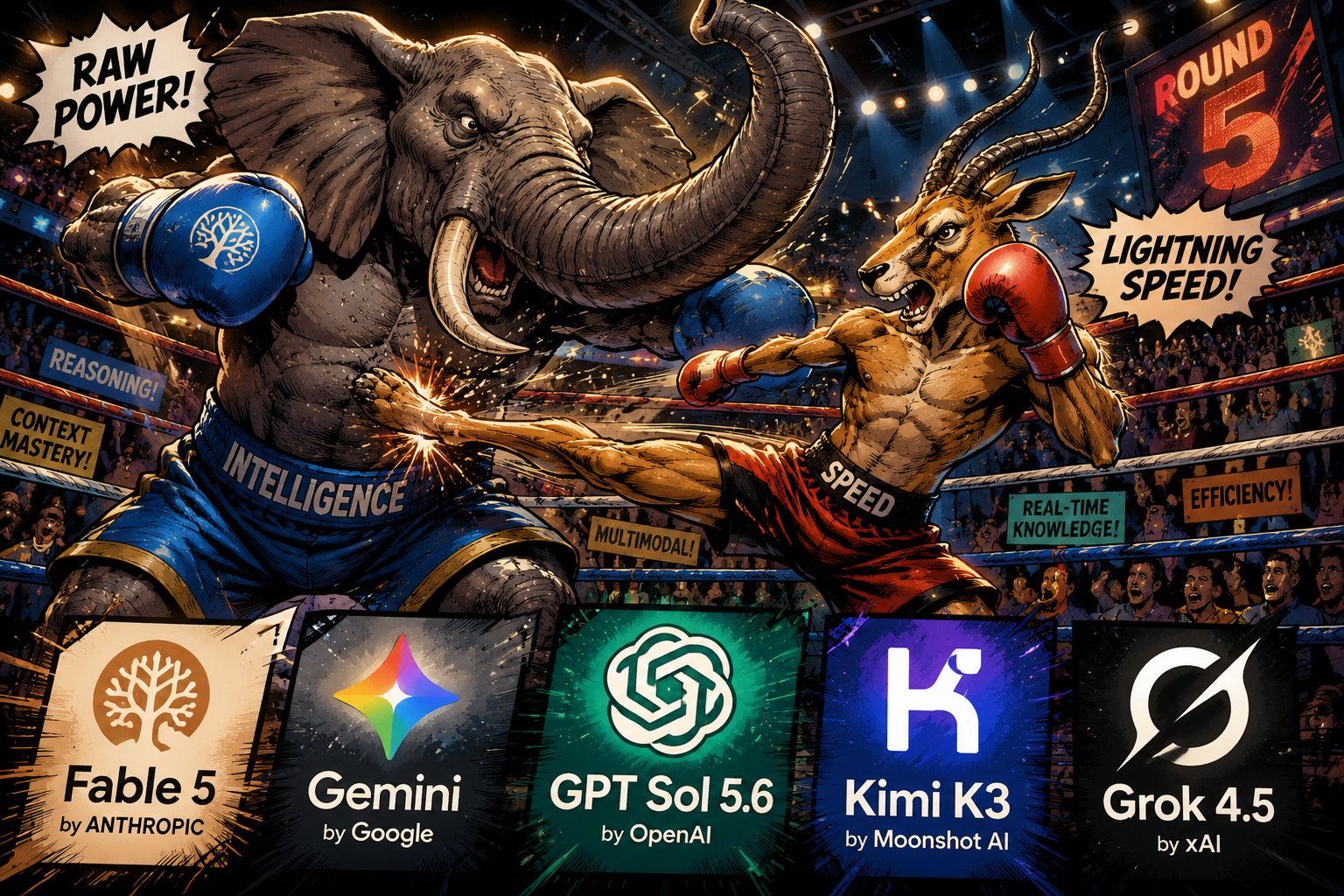
Anthropic’s Claude Fable 5 currently occupies the top position on several broad intelligence rankings. OpenAI’s GPT-5.6 Sol is close enough that the difference often disappears in practical use, while benefiting from the reach and tooling of ChatGPT. Moonshot AI’s Kimi K3 has placed an open-weight model within striking distance of the most powerful proprietary systems. SpaceXAI’s Grok 4.5 offers an unusually aggressive combination of speed, price and directness. Google’s Gemini 3.5 Flash, meanwhile, demonstrates that a fast model deeply embedded in a global product ecosystem can be more strategically valuable than a slower model with a slightly higher benchmark score.
The result is not a conventional ranking in which first place is excellent and fifth place is mediocre. Every model in this comparison is capable of work that would have seemed extraordinary only a few years ago. The important differences are subtler: how reliably a model follows complicated instructions, how long it can sustain a task, how frequently it invents information, how it behaves when requirements conflict, how much it costs to operate, and whether users actually enjoy collaborating with it.
This comparison examines five leading publicly available models: Claude Fable 5, GPT-5.6 Sol, Kimi K3, Grok 4.5 and Gemini 3.5 Flash. It combines independent benchmarks, developer evaluations, human-preference rankings, pricing, context windows, adoption estimates and recurring subjective opinions from active users.
The central conclusion is simple. There is no universally best AI model. There are, however, increasingly clear winners for particular kinds of work.
How to Compare Models Without Being Misled
AI benchmarks are valuable, but they are not neutral measurements of some universal quantity called intelligence.
A mathematics test rewards formal reasoning. A coding benchmark may measure whether a model can repair real software repositories. An agent benchmark evaluates whether it can use tools and complete a sequence of actions. A human-preference leaderboard asks people which of two answers they like better. These evaluations overlap, but they do not measure the same thing.
This is why the benchmark picture looks contradictory. On the Artificial Analysis Intelligence Index, which aggregates several difficult evaluations, Claude Fable 5 scores 60. GPT-5.6 Sol at maximum reasoning scores 59, Kimi K3 scores 57, Grok 4.5 scores 54 and Gemini 3.5 Flash scores 50.
That appears to produce a straightforward order. Human preferences complicate it.
In the Arena.ai text leaderboard published on July 16, Claude Fable 5 held first place with a score of 1507. Kimi K3 and GPT-5.6 Sol were effectively tied around 1486, although both results were based on fewer votes than longer-established models. Gemini 3.5 Flash sat within the top group but below those three. Grok 4.5 ranked considerably lower in the general text arena despite performing strongly on several independent reasoning and efficiency tests.
This does not mean one leaderboard is correct and another is defective. It means users evaluate qualities that conventional tests do not capture fully. People notice tone, pacing, formatting, unnecessary disclaimers, conversational warmth, willingness to make a decision and the amount of editing needed before an answer becomes useful.
Speed and cost introduce another dimension. Artificial Analysis measured Gemini 3.5 Flash at roughly 157 output tokens per second, Grok 4.5 at about 97, Claude Fable 5 at 66, Kimi K3 at 62 and GPT-5.6 Sol at 54. These values can change with infrastructure, reasoning settings and provider load, but they illustrate the trade-off. The models with the highest intelligence scores are not necessarily the fastest.
The same is true of price. At representative blended usage rates tracked by Artificial Analysis, Claude Fable 5 was the most expensive of this group. GPT-5.6 Sol cost less, while Kimi K3, Grok 4.5 and Gemini 3.5 Flash offered progressively more aggressive economics. For a consumer sending a few prompts, these differences may be invisible. For a company processing hundreds of millions of tokens, they can determine whether an application has a viable business model.
A responsible comparison must therefore treat intelligence, preference, speed, cost, ecosystem and adoption as separate variables.
| Model | Broad intelligence score | Context window | Approximate output speed | Best available reach indicator |
|---|---|---|---|---|
| Claude Fable 5 | 60 | Around 1 million tokens | 66 tokens per second | Claude app estimated at 56 million monthly active users |
| GPT-5.6 Sol | 59 | About 1.05 million tokens | 54 tokens per second | ChatGPT exceeds 900 million weekly active users |
| Kimi K3 | 57 | About 1.05 million tokens | 62 tokens per second | No reliable current global total publicly disclosed |
| Grok 4.5 | 54 | 500,000 tokens | 97 tokens per second | Grok reached 17.8% of the US chatbot app market in early 2026 |
| Gemini 3.5 Flash | 50 | Around 1 million tokens | 157 tokens per second | Gemini exceeds 900 million monthly active users |
These adoption figures are not directly comparable. OpenAI reports weekly users, Google reports monthly users, Claude’s figure comes from a third-party app estimate, and Grok’s public data frequently measures market share rather than a consolidated global audience. Model usage is also not the same as product usage. ChatGPT and Gemini can route requests between several models, meaning not every user is interacting with the flagship system examined here.
Even with those limitations, adoption matters. A model’s practical influence depends on distribution as much as raw intelligence.
Claude Fable 5: The Deliberate Expert
Claude Fable 5 is the strongest candidate for the title of most intellectually capable general-purpose model currently available to ordinary developers and professional users.
It leads the Artificial Analysis Intelligence Index and the Arena.ai text leaderboard. It also performs particularly well on advanced mathematics, analytical work and tasks that require sustained reasoning over long periods. On the most difficult tier of the FrontierMath evaluation, Fable 5 recorded a reported score of 87.8%, ahead of the other broadly available systems measured in that test.
Those results reflect Claude’s defining quality: it tends to take the structure of a difficult problem seriously.
When asked to analyze a complex contract, debug an unfamiliar codebase, compare competing strategic plans or explain a technical dispute, Claude often produces an answer that feels considered rather than merely fluent. It is particularly good at identifying hidden assumptions, separating evidence from speculation and maintaining a consistent argument across a long response.
This makes Fable 5 attractive for research, financial analysis, legal drafting, software architecture, policy work and other domains where the quality of the reasoning process matters more than immediate response speed.
Its writing is another major advantage. Claude has long been popular among editors, researchers and developers who dislike the formulaic tone associated with some AI-generated text. Fable 5 generally handles voice, rhythm and transitions well. It can produce polished prose without automatically dividing every thought into a collection of headings and numbered lists. It is also unusually capable of preserving stylistic constraints across lengthy documents.
Subjective user research supports this reputation. A 2026 cross-platform survey of active chatbot users found that Claude attracted people primarily because of perceived answer quality. In the same research, ChatGPT was more strongly associated with interface quality, while Grok attracted users partly through its less restrictive content policies.
Claude’s coding performance is equally important. Anthropic’s broader model family has become deeply associated with agentic programming, largely through Claude Code. Developers frequently praise Claude for reading large repositories, understanding relationships between files and proposing coherent changes instead of isolated snippets. Its strongest coding advantage is not necessarily writing a single function. It is maintaining a workable mental model of an evolving project.
Fable 5 is also designed for long-running agents. A one-million-token context window allows it to inspect substantial document collections or code repositories, although a large context window should never be confused with perfect memory. Like every model, Claude can overlook information buried in an enormous prompt, particularly when instructions are duplicated or contradictory.
Its weaknesses emerge from the same characteristics that make it strong.
Claude can be slow and expensive. At its highest reasoning settings, it may spend substantial time and tokens exploring a problem before delivering an answer. For a high-value analysis, that deliberation may be desirable. For customer support classification, simple extraction or an interactive application, it can be wasteful.
Its API pricing reinforces that concern. Fable 5 is positioned as a premium model, and its representative cost is substantially higher than Grok 4.5, Gemini 3.5 Flash or many open-weight alternatives. Anthropic has improved the range of lower-cost models around it, but Fable itself is not designed to be the default engine behind every routine prompt.
Claude can also be overly cautious. Users regularly report that it interprets ambiguous requests conservatively, adds safety qualifications that interrupt the flow or declines requests that another model would complete. The exact experience varies by model version and system configuration, but the perception has remained persistent across Claude generations.
There is a subtler limitation. Claude’s thoughtful tone can make uncertainty sound like judgment. Its answers are often elegantly reasoned, which may encourage users to trust conclusions that still depend on incomplete or incorrect information. Good prose is not proof of factual accuracy.
Claude therefore works best with users who value depth, can tolerate some latency and know how to verify high-stakes claims. It is the strongest choice in this group for difficult writing, nuanced analysis and large software tasks. It is a weaker choice for extremely price-sensitive applications or workflows that need instant, lightweight responses.
GPT-5.6 Sol: The Most Complete Generalist
GPT-5.6 Sol does not lead every benchmark, but it may be the most complete AI product when model quality, tools, distribution and workflow integration are considered together.
Its Artificial Analysis score of 59 places it only one point behind Claude Fable 5. In practical terms, that difference is too small to justify declaring Claude universally more capable. The models have different performance profiles, and prompt design can matter more than a one-point gap in an aggregate index.
OpenAI reports that GPT-5.6 Sol achieved 92.2% on BrowseComp, an evaluation of difficult web-research tasks, and 62.6% on OSWorld 2.0, which tests a model’s ability to operate computer interfaces. It also demonstrated major improvements in multistage scientific reasoning, agentic research and professional knowledge work.
Its defining strength is breadth.
GPT-5.6 Sol can write, code, browse, analyze images, operate tools, work with files and participate in extended agentic workflows. Individual competitors may outperform it in specific areas, but few combine so many abilities within one mature consumer and enterprise environment.
This matters because users rarely buy intelligence as an isolated API score. They buy an outcome. A researcher may need the model to search, inspect documents, run calculations and produce a report. A developer may need it to understand an issue, modify a repository and test the result. A business user may need it to connect with internal applications and complete a task rather than merely explain how the task should be completed.
OpenAI’s advantage is that GPT-5.6 Sol sits inside the most widely adopted AI platform. OpenAI reported more than 900 million weekly active ChatGPT users in early 2026 and more than 50 million consumer subscribers. Sensor Tower subsequently estimated that the ChatGPT app reached one billion monthly active users in May.
Those numbers are not a direct measure of GPT-5.6 Sol usage. ChatGPT serves multiple models and automatically routes some requests. They nevertheless reveal the scale of OpenAI’s distribution. More people understand how to use ChatGPT, more businesses already support it, and more third-party products are designed around OpenAI-compatible interfaces.
Subjectively, GPT-5.6 Sol feels highly adaptable. It is usually good at inferring the desired format, balancing detail with readability and recovering when a user changes direction. Compared with earlier GPT generations, it is less likely to become trapped in shallow patterns when a task requires several stages of reasoning.
It is especially strong for mixed work. Claude may be preferable for a dense policy memorandum, while Gemini may be preferable for a heavily multimodal Google-based workflow. GPT-5.6 Sol is often the safer choice when the task crosses several categories and the user does not yet know which capabilities will become important.
OpenAI’s research and computer-use results strengthen that position. GPT-5.6 Sol is not merely a chatbot with a better answer generator. It is increasingly an action model capable of navigating software environments and coordinating tools.
Its weaknesses are mostly related to cost, predictability and product complexity.
GPT-5.6 Sol is cheaper than Claude Fable 5 in representative independent measurements, but it remains considerably more expensive than Grok 4.5 or Gemini 3.5 Flash. Maximum reasoning can also generate long internal computations, making cost and latency difficult to predict in applications where prompts vary significantly.
The system’s flexibility can introduce behavioral inconsistency. ChatGPT may route prompts differently depending on plan, mode, load or product settings. Consumers do not always know which model configuration produced a particular answer. Developers have more control through fixed API versions, but they must still manage model updates and changing tool behavior.
OpenAI models also have a recognizable stylistic tendency toward polished structure. This is useful for business communication but can feel overly packaged. GPT answers sometimes convert straightforward requests into frameworks, categories and summaries that the user did not ask for. Careful prompting reduces this behavior, but it remains a common subjective complaint.
Another concern is ecosystem dependence. A company that builds deeply around OpenAI’s agents, file systems, tool protocols and hosted workflows can gain enormous productivity, but it also becomes more sensitive to pricing changes, policy decisions and product redesigns.
GPT-5.6 Sol is therefore the best overall choice for users who want one model to cover the widest range of serious work. It may not be the absolute leader in prose, coding, price or speed, but it has the fewest severe weaknesses. That balance, combined with ChatGPT’s distribution, makes it the model most likely to remain the default reference point for the industry.
Kimi K3: The Open-Weight Disruptor
Kimi K3 is the most strategically significant model in this comparison.
Moonshot AI’s new system demonstrates that the highest tier of AI performance is no longer reserved for a small group of closed American laboratories. Kimi K3 scores 57 on the Artificial Analysis Intelligence Index, placing it behind Claude Fable 5 and GPT-5.6 Sol but ahead of many proprietary systems. In the Arena.ai text leaderboard, its preliminary score put it approximately level with GPT-5.6 Sol in human preference.
That is an extraordinary position for an open-weight model.
Moonshot describes Kimi K3 as a 2.8-trillion-parameter mixture-of-experts system built for long-horizon coding, advanced reasoning and end-to-end knowledge work. The full parameter count is less important than the architecture’s active computation, but the scale shows the ambition behind the release. Its context window exceeds one million tokens, enabling it to process large repositories, extensive research material or long organizational records.
Kimi’s strongest practical advantage is control.
OpenAI, Anthropic, Google and SpaceXAI operate proprietary frontier models. Customers access them through hosted products or APIs and must accept the provider’s pricing, policies, availability and update schedule. An open-weight model can be inspected, adapted and deployed through a broader range of infrastructure, subject to its license and the organization’s technical resources.
That flexibility is particularly attractive to companies concerned about data sovereignty, vendor concentration or long-term inference costs. It is also valuable to researchers who want to fine-tune a frontier-class model or study its behavior more directly.
Kimi K3’s economics are aggressive. Its published API pricing sits below the premium models from OpenAI and Anthropic, while its independent intelligence score remains close to both. Artificial Analysis also measured a much shorter time to first token than the most deliberative versions of Claude and GPT, although complete task time depends on reasoning settings and output length.
Developers have praised earlier Kimi generations for coding, long-context work and value. K3 extends that reputation into a more general knowledge-work model. It appears particularly promising for autonomous software tasks, document-heavy research and agent systems that would become prohibitively expensive on premium proprietary APIs.
It may also prove important for multilingual AI. Moonshot originates in China, and Kimi has historically performed well with Chinese-language material while remaining competitive in English. Global organizations that operate across both linguistic environments may find that more valuable than a marginal advantage on English-centric benchmarks.
The weaknesses are significant, however.
Kimi K3 is extremely new. Its early Arena score was based on only a few thousand votes, far fewer than established models such as Gemini 3.1 Pro. Initial benchmark performance can change as researchers discover prompt sensitivities, evaluation contamination, reliability problems or weaknesses in less-publicized tasks.
Open weights also do not mean easy deployment. A model of K3’s scale requires substantial infrastructure. Most companies will still access it through a cloud provider rather than operate the full system themselves. The freedom to self-host is strategically meaningful, but it is not automatically economical for smaller teams.
Moonshot’s global support ecosystem is less mature than those of OpenAI, Google or Anthropic. Documentation, enterprise integrations, compliance programs and regional customer support can matter more than benchmark scores when a model enters production. Kimi has progressed quickly, but it must prove that it can support demanding international customers over time.
Geopolitical risk is another factor. Chinese AI models are becoming popular because they offer strong capability at lower prices, yet organizations in regulated sectors may face restrictions concerning data processing, procurement or cross-border technology. Conversely, Chinese organizations may view Kimi’s domestic origins as an advantage over American providers. The calculation depends on jurisdiction.
Kimi’s consumer reach is also difficult to quantify. Public reports have provided various historical estimates, but Moonshot has not disclosed a current consolidated global active-user figure comparable with OpenAI or Google. Earlier Kimi products achieved significant adoption in China, then lost consumer ranking during the rise of DeepSeek and other competitors. K3 could reverse that trajectory, but benchmark attention is not the same as durable user loyalty.
Kimi K3 is consequently the strongest option for organizations that prioritize open weights, model control and high capability per dollar. It is not yet the safest choice for a conservative enterprise seeking a mature global vendor relationship. Its importance lies in what it changes: proprietary frontier labs can no longer assume that openness requires accepting dramatically weaker intelligence.
Grok 4.5: The Fast, Unfiltered Challenger
Grok 4.5 occupies an unusual position. Independent measurements suggest that it is technically formidable, particularly relative to its price, but human-preference rankings and enterprise adoption do not place it in the same tier as its strongest benchmark results.
On the Artificial Analysis Intelligence Index, Grok 4.5 at high reasoning scores 54. That puts it below Claude Fable 5, GPT-5.6 Sol and Kimi K3 but above most mass-market models. Its representative output speed of roughly 97 tokens per second is considerably faster than the three systems above it. Its blended cost is also substantially lower.
For developers, that combination is compelling. A model does not need to be number one to be commercially superior. If it produces 95% of the desired quality at a fraction of the latency and cost, it may be the better production model.
SpaceXAI positions Grok 4.5 for coding, agentic work, science, engineering and knowledge tasks. Its 500,000-token context window is smaller than those of Claude, GPT, Kimi and Gemini in this comparison, but still large enough for extensive documents and software repositories.
Grok’s subjective appeal is distinct from its technical performance. It tends to sound more direct, informal and willing to take a position. Users who dislike heavily filtered assistants often perceive Grok as less paternalistic. The 2026 cross-platform user survey found that Grok attracted users partly because of its content policy, whereas Claude was more closely associated with answer quality and ChatGPT with interface design.
Its connection to X also gives it cultural immediacy. Grok can engage with fast-moving online discussions, public posts and breaking narratives in a way that feels native to social media. For trend monitoring, rapid public-sentiment analysis and internet culture, that integration can be useful.
Distribution through X helped Grok grow quickly. Apptopia data reported by Reuters showed its US chatbot market share rising from 1.9% in January 2025 to 17.8% in January 2026. This made it one of the most-used chatbot applications in the United States, although market-share estimates vary depending on whether the measurement includes web, mobile, embedded usage or time spent.
The major weakness is trust.
Grok’s lower Arena.ai position suggests that users do not consistently prefer its responses when shown anonymous side-by-side comparisons. Grok 4.5 ranked around 34th in the general text leaderboard shortly after release, well behind its placement on the Artificial Analysis index. The limited number of initial votes means that position may change, but the gap is too large to ignore.
One explanation is style. Directness can become carelessness. Grok may provide an answer quickly without matching the nuance, organization or restraint of Claude and GPT. For brainstorming or informal analysis, that can feel refreshing. For legal, financial, medical or executive work, it may create extra verification and editing.
Safety controversies surrounding Grok’s image tools and its deployment on X have also affected confidence in the broader product. Even organizations that never use those functions must consider reputational risk, governance practices and the maturity of the provider’s controls.
Enterprise adoption appears weaker than consumer awareness. Reuters reported limited use of Grok across US government applications compared with OpenAI, Anthropic and Google. Some agencies and businesses have preferred competitors because of security, functionality or procurement requirements.
Grok 4.5 is therefore best understood as a high-performance value model with a distinctive personality. It is attractive for fast coding, high-volume agent workloads, research experiments and applications where cost matters. It is less attractive for conservative institutions that prioritize predictable behavior, mature compliance and neutral presentation.
Gemini 3.5 Flash: The Ecosystem Powerhouse
Gemini 3.5 Flash has the lowest broad intelligence score of the five models in this comparison, yet dismissing it as the weakest would be a serious strategic mistake.
Google designed 3.5 Flash to deliver frontier-level capabilities at high speed. Its Artificial Analysis score of 50 trails the premium reasoning models, but its measured output speed of approximately 157 tokens per second is the fastest in this group. Its pricing is also among the most competitive.
More importantly, Gemini is not merely an API or chatbot. It is part of a global software ecosystem that includes Search, Android, Workspace, Cloud, YouTube and a growing collection of agentic products.
Google reported more than 900 million monthly active users for the Gemini application in May 2026, up from 400 million one year earlier. Daily requests increased more than sevenfold over the same period. That puts Gemini’s consumer reach in the same general class as ChatGPT, even though OpenAI reports weekly users and Google reports monthly users.
Distribution on that scale changes the meaning of model competition. A slightly stronger model may be less useful than one already connected to a person’s email, files, calendar, documents, phone and search history. Gemini can become valuable through context and integration even when another model produces a better isolated answer.
Gemini 3.5 Flash is especially strong in multimodal work. Google reported leading results on visual reasoning tests and major improvements in coding, terminal use and agent protocols. The model can process text, images, audio and other media within a single workflow, building on Google’s long-standing strengths in vision and large-scale information retrieval.
Its one-million-token context window makes it suitable for lengthy documents and codebases. Its speed makes it effective for interactive applications, voice systems, real-time assistance and large-volume enterprise processing.
For businesses already using Google Cloud or Workspace, Gemini can offer the lowest integration friction. Security controls, identity management, document access and organizational permissions may already exist. This operational advantage rarely appears on benchmark charts, but it can outweigh a moderate quality difference.
Gemini’s weakness is inconsistency.
Users often describe its best answers as excellent and its ordinary answers as uneven. It may solve a sophisticated visual or scientific problem, then mishandle a comparatively simple instruction. The model’s performance can depend heavily on the specific Gemini mode, reasoning level, product surface and integration being used.
Google’s naming and release strategy adds confusion. Gemini 3, 3.1 Pro, 3.5 Flash, specialized live models and product-specific variants can coexist, while planned flagship releases may be delayed or previewed separately. Technical users can navigate this complexity, but consumers may not know which model they are evaluating.
Its writing is generally competent but less consistently distinctive than Claude’s. Gemini can also over-rely on broad summaries when a prompt requires a decisive interpretation. In extended conversations, it may lose stylistic or procedural constraints even when the raw context remains available.
The gap between Gemini’s enormous adoption and its lower independent intelligence score reveals an important reality: mass-market users do not choose models by benchmark alone. Availability, speed, price and integration can be more influential.
Gemini 3.5 Flash is the best choice for high-volume multimodal applications, Google-centered workflows and products where latency matters. It is less convincing for the most demanding long-form reasoning, where Claude Fable 5 or GPT-5.6 Sol usually provides a stronger baseline.
What User Numbers Really Tell Us
The adoption contest appears to have two giants and three challengers.
ChatGPT has more than 900 million weekly active users, while the Gemini app has more than 900 million monthly active users. Because weekly and monthly activity are different measurements, ChatGPT’s figure represents a higher level of repeated engagement. Sensor Tower’s estimate of one billion monthly ChatGPT app users further reinforces OpenAI’s lead in consumer habit.
Claude remains much smaller, although it has been growing rapidly. Sensor Tower estimated 56 million monthly active users for the Claude mobile app during the second quarter of 2026. That number excludes some web and enterprise usage, and Anthropic has not published a consolidated total.
Grok has achieved substantial US reach through X and its standalone applications, reaching an estimated 17.8% of the American chatbot app market in January. Its penetration appears stronger among consumers than in enterprises and government.
Kimi’s present global audience is the hardest to measure. Historical estimates show meaningful adoption, especially in China, but no current figure is sufficiently reliable for direct comparison with ChatGPT or Gemini.
These figures reveal distribution, not model quality. They are influenced by preinstallation, brand recognition, free access, mobile availability and integration with existing services. Google can place Gemini inside products used by billions. Grok benefits from X. ChatGPT benefits from becoming the generic term many consumers use for conversational AI.
Claude and Kimi must earn adoption more directly through performance.
User scale nevertheless creates a feedback advantage. A widely used product can observe more failure patterns, test more interfaces and support a larger third-party ecosystem. It can also become familiar enough that switching feels inconvenient, even when another model performs better on a particular task.
Yet engaged AI users increasingly refuse to choose only one platform. The cross-platform survey of 388 active users found that more than 80% used at least two AI services. This suggests that the market may evolve less like traditional search, where one engine dominated, and more like cloud computing, where organizations combine several providers.
The Subjective Verdict
Benchmarks can identify capability, but preference determines whether people continue using a system.
Claude Fable 5 feels like the strongest analytical collaborator. Its answers are usually coherent, nuanced and well written. It is the model most likely to notice that the user has asked the wrong question. Its downside is that it can be expensive, slow and too cautious.
GPT-5.6 Sol feels like the strongest universal professional tool. It may not be as elegant as Claude in every writing task or as cheap as Grok and Gemini, but it is consistently capable across more categories. Its ecosystem is the most mature, although that ecosystem can also become complicated and difficult to leave.
Kimi K3 feels like the industry’s most important economic challenge. It offers near-frontier intelligence, open weights and competitive pricing. Its weaknesses are uncertainty, deployment scale, support maturity and the absence of long-term evidence about reliability.
Grok 4.5 feels like the most aggressive value proposition. It is fast, inexpensive and refreshingly direct. It is also the model in this comparison most likely to require additional governance, fact-checking and tone control.
Gemini 3.5 Flash feels like the model designed for ubiquity. It is fast, multimodal and integrated into a software empire. Its strongest argument is not that it wins every test, but that it can be present everywhere. Its weakness is that raw availability does not always translate into consistent depth.
Which Model Should You Choose?
For high-stakes analysis, complex writing and large coding projects, Claude Fable 5 is the strongest first choice. It offers the best combination of reasoning discipline, prose quality and long-horizon coherence.
For organizations seeking one primary AI provider across research, coding, automation and everyday knowledge work, GPT-5.6 Sol is the most balanced option. Its small benchmark deficit relative to Claude is offset by superior distribution and a broader product ecosystem.
For teams that need open weights, lower costs and deployment control, Kimi K3 is the clear strategic candidate. It should still be evaluated carefully under real production conditions because its public track record is short.
For cost-sensitive, latency-sensitive applications that can tolerate more behavioral variation, Grok 4.5 deserves serious consideration. It may be particularly effective as one component in a routed multi-model system.
For multimodal applications, Google Workspace integration and large-scale interactive services, Gemini 3.5 Flash is likely to offer the strongest operational package.
The most sophisticated answer is not to choose one.
A company might use Gemini for fast document classification, Grok for inexpensive first-pass research, Kimi for controlled internal deployment, Claude for final analysis and GPT for tool-rich orchestration. Model routing adds engineering complexity, but it reduces dependence on any one provider and allows each task to reach the system best suited to it.
That multi-model future is becoming more likely because the performance gaps are narrowing. A difference of three or five benchmark points matters at the frontier, but it rarely justifies sending every prompt to the same model.
The Real Winner Is the Portfolio
Claude Fable 5 currently deserves the technical crown. It leads the broadest independent intelligence ranking and the largest human-preference text arena. For difficult reasoning, writing and coding, it is the model to beat.
GPT-5.6 Sol remains the overall market leader. Its intelligence is nearly equal to Claude’s, its tool capabilities are formidable and ChatGPT’s scale gives OpenAI an unmatched distribution advantage.
Kimi K3 is the disruptive winner. It proves that an open-weight model can compete near the top rather than occupying a separate, lower-quality category.
Grok 4.5 is the efficiency winner. Its speed and pricing make it more commercially interesting than its general preference ranking might suggest.
Gemini 3.5 Flash is the platform winner. Google can place capable, fast multimodal intelligence inside products that already mediate work, communication and information for much of the world.
The most important weakness is shared by all five models. None is reliably truthful. All can produce false claims, misunderstand incomplete prompts, accept flawed assumptions or express uncertainty poorly. Research into chatbot performance on current news has found that retrieval failures remain a major source of error, while tests of academic references continue to show that even advanced systems can fabricate citations.
The models are improving rapidly, but fluency continues to advance faster than reliability.
That is why the correct question is no longer, “Which AI is smartest?” The more useful question is, “Which model creates the least dangerous failure mode for this particular task?”
Claude’s failure may be overcaution. GPT’s may be polished overconfidence. Kimi’s may be insufficiently tested behavior. Grok’s may be excessive directness. Gemini’s may be inconsistency concealed by seamless integration.
Understanding those differences is more valuable than memorizing a leaderboard.
The AI market of 2026 has no permanent champion because the contest is no longer being fought on one field. Intelligence, price, speed, openness, user experience and distribution are separate competitions. Claude currently leads some of the most important ones. ChatGPT leads the largest. Gemini possesses the broadest route into existing digital life. Grok is challenging the economics of proprietary APIs, and Kimi is challenging the assumption that frontier intelligence must remain closed.
The five-way fight will continue, and the rankings will change. The durable advantage will belong not to the company that briefly wins the most benchmarks, but to the model that becomes trustworthy enough, affordable enough and useful enough to remain inside real human workflows.

Artificial intelligence writing 90% of a company’s software sounds like the beginning of a mass layoff announcement. Anthropic CEO Dario Amodei sees it differently—at least initially. In his view, automating most of a job does not immediately eliminate the worker. It creates a productivity surge in which humans concentrate their time on the small portion the machine still cannot complete.
That distinction sits at the center of Amodei’s increasingly provocative argument about the future of work.
When Claude generates most of the code, engineers do not necessarily disappear. They become reviewers, architects, product designers, security investigators and managers of increasingly capable digital workers. The human contribution shrinks as a percentage of the production process, but the output of each person can rise dramatically.
The more unsettling question is what happens when AI masters the final 10%.
Amodei’s answer reaches far beyond software development. He imagines artificial intelligence becoming the cognitive core of companies, helping organizations reason, coordinate and execute at a level that makes the modern enterprise resemble a form of collective superintelligence.
It is an ambitious vision combining extraordinary productivity, accelerated medical discovery and potentially severe disruption to white-collar employment.
Writing Code Is Not the Same as Doing the Job
The percentage of code written by AI has become one of the most widely repeated statistics in the technology industry.
Amodei has said that Claude now produces most of the code written by some engineers inside Anthropic. In parts of the company, developers may no longer type significant amounts of code manually. They describe the intended feature, direct the model, inspect its output, test the implementation and intervene when something goes wrong.
This is a fundamental change in the interface between an engineer and a computer.
Traditional software development requires humans to translate ideas into precise instructions written in programming languages. AI coding agents can absorb much of that translation work. A developer can increasingly communicate at the level of goals, constraints and architecture while the model handles implementation.
But lines of code are a poor measurement of complete job automation.
Compilers already generate enormous quantities of machine code, yet their arrival did not make programmers unnecessary. Higher-level programming languages automated much of the work once performed manually, allowing developers to build larger and more complex systems.
Claude writing 90% of a codebase may therefore say less about the disappearance of engineers than it does about the abstraction level at which they work.
The remaining 10% can still contain the most difficult and consequential decisions. Someone must determine what should be built, understand the needs of users, choose between competing technical designs, identify security risks and decide whether the output is safe to deploy.
AI can generate a plausible implementation in minutes. Knowing whether it solves the correct problem remains a different challenge.
The Productivity Hump
Amodei describes a transitional period in which automation produces an enormous increase in productivity before it produces full replacement.
Imagine that AI can reliably perform 90% of the work involved in a software project. The engineer is still necessary because the final 10% requires human judgment, organizational knowledge or technical expertise. Yet the engineer can now spend nearly all available time on those remaining tasks.
In simplified terms, one engineer may become capable of supervising the volume of work previously handled by ten.
Companies could respond by reducing staff, but they could also build far more software. Projects previously rejected as too expensive could become viable. Internal tools that never reached the top of the development queue could be created quickly. Small teams could launch products that once required large engineering departments.
This is the productivity hump: the period in which humans remain essential but become dramatically more leveraged.
The economic consequences will depend on how much additional demand appears. When productivity rises, companies do not always reduce employment proportionally. Lower costs can create new markets, new products and new categories of work.
However, that protection has limits.
If AI advances from writing most of the code to completing nearly the entire software-engineering process, the remaining human bottleneck begins to disappear. The model would not merely implement a feature. It would identify the requirement, inspect the existing system, design the solution, configure the environment, run tests, diagnose failures, document the change and prepare it for deployment.
At that point, engineering becomes less about humans using better tools and more about humans assigning objectives to autonomous systems.
From Roughly 5% to More Than 77%
The speed of improvement in coding benchmarks helps explain Amodei’s confidence.
The original SWE-bench evaluation was designed around genuine software issues collected from public GitHub repositories. Instead of asking a model to write a small function or solve an interview-style coding puzzle, it required the system to understand an existing codebase and generate a patch that resolved a documented problem.
Early results were poor. Claude 2 resolved only a small percentage of the tasks under the initial evaluation setup. The result demonstrated how far language models still had to go before they could perform practical repository-level software engineering.
Later Claude models made rapid gains. Anthropic reported that Claude Sonnet 4.5 achieved 77.2% on SWE-bench Verified, a human-reviewed subset containing 500 software problems.
The figures should not be treated as a perfectly controlled comparison. The benchmark variant, model scaffolding, prompting strategy, tool access and evaluation methodology changed over time. A score on the original benchmark is not directly interchangeable with a score on the Verified subset.
Even with those caveats, the direction of travel is difficult to ignore.
AI coding systems have moved from solving only the simplest isolated issues to handling substantial portions of carefully selected real-world software tasks. They can navigate repositories, edit multiple files, execute commands, run tests and revise their own attempts.
Benchmarks still do not capture the complete reality of production engineering. Real companies have undocumented systems, conflicting stakeholder demands, legacy infrastructure and security requirements that cannot be represented by a clean test suite.
Yet the improvement suggests that the islands of work reserved for humans are becoming smaller.
A Medical Story With Larger Implications
Amodei has also used a personal family experience to illustrate how AI can identify patterns across complicated information.
According to his account, his sister and Anthropic co-founder Daniela Amodei developed an infection while pregnant. Several doctors believed the illness was viral. After her medical information was provided to Claude, the model suggested that the infection could instead be bacterial.
The anecdote is powerful because it captures a potential advantage of medical AI: the ability to process a large volume of records, symptoms and reference material without fatigue.
A doctor may have limited time with each patient and may receive information spread across laboratory reports, previous appointments, medication histories and specialist notes. A model can examine those records together and surface possibilities that deserve another look.
That does not make Claude a replacement for a physician.
A personal account is not a clinical trial, and an AI-generated suggestion should not be treated as a verified diagnosis. Language models can misunderstand records, overlook critical context or produce confident but inaccurate conclusions. Medical decisions also require physical examinations, professional accountability and an understanding of the patient that cannot always be captured in uploaded data.
The more realistic near-term role is that of a second reader.
An AI system can summarize a patient’s history, identify unusual combinations of symptoms, compare test results over time and suggest questions for a clinician. The doctor remains responsible for evaluating those suggestions and deciding whether further tests or treatments are appropriate.
The same productivity dynamic seen in coding could emerge in medicine. AI handles the information-intensive portion of the work, allowing medical professionals to spend more time on difficult judgments, procedures and patient relationships.
The stakes, however, are much higher. A coding error may break an application. A medical error can harm a person.
The Enterprise as a Collective Intelligence
Amodei’s broadest idea concerns the nature of the company itself.
An enterprise already behaves like a distributed intelligence. It collects information from customers and markets, stores institutional knowledge, assigns tasks, makes decisions and coordinates the actions of thousands of people.
Executives act as strategic planners. Managers distribute information and resources. Employees operate as specialized units. Databases and software systems function as organizational memory.
The result is more capable than any individual person.
Placing AI at the center of that structure could make the organization faster, more coordinated and more responsive. Instead of acting as a chatbot used by isolated employees, the model could become a shared reasoning layer connected to the company’s data, applications and operational processes.
An AI-centered enterprise might monitor sales activity, examine customer feedback, analyze product performance and recommend changes continuously. It could draft software updates, prepare financial forecasts, identify supply-chain risks and coordinate specialized agents responsible for different departments.
Human employees would establish objectives, approve sensitive decisions and intervene when judgment or accountability is required.
In this model, AI is not simply another application purchased by the information-technology department. It becomes part of the company’s operating system.
That prospect explains why enterprise AI is strategically important to Anthropic. Consumer chatbots attract public attention, but organizations control enormous collections of proprietary data and repeatable workflows. Connecting models to those systems could generate far greater economic value than answering standalone questions.
The New Bottleneck Is Judgment
As AI takes over execution, the value of human work may shift toward deciding what deserves to be executed.
A model can write a technically correct feature that customers do not need. It can optimize a metric that damages the wider business. It can confidently follow instructions that were badly designed from the beginning.
Greater execution capacity can therefore magnify poor judgment.
When software becomes cheaper to produce, companies may generate more unnecessary complexity. When reports become effortless to create, employees may drown in synthetic analysis. When autonomous agents can perform thousands of actions, a poorly specified objective can produce failures at extraordinary speed.
The most valuable workers may be those who understand systems deeply enough to direct AI effectively and recognize when its output is misleading.
That requires more than clever prompting. It requires domain knowledge, skepticism, taste and accountability.
Junior roles present a particular challenge. Companies traditionally develop senior experts by giving beginners routine tasks and gradually exposing them to harder problems. If AI absorbs the entry-level work, organizations may struggle to train the people eventually expected to supervise advanced systems.
A company cannot indefinitely remove the bottom rung of the career ladder while expecting experienced professionals to appear at the top.
Productivity and Displacement Can Both Be True
The optimistic and pessimistic interpretations of Amodei’s argument are not mutually exclusive.
AI can make engineers ten times more productive and still reduce the total number of engineers companies need. It can create new products while eliminating familiar roles. It can help doctors detect overlooked conditions while introducing new forms of diagnostic risk.
The outcome will not be determined by a single automation percentage.
It will depend on how quickly new demand develops, whether organizations reinvest productivity gains, how governments respond and whether humans can continue moving into new areas of comparative advantage.
The transition may also unfold unevenly. The strongest engineers could become dramatically more valuable because they can manage fleets of coding agents. Less experienced developers may face fewer opportunities. Large companies could become leaner, while small teams gain the power to compete with established organizations.
The result could be both democratizing and concentrating at the same time.
What Happens When AI Learns the Rest?
The most important part of Amodei’s argument is not that Claude writes 90% of the code. It is that the remaining percentage may not remain protected for long.
Today’s models still need supervision. They make mistakes, lose track of objectives and struggle with ambiguous organizational realities. Humans remain necessary because the final portion of the task contains uncertainty, responsibility and context.
But frontier AI companies are specifically working to improve reasoning, memory, tool use and long-horizon autonomy—the capabilities required to attack that final portion.
The productivity hump may therefore be temporary.
For now, AI allows one person to accomplish far more. The engineer becomes an architect. The doctor gains a tireless second reader. The enterprise acquires a new layer of collective intelligence.
Beyond that stage lies a harder question: not how humans work with machines, but what economic role remains when machines can carry an objective from conception to completion.
Amodei’s vision is compelling because it contains both possibilities. AI could become the greatest amplifier of human capability ever created. It could also advance so quickly that the new roles it creates are automated almost as soon as people learn to perform them.
The decisive battle will not be over the first 90%.
It will be over the last 10%.
-

 AI Model11 months ago
Tutorial: Mastering Painting Images with Grok Imagine
-
 AI Model12 months ago
Tutorial: How to Enable and Use ChatGPT’s New Agent Functionality and Create Reusable Prompts
-

 AI Model10 months ago
How to Use Sora 2: The Complete Guide to Text‑to‑Video Magic
-

 AI Model1 year ago
Complete Guide to AI Image Generation Using DALL·E 3
-

 AI Model1 year ago
Mastering Visual Storytelling with DALL·E 3: A Professional Guide to Advanced Image Generation
-
 Tutorial10 months ago
From Assistant to Agent: How to Use ChatGPT Agent Mode, Step by Step
-

 News1 year ago
Anthropic Tightens Claude Code Usage Limits Without Warning
-
 AI Model1 year ago
Crafting Effective Prompts: Unlocking Grok’s Full Potential